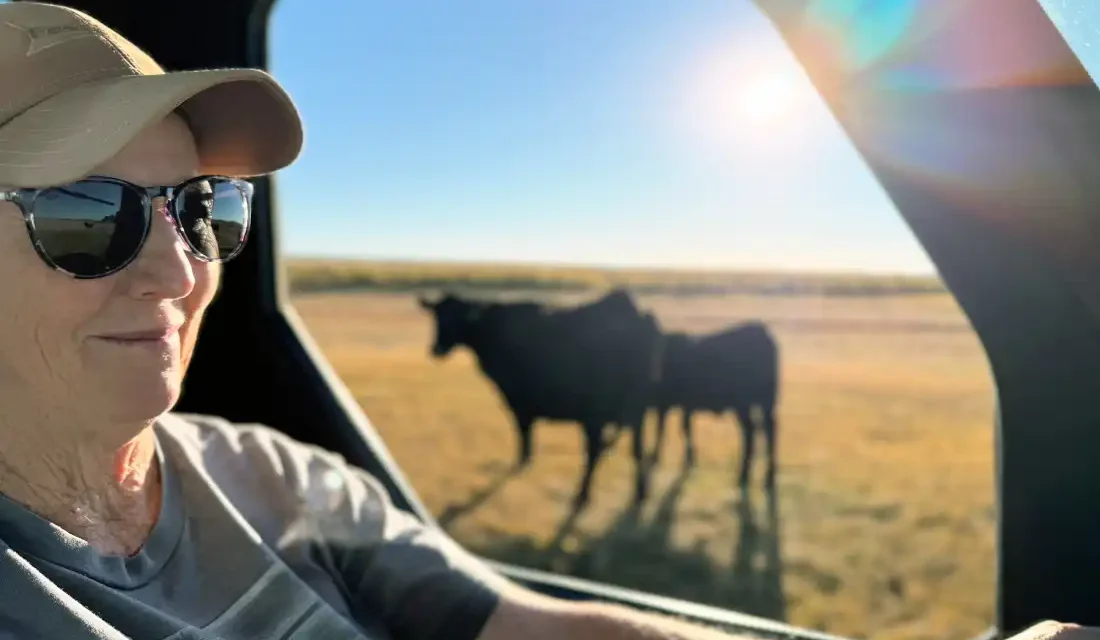
Katie Baltzor navigates her side-by-side vehicle among black angus cattle she raises near her home in Hines, Oregon. Throughout the roadside, late-blooming rabbitbrush with swaying ochre hues decorate the landscape. Horses graze on standing hay nearby, while she observes her cattle on this autumn day.
The vehicle resembles an oversized golf cart with a pickup bed, built for rugged ranch work. The animals remain quiet and content with their heads immersed in grazing. “Do you see that horse with the speckled colors?” Baltzor asks with a smile. “He looks like country gravy, which is why they named him Gravy.”
The spike in diesel prices is impacting cattle ranchers in western states, including Harney County, where there are significantly more cattle than people. These price hikes add pressure to ranchers already dealing with persistent droughts.
Fuel costs, parts costs, everything has increased,” Baltzor mentions. “While calf prices have risen too, they haven’t matched inflation, making it tough for ranchers to stay afloat.
Baltzor’s appearance reflects her life working in the desert sun. Recently, Baltzor and her husband Keith shepherded 150 head of cattle down Highway 205 from another pasture. She recalls, “Cars started coming through our bunch of cows … a woman jumped out, scaring the cattle.” She advises, “If you see a herd, don’t stop, just keep moving through them.”
The cattle were relocated closer to home in preparation for checks. The goal is to verify pregnancies and administer necessary vaccinations and dewormers.
This year has been challenging for Baltzor. Wildfires destroyed grazing grass in the mountains, forcing an early cattle return from the highlands. “We brought them home in July, rather than September,” Baltzor notes. “Others did too, but now we face fresh challenges.”
Some fields that burned will not be usable for years. With pastures low, hay becomes vital. But drought has diminished Baltzor’s hay meadows. “The meadows were short” she says. Limited irrigation water forced adaptations.
High diesel costs exacerbate harvesting difficulties. “Tractors run on diesel, which is costly,” she explains. Harvesting usually involves multiple tractor passes, each requiring about $300 of diesel. “We debated whether to bale this year or rakebunch due to the cost.” Rakebunching involves fewer passes, which conserves fuel.
Yet, limited hay stock spells trouble for next year. Lack of precipitation may force hay purchases, adding logistical challenges due to diesel-dependent transportation.
This year’s high diesel prices coincide with soaring beef prices. Although ranchers can sell calves for good money, they must consider long-term herd viability. “You keep some heifers,” Baltzor says, emphasizing patience. Heifers ensure future herds, but take years to yield calves.
To cut diesel expenses, Baltzor and her husband switched to gas pickups. Each ranch faces its own financial tipping point, influenced by loans and investments. Reflecting on her journey, Baltzor remarks, “We’ve been lucky to avoid debt after working hard. Not everyone is so fortunate.”
On exiting the pasture, a metal gate clanks shut. “Getting into cattle wasn’t easy for us,” she admits. “But the journey makes you value your work.” Southeastern Oregon braces for leaner times as winter approaches.
 Hunter’s Discovery Raises Concerns About New World Screwworm in Texas
 Python Hunter Helps Capture Record-Breaking Snake in Puerto Rico
 Environmental Concerns Halt Tree Removal at East Potomac Golf Links
 West Virginia’s Nuclear Proposal Faces Local Opposition
 Texas Data Centers Face Criticism Over Water Use Reporting
 First Offshore Mining Lease Sale by U.S. Government