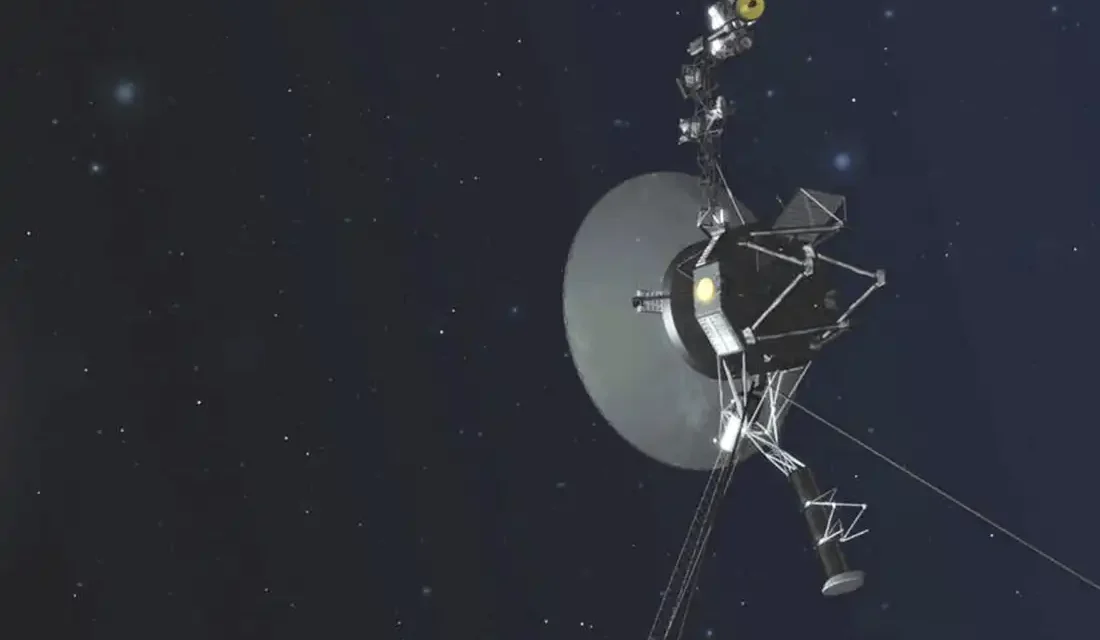
NASA’s Voyager 1 has traveled farther than any other human-made object in space. On Wednesday, it is set to achieve a new milestone by reaching a distance equivalent to one light-day from Earth. This distance measures over 16 billion miles.
In honor of this event, NASA is hosting a celebration called the “Shine Bright for Voyager’s Light-Day.” They invite the public to participate by sending Voyager’s call sign “V-G-R” into the sky using Morse code on Tuesday night. Use a flashlight, phone light, or any device that can blink a sequence:
- V – Three quick flashes, one long flash
- G – Two long flashes, one quick flash
- R – One quick flash, one long flash, one quick flash
Voyager 1’s Historic Journey
Launched on September 5, 1977, Voyager 1 has been exploring the cosmos for nearly 50 years. During its mission, it conducted flybys of Jupiter and Saturn, discovering a faint ring system on Jupiter in 1979 and capturing detailed images of Saturn’s rings and moons in 1980.
On February 17, 1998, Voyager 1 surpassed the U.S. space probe Pioneer 10 to become the most distant human-made object. Together with its twin, Voyager 2, it remains the only spacecraft to have ventured beyond the heliosphere, a protective boundary surrounding the solar system. Voyager 1 crossed the interstellar boundary in 2012. Its mission now focuses on studying the magnetic fields, particles, and plasma waves beyond the heliosphere.
Earlier this year, NASA decided to power down the Low-energy Charged Particles experiment (LECP) on Voyager 1 to conserve energy. This decision aims to extend the probe’s operational lifespan. Currently, two science instruments remain active: one measuring magnetic fields and another detecting plasma waves.
The Golden Record
Voyager 1 also carries the Golden Record, an interstellar “time capsule” intended to convey Earth’s story to extraterrestrial beings. The record includes 115 images, natural sounds, and spoken greetings in 35 languages, accompanied by instructions on playing the record and details of the probe’s origin.
Voyager 1 is expected to reach the “light-day status” at 5:16 a.m. ET on Wednesday, marking 49 years, two months, and 11 days since its launch.
 Developments in Bar-tailed Godwit’s Migration, Trump-Cornyn Dispute, and Measles Resurgence
 November’s Beaver Moon: A Celestial Event to Watch
 AI Claims Breakthrough in Solving the Riemann Hypothesis
 AI and Human Mathematicians Clash over Riemann Hypothesis
 Developing Stories: Legal Troubles, TV Series, Fall Salads, Prison Closures, and More
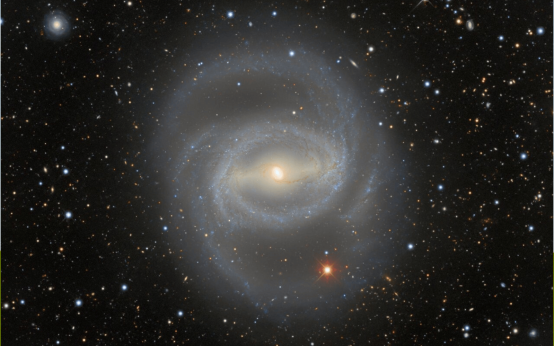 Astronomers Observe Early Stages of Rare Supernova in Distant Galaxy