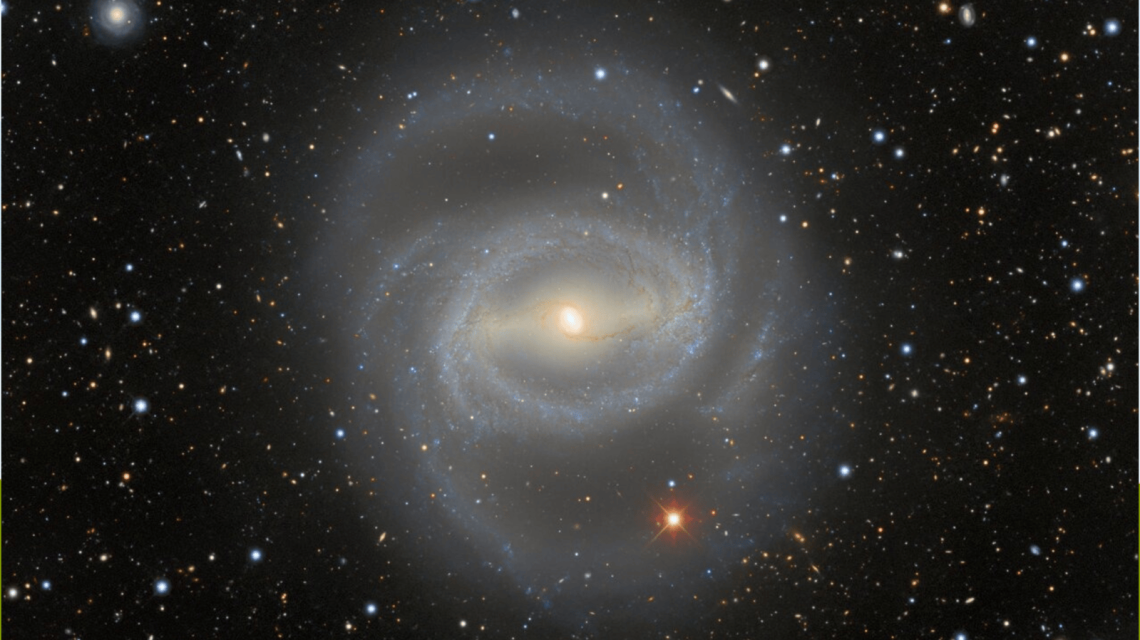
Astronomers are witnessing the initial stages of a newly discovered supernova explosion in a galaxy approximately 50 million light-years from Earth. The event, named SN 2026ahvu, started its cosmic journey around 50 million years ago, shortly after the end of the dinosaur era. This early detection offers scientists a unique chance to examine the unfolding of such explosive events in detail.
Discovery and Observation
The supernova erupted in NGC 1433, a spiral galaxy located in the constellation Horologium, otherwise known as the Pendulum Clock. The discovery was made on November 2 by the Asteroid Terrestrial-impact Last Alert System (ATLAS) and recorded by the International Astronomical Union’s Transient Name Server.
ATLAS initially measured the supernova at an apparent magnitude of about 17. For reference, brighter objects possess lower magnitude values. The sun, for example, measures around -27, while a full moon is near -12.6. The National Science Foundation’s NOIRLab reported that the supernova brightened to magnitude 13.5 within days, indicating its increasing luminosity.
Understanding the Explosion
Follow-up studies confirmed that SN 2026ahvu is a “Type Ia supernova,” involving a “white dwarf” – a remnant core of a sun-like star. White dwarfs are small, hot cores left after stars like our sun reach the end of their life cycle.
NOIRLab describes Type Ia supernovas as the “thermonuclear destruction of white dwarfs,” involving an uncontrollable nuclear reaction.
These reactions can occur when a white dwarf accumulates material from a nearby companion star, potentially leading to a runaway reaction that results in an explosion. However, scientists are not yet certain what specifically triggered SN 2026ahvu.
Significance of SN 2026ahvu
The relatively close proximity of 50 million light-years makes SN 2026ahvu remarkably significant by astronomical standards. NOIRLab mentioned it as one of the nearest Type Ia supernovae since the appearance of SN 2011fe in the Pinwheel Galaxy.
The early detection adds further importance, allowing astronomers to monitor its progression rather than only capturing its peak brightness. Observations from such events can offer insights into the physics and star systems responsible for Type Ia supernovas.
Future Observations
Astronomers have already begun imaging the supernova using the Dark Energy Camera on the Víctor M. Blanco 4-meter telescope in Chile and the Gemini South telescope. Predictions by NOIRLab suggest that SN 2026ahvu will reach its maximum brightness between November 18 and 23, with an apparent magnitude ranging from 10.5 to 12.1.
Ongoing observations will allow scientists to monitor its fading over the ensuing weeks and months. By comparing data from before, during, and after the explosion, researchers aim to deepen their understanding of both the star system that gave rise to SN 2026ahvu and the underlying physics of Type Ia supernovas.
 Developments in Bar-tailed Godwit’s Migration, Trump-Cornyn Dispute, and Measles Resurgence
 November’s Beaver Moon: A Celestial Event to Watch
 AI Claims Breakthrough in Solving the Riemann Hypothesis
 AI and Human Mathematicians Clash over Riemann Hypothesis
 Developing Stories: Legal Troubles, TV Series, Fall Salads, Prison Closures, and More
 Discovery of Ancient Bronze Sword in Italian Lake