
Nvidia’s stock has recently been under pressure. Investors are concerned about potential restrictions in China, leadership uncertainty, and AI spending.
Despite reporting strong earnings, including a 103% annual revenue increase to $115.8 billion, Nvidia’s shares declined 3% on a recent Wednesday. They have fallen over one-third from an October peak.
BIT Capital, a Berlin-based investment firm managing over 3 billion euros, decided to sell its entire position in Nvidia earlier this month. The firm cites the ongoing uncertainty regarding US controls on China’s advanced chip access as a significant factor.
The US government has tightened restrictions. The Trump administration aims to curb Chinese companies from accessing US AI chips. Treasury Secretary Scott Bessent and Commerce Secretary Howard Lutnick have publicly differed on restricting certain Nvidia customers suspected of channeling chips to China. This divide creates more uncertainty for investors.
Internal debates in the US administration are partly to blame for Nvidia’s struggles. This has overshadowed Nvidia’s robust performance in the past quarter when data-center revenue grew by 110%.
BIT Capital’s decision to sell Nvidia was not influenced by any anticipation of a leadership change. Instead, it reacted to a surprising political development in Texas that could delay data-center projects, potentially affecting chip stocks. By selling Nvidia, BIT Capital also sought opportunities in other AI investments that appeared more appealing.
Investment manager Marcel Oldenkott from BIT Capital highlighted other attractive options in the AI infrastructure market. The firm has increased its holdings in Silicon Motion, a Taiwan-based NAND-flash storage controller maker, whose US-listed shares have risen by over 60% this year.
The firm maintains holdings in companies like TSMC due to its strong position in chip manufacturing. Meanwhile, Samsung and SK hynix are focusing on high-bandwidth memory for AI, presenting new opportunities in other storage market areas.
BIT Capital has been cautious with China tech investments this year. They find no sufficient valuation advantage compared to US cloud peers. Instead, the firm has turned its attention to Japan’s semiconductor supply chain.
Amazon and IREN are among BIT Capital’s recent additions. The firm considers Amazon a strong investment due to its cloud business’s potential to benefit regardless of the AI landscape outcome, offering stability with its core activities.
Oldenkott mentions that while there has been a neocloud downturn, IREN’s low valuation presents an attractive entry point. Despite the market’s downturn in semiconductors and AI-infrastructure, Oldenkott sees this as a time ripe with opportunities and is tactically buying while holding significant cash reserves.
 Taiwan Limits Short Selling Amid Market Turmoil
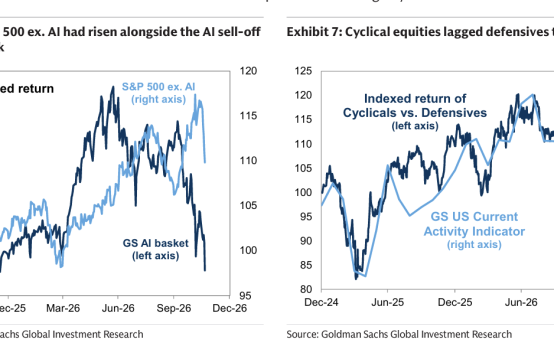 Goldman Sachs Outlines Market Recovery Conditions Amid S&P 500 Correction
 Market Downturn Triggered by AI Stock Sell-Off
 U.S. Stock Market Hit by AI Stock Sell-Off
 Insights on the Current Market Decline Affecting Tech and AI
 U.S. Stocks Face Steep Decline Amid Tech Sector Concerns