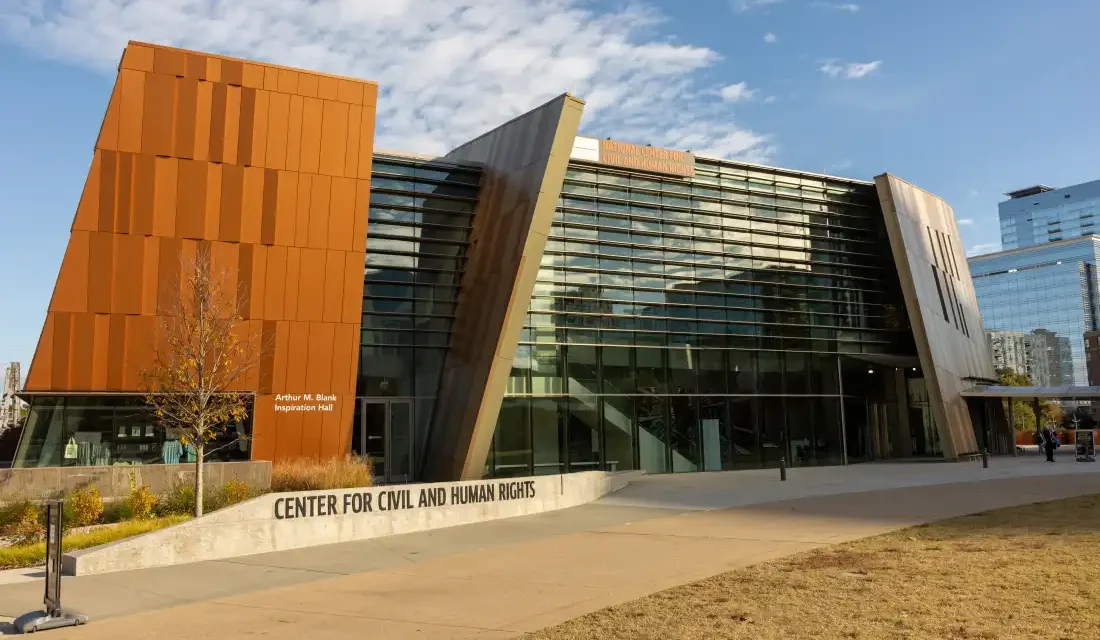
The National Center for Civil and Human Rights in Atlanta, Georgia, presents a rare opportunity to view a significant piece of American history: the only known draft of Martin Luther King Jr.’s speech from the 1963 March on Washington. This manuscript, written by King himself, is available for public viewing for a limited time.
Jill Savitt, CEO of the center, emphasized the importance of this artifact. “Doctor King’s handwritten, final draft of what has become known as the ‘I Have a Dream’ speech is here,” she said. “Viewing this document, where King refines one of the nation’s most iconic speeches, is a chilling experience.” The document is written in cursive using blue ink on yellow legal paper, showing signs of King’s revisions.
“You observe his struggle with the language,” Savitt continued. “How does he persuade America that it is failing to meet its ideals?” The document will be on display through Sunday in a dedicated gallery, alongside footage of the historic event at which 250,000 people gathered on the National Mall on August 28, 1963. Savitt notes the original title of the speech was “Normalcy Never Again,” and it noticeably lacks the famous “I Have a Dream” lines, which were improvised by King during its delivery.
These spontaneous words included King’s dream that his children would be judged by their character rather than their skin color. The speech draft was typed out in the pre-dawn hours from the Willard Hotel in Washington, D.C., just before King was to deliver it.
Xernona Clayton, an Atlanta civil rights leader, discovered this draft in her husband’s old desk. Her late husband, Edward Clayton, was a speechwriter for King. She recalled finding the document and recognizing King’s handwriting, a discovery she initially found overwhelming. Clayton rediscovered the manuscript a few years ago, prompting her to share it publicly. Her charitable trust plans to auction the document through Christie’s in New York in January, with bids expected to exceed $10 million. It will also be displayed in Chicago before the auction.
Clayton hopes that the manuscript will continue to inspire. “King often expressed frustration about why people couldn’t live together,” she said, reflecting on King’s legacy of fostering love and unity.
Former Atlanta Mayor Shirley Franklin, who viewed the document, shared her personal connection. She was a young participant at the 1963 March, pictured in the crowd by the reflecting pool. As Atlanta’s mayor from 2002 to 2010, she remarked on the manuscript’s survival and King’s meticulous attention to language. Franklin noted the impromptu delivery of the famous lines that stemmed from King’s heart.
Reflecting on the enduring relevance of King’s message, Franklin acknowledged progress in the last 60 years but stressed the ongoing challenges in fulfilling a vision of a loving community. As a co-founder of the National Center for Civil and Human Rights, Franklin finds it fitting that the speech’s public unveiling occurs in Atlanta. Summarizing her experience, Franklin expressed how King’s words still evoke emotion and stand as a powerful reminder of the enduring fight for civil rights.
 Tyler Lundblade: Shooting Star with a Purpose
 Jacqueline Sommer Celebrates $1 Million Lottery Win
 Carmelo Anthony’s Defense of Baltimore Sparks Controversy
 Thanksgiving Remembrance: A Family’s Tribute to NYPD Detective Wenjian Liu
 Developments in Bar-tailed Godwit’s Migration, Trump-Cornyn Dispute, and Measles Resurgence
 Voices Shaping Chicago: From Legacy Building to Mathematical Genius