
Neptune’s distant moon, Nereid, might be its last original companion to survive a cosmic collision, according to recent findings. Of the sixteen known moons orbiting Neptune, the solar system’s eighth and furthest planet, Nereid stands out. Unlike Neptune’s largest moon, Triton, which arrived from the solar system’s icy outskirts billions of years ago displacing the planet’s original moons, Nereid managed to avoid destruction.
Researchers from the California Institute of Technology employed NASA’s Webb Space Telescope to examine Nereid. Their findings indicate that Nereid is unlikely a recent addition like Triton, but rather a survivor of the ancient disruptions. It has maintained existence by settling into an extreme elliptical orbit around Neptune. As study author Matthew Belyakov notes, despite Nereid’s size, it remains understudied.
NASA’s Voyager 2, launched in 1989, is the only spacecraft to have visited Neptune. Nereid was discovered four decades earlier by Gerard Kuiper, a Dutch astronomer, who named it after Greek mythology’s sea nymphs. Nereid measures approximately 220 miles (350 kilometers) across, and exhibits a rare orbit for a moon, completing a circuit around Neptune in almost an entire Earth year. Its path varies significantly, from less than 1 million miles (1.4 million kilometers) to as much as 6 million miles (9.6 million kilometers) from Neptune.
Nereid was once thought to have migrated from the Kuiper Belt, a distant region home to many celestial bodies. However, the Webb telescope findings revealed inconsistency between Nereid’s composition and typical Kuiper Belt objects due to its substantial ice content. This implies that Nereid has always been part of Neptune’s system.
Study author Belyakov points out there is limited evidence around Neptune, as many of its moons were scattered. Despite this, the recent observations cast doubt on the theory that Nereid was captured by Neptune upon passing by, a view shared by Scott Sheppard, a planetary astronomer from Carnegie Science. The findings, published in Science Advances, illustrate that Nereid’s unique orbit suggests it originally formed near Neptune and was later displaced due to Triton’s arrival.
The inner moons of Neptune, as Belyakov’s team suggests, likely emerged from the debris of moons destroyed by Triton. In comparison, other giant planets like Saturn, which leads with 292 moons, have more satellites.
Although a spacecraft visit could confirm the origins of Neptune’s moon system, no missions are currently scheduled.
The content is supported by the Howard Hughes Medical Institute’s Department of Science Education and the Robert Wood Johnson Foundation, with the Associated Press being solely responsible for the article.
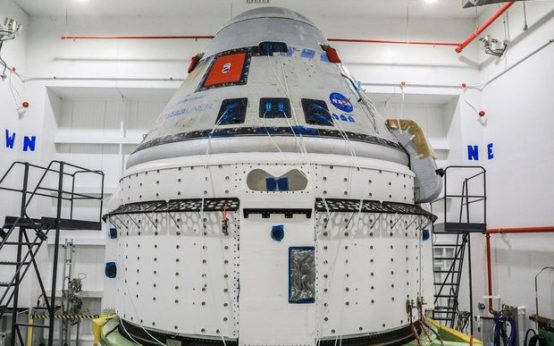 NASA Collaborates with Boeing to Launch Unpiloted Starliner Test
  Winter Weather Forecasts for 2026-2027
 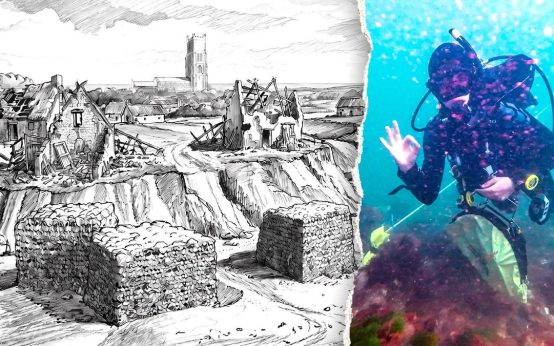 Underwater Discoveries: Exploring the Lost Town of Shipden
  Virginia Tech Researchers Investigate Black Bear Hibernation
 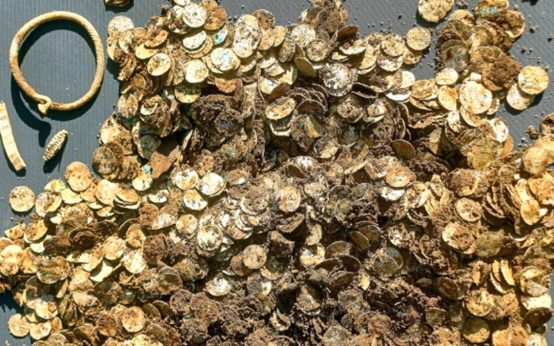 Significant Viking Age Silver Hoard Discovered in Finland
  Dogs Use Similar Language Recognition Techniques as Human Infants