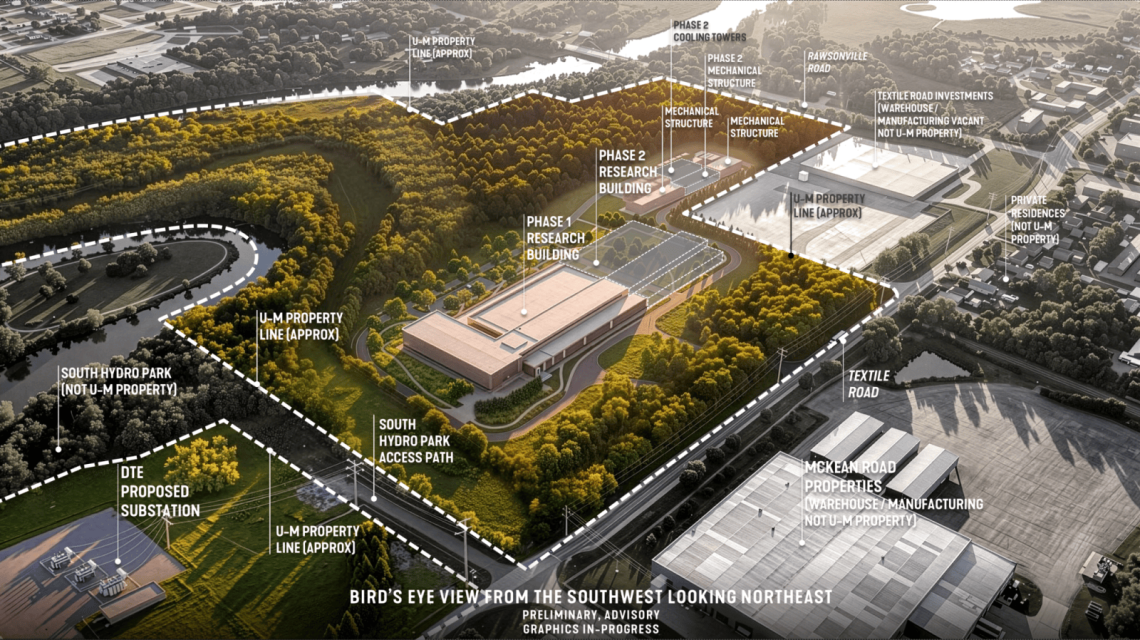
Residents of Ypsilanti Township in Michigan continue to oppose a project they describe as a proposed “data center,” following the University of Michigan’s Board of Regents’ recent approval. The board allocated funds for a substantial research computing facility last week.
The board’s 7-1 vote approved $785 million in construction costs for the colossal $1.25 billion high-performance computing center. This center will focus on research in fields like medicine, science, clean energy, engineering, and national security. Planned for a 124-acre site designated for industrial use, the project includes an additional 20 acres for a DTE electrical substation. The university insists the facility is a “computing and research hub” rather than a data center or manufacturing site.
University Promises
Before the decision, University President Domenico Grasso emphasized the project’s importance as “a critical step” in advancing one of the university’s essential research initiatives. The university collaborates with Los Alamos National Laboratory and the state, initially delivering 50 megawatts of power, with potential expansion to 100 megawatts.
Grasso pledged to engage with the local community to protect the environment, monitor utility usage, and preserve the Huron River. Over the next five years, $5 million will be committed to the greater Ypsilanti area through the Community Partnership Program. In his words, leadership requires listening, learning, and adjusting. A Memorandum of Understanding was signed with Los Alamos, although no funding commitments were made.
According to Los Alamos, activities will be governed by separate agreements addressing specific terms, conditions, funding, and other obligations. There are no further commitments between U-M and LANL. The National Nuclear Security Administration budget does not currently include the classified computing center.
Community Backlash
Critics, including residents and “Stop the Data Center,” argue the facility will disturb the area and environment. Reports highlight resident dissatisfaction, and local attorney Doug Winters pledged to exhaust legal options to oppose the project.
The United Tribes of Michigan (UTM) also opposes the proposal, aiming to safeguard Native American cultural and heritage sites in the area. Concerns include land use, noise, water consumption, and power needs. The UTM seeks involvement in development consultations.
Ypsilanti Township, situated along the Huron River in Southeastern Michigan, has historical significance for indigenous tribes’ navigation. UTM emphasizes potential impacts on tribal cultural resources. The university conducted preliminary searches finding no evidence of archaeological or culturally sensitive materials.
Regent member Paul Brown, who opposed the measure, supports community protests due to insufficient community engagement. He stressed the importance of inclusivity when developments impact communities and criticized the university’s approach as appearing environmentally discriminatory.
The university, exempt from local building and zoning regulations and not liable for property taxes, faces legislative challenges. Michigan House Democrats proposed legislation to revoke the university’s power to bypass zoning laws. State Representative Jimmie Wilson criticized the institution’s decision-making without community consultation, labeling it a betrayal of public trust.
Local Community Impacts
The university stated that the new facility will not affect the Huron River or local groundwater and aims to protect nearby wildlife. In response to concerns, the university evaluates cooling technologies to balance water and energy usage. Reclaimed wastewater for cooling, reducing municipal water demand, is under consideration.
The university estimates the full capacity 100 megawatt facility may consume up to 650,000 gallons of water daily. It is expected to create 300 construction jobs, over 200 permanent research positions, and 30-50 technical support roles. An environmental impact report is ongoing, with construction planned for late next year and completion by 2031.
 NOAA Signals Early End to 2026 Hurricane Season Amidst Strong El Niño
 Concerns Over Army’s Plan to Detonate Explosives in Iowa
 Mayor Mamdani Urged to Address NYC School Enrollment Crisis
 Concerns Over Army’s Planned Detonation of Lead Waste in Iowa
 Reevaluating Early Education for Better Future Outcomes
 Understanding the Insurance Dilemma in Fire-Prone Areas