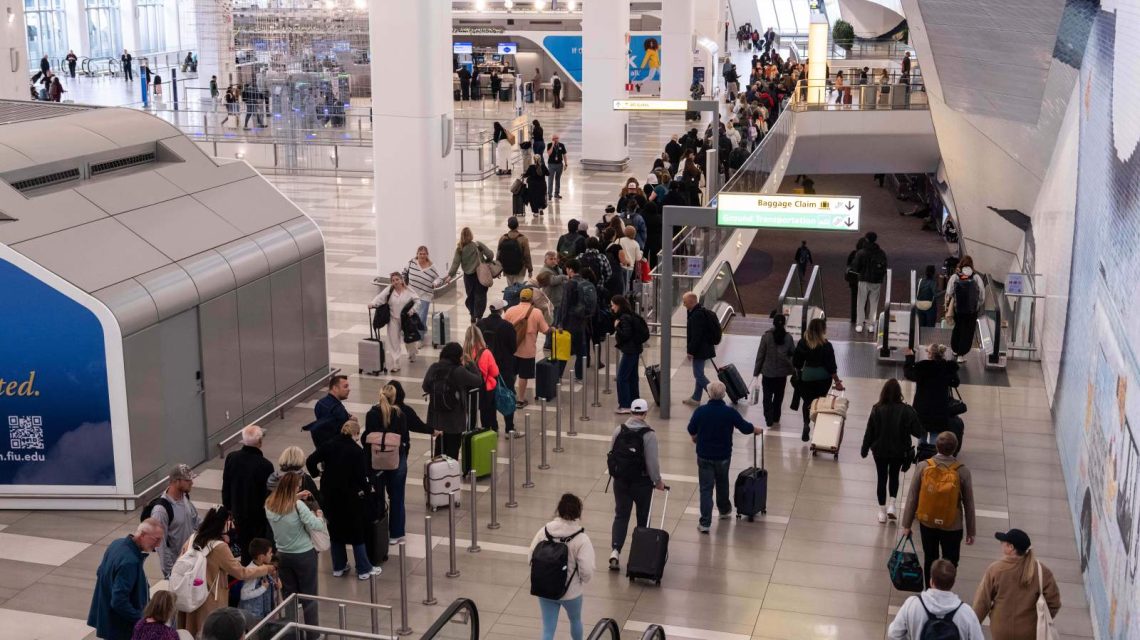
A new Federal Aviation Administration (FAA) rule for staffing air traffic control towers using the Line Up and Wait (LUAW) procedure started as Thanksgiving travel surged. Under FAA Notice JO 7210.979, towers conducting LUAW must have a dedicated watch-supervision position. This role cannot be combined with other duties. The aim is to enhance runway safety by allowing supervisors to focus solely on LUAW operations.
LUAW permits pilots to line up on departure runways while awaiting actual takeoff clearance. It does not authorize takeoff. With 81.8 million Americans anticipated to travel at least 50 miles from home during Thanksgiving, including six million by air, the timing of this requirement is noteworthy, according to AAA.
The oddest part is why now?said Sheldon Jacobson, Professor at the University of Illinois Urbana-Champaign.This should be enforced during less intense air traffic times.
Jacobson noted that LUAW could slightly increase runway efficiency. It saves a few seconds per takeoff and demands focused air traffic control. Clear weather can increase hourly takeoffs, while poor weather poses challenges regardless.
The FAA released the notice on October 9, 2026. It took effect on November 24 amidst recent air travel disruptions, including significant ground stops at Chicago O’Hare and Hartsfield-Jackson airports.
Details of LUAW
LUAW is a long-standing procedure where pilots taxi onto a departure runway to wait for takeoff clearance. It is used when immediate takeoff clearance is not possible.
Notice JO 7210.979 enhances staffing requirements. During LUAW operations, a stand-alone watch-supervision role must be present. The FAA changed guidance from optional to mandatory. Combining local control with nonlocal duties like ground control or flight data is not allowed during LUAW operations. The objective is to heighten safety standards and clarify roles.
Impact on Flights
The new requirement could affect flights depending on staffing, airport traffic, weather, and runway setup. Anton Radchenko, CEO of AirAdvisor, highlighted LUAW’s role in managing busy runways.
Line Up and Wait lets a control tower move a plane onto the runway and hold it there until takeoff clearance can be issued, so departures can proceed efficiently,”said Radchenko.
However, staffing shortages might lead to longer wait times for takeoff. The procedure can save several seconds and potentially allow extra hourly takeoffs.
These changes might mean passengers wait longer on planes. Radchenko mentioned potential delays later in the day as well.
Implementation and Extended Effects
The FAA’s notice was issued on October 9, 2026. It is effective through June 9, 2027, but extensions or modifications are possible.
Jacobson questioned its implementation during a peak travel period. Travelers need not alter plans, as LUAW affects only airport operations. Some passengers might face extended waiting times before departure.
Radchenko urged early flight bookings and extra time for connections during the holiday period.
Relation to Recent Ground Stop
Shortly before LUAW took effect, a separate technical failure prompted the FAA to halt departures nationwide. The issue arose from a telecommunications problem affecting the Federal Telecommunications Infrastructure network.
The problem began with a data overload caused by new router installations. This affected multiple air traffic centers. The nationwide halt lasted over four hours, but was deemed non-cyberattack related. Investigations continue into the incident.
The new LUAW requirement and the ground stop are distinct issues: one pertains to staffing, the other to technical failures.
 Asian Tech Stocks Decline After Nvidia Boost Fades
 Tidal’s New Policy Bans AI-Generated Music
 Jensen Huang Retains Security Clearance Amid Scrutiny
 Upgrade Your Audio Experience with Apple AirPods Pro 3
 Huawei Convicted of Trade Secret Theft and Deception
 Pentagon Considers $15 Billion Loan to Startup Linked to Trump Jr.