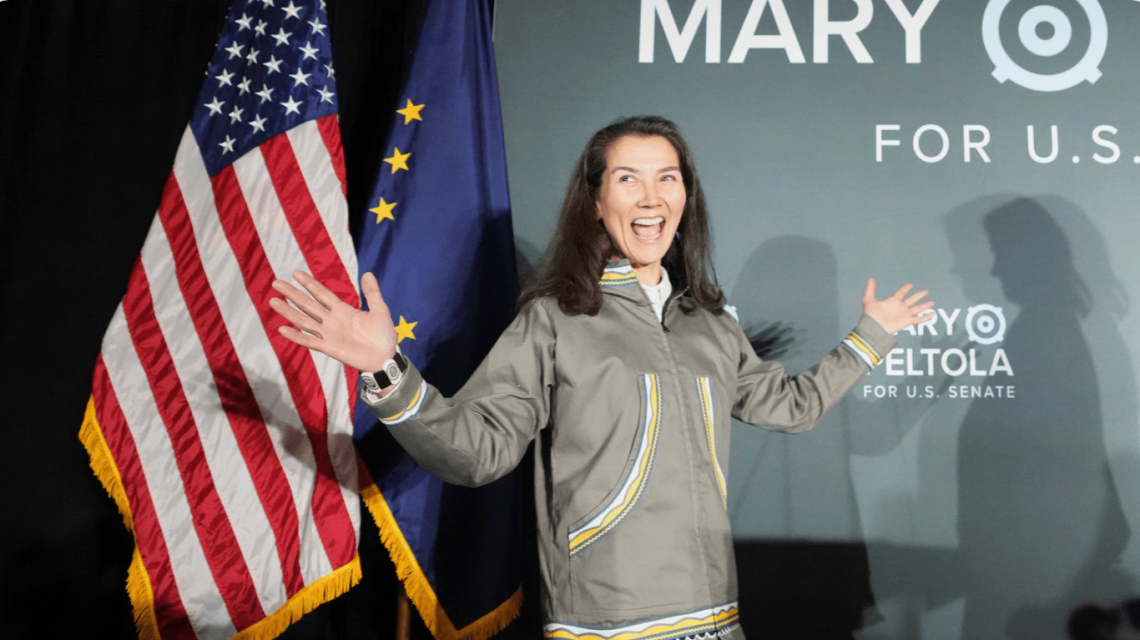
Alaska’s election process exemplifies its unique approach: gradual and spanning great distances. In the U.S. Senate race, Democrat Mary Peltola is nearing an outright win. She stands 157 votes shy of a majority. According to the latest unofficial report from the Division of Elections, Peltola secured 140,637 first-choice votes, or 49.94%. Her main rival, Republican Senator Dan Sullivan, garnered 129,424 votes, accounting for 45.96%. Other candidates, Gerald L. Heikes and Daniel J. Sullivan Jr., received 6,002 and 4,652 votes, respectively. Write-ins totaled 872.
As of Sunday morning, The Associated Press indicated that 97% of the votes had been counted, although it did not declare a winner. The count includes 872 unresolved write-ins treated as a block in the initial tally. Winning over half of the first-choice votes guarantees election. If this threshold isn’t met, ranked-choice tabulation begins on November 18. The lowest-ranking candidate is excluded, and their votes transfer to voters’ next choices. A candidate winning over 50% at any stage wins, but counting continues until only two remain.
The Mechanics of a Majority
The 157-vote margin remains fluid. New ballots increase the majority threshold, requiring Peltola to capture a significant share of the remaining votes. AP’s projection of 97% is an estimate. If rounded, this suggests between 96.5% to just under 97.5% completion. Newsweek extrapolates several thousand votes are still uncounted. To secure over 50% initially, Peltola needs about 52% of these ballots.
Assumptions underlie this estimate: that AP’s percentage also applies to the Senate race and every remaining ballot includes a valid vote. Overseas ballots postmarked by November 18 may also alter the current count.
Sullivan’s Strategic Options
Sullivan finds himself with limited options. He is trailing by 11,213 votes, and not enough uncounted votes seemingly remain to bridge this gap. If Peltola falls short of an outright majority, ranked-choice calculations become pivotal.
Newsweek conducted an independent analysis of the Division’s ballot-level records using RCTab software. Out of 282,698 ballots, 1,059 had no Senate candidate marked. Among these, 428 were overvotes and 170 were disqualified due to skip rules.
Ranked-Choice Analysis
The ranked-choice process involves successive elimination and redistribution of votes. Initially, the write-ins are eliminated. From 870 ballots, Peltola gained 165 votes and Sullivan 117. Sullivan Jr. followed, with his ballots marginally favoring Peltola. Finally, Heikes’ votes were redistributed. After eliminations, Peltola leads in Newsweek’s model with 143,127 votes, or 51.83%, while Sullivan has 132,985 or 48.16%.
This analysis relies on scanned ballots, excluding those counted manually and those yet to be processed. The Division will officially tabulate results from its data on November 18. For now, Newsweek’s findings give Peltola a lead.
Campaigns’ Stances and Legal Questions
Peltola’s campaign expresses confidence in her victory, though Sullivan’s side hasn’t conceded. Sullivan Jr.’s involvement added complexity, sparking speculation about vote splitting.
The Justice Department challenged potential certification if Sullivan Jr.’s votes affected the incumbent’s loss, but a federal judge dismissed the suit, citing ballot secrecy concerns. An appeal is underway.
Implications for the Senate
Alaska’s result influences the Senate’s composition. A Peltola win adds to the Democrats’ majority after reclaiming Congress. Results will be finalized after overseas ballots arrive and rank-choice tabulation completes by November 25. For skeptics, explanations of their ranked choices will decide the winner in this closely watched race.
 Former Press Secretary Criticizes GOP’s Election Strategies
 Carmelo Anthony’s Defense of Baltimore Sparks Controversy
 Thanksgiving Remembrance: A Family’s Tribute to NYPD Detective Wenjian Liu
 Developments in Bar-tailed Godwit’s Migration, Trump-Cornyn Dispute, and Measles Resurgence
 Newly Proposed Legislation Aims to Ease Family Travel
 Princeton Student Detained by U.S. Immigration After Conference