Archaeological Discoveries at Tell Al-Abqain
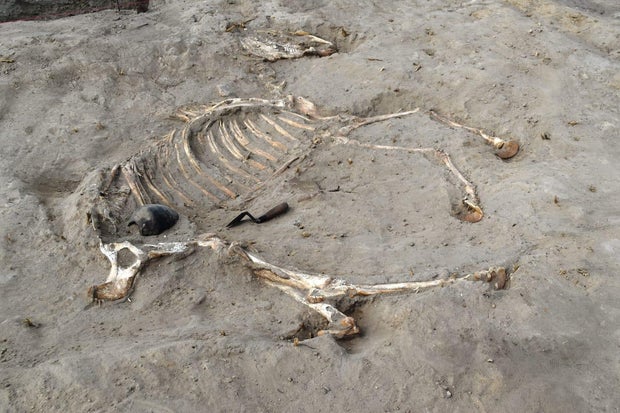
Archaeologists in Egypt have uncovered a warhorse’s remains, likely from ancient times, buried with great honor over 3,000 years ago. This significant discovery took place at Tell Al-Abqain in the Nile Delta, within Egypt’s northern Beheira province. The site, believed to be a military fort from the New Kingdom era (1570-1069 B.C.), was crucial for defense against Libyan tribes.
The Ministry of Tourism and Antiquities released details, revealing structures and artifacts indicative of military and civilian life in ancient Egyptian fortresses. A large mudbrick residential complex was found, featuring planned streets and intricate rooms with grain-storage silos and pottery ovens for food preparation.
Insights from Dr. Hisham El-Leithy
Dr. Hisham El-Leithy, secretary general of the Supreme Council of Antiquities, emphasized the importance of the findings. They reflect meticulous urban planning and efficient resource management within the fortress.
Among the most thrilling discoveries is the burial of a young male horse. Egyptian Ministry of Tourism and Antiquities shared an image displaying the complete remains, emphasizing its role for military purposes during the New Kingdom.
Horse’s Role and Burial Significance
Mohamed Abdel-Badie, head of the Egyptian Antiquities Sector, noted the horse likely belonged to a medium-sized breed. Known for speed and agility, such horses were possibly utilized to pull war chariots. The organized burial suggests the horse received an honorific burial.
Near the burial site, archaeologists found cylindrical alabaster and limestone pieces, presumably parts of a chariot harness. This discovery supports the idea of the site’s military function.
Limestone Stela and Other Artifacts
Excavations unveiled a limestone stela depicting a prisoner bent in submission with bound hands, wearing Libyan attire, suggesting he was a captive from the same era. Additional findings include religious amulets symbolizing protection, fertility, and renewal, along with pottery vessels, ostraca, tools, and jewelry.
These artifacts offer insight into the lifestyles and beliefs of those inhabiting the ancient fortress.
 Discovery of Tilcayo Tiger Cat, a New Wild Cat Species in Bolivia
  Humpback Whale’s Grief Over Stillborn Calf Reveals Emotional Complexity
  Discovery of Massive Lunar Crater Sheds New Light on Moon’s Surface
  Tropical Depression Six Forms in the Atlantic Amid Quiet Hurricane Season
  Fat Bear Week: Celebrating Resilient Giants and Ecosystem Conservation
  Understanding Pyrocumulonimbus Clouds Through NASA’s INSPYRE Mission