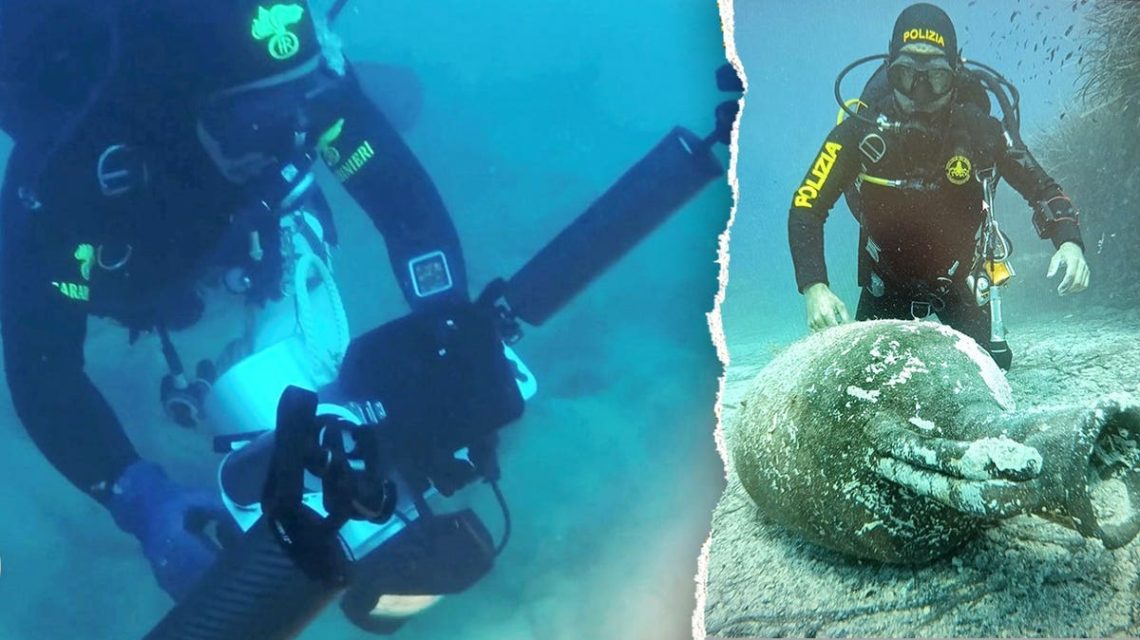
Police officers on a routine dive in Italy recently found ancient Roman artifacts on the seabed. These relics, dating back 2,000 years, were discovered off the coast of Porto Rotondo in Sardinia, a Mediterranean island in Italy.
The Sassari Police Headquarters announced the discovery in late August. Officers from Olbia, Sardinia, identified the objects during an underwater safety operation. Initially, they spotted a piece of broken terracotta, leading to a second dive where they found largely intact vessels.
Divers retrieved ancient Roman relics off the coast of Porto Rotondo, Sardinia. (Italian Ministry of Culture/Cover Images)
The discovery prompted divers to conduct a thorough search for more archaeological objects. Through careful dredging, they recovered three intact terracotta items, including a transport basin and other minor pieces. Officials recorded the artifacts and handed them over to the Archaeological Superintendent.
Images depict police divers examining the seabed and submerged ancient pottery off Sardinia. One picture shows an intact amphora among seagrass, while another captures a diver inspecting an encrusted vessel.
In ancient times, amphorae served to transport various materials like wine, olive oil, and grain. Police suggested the artifacts date from the fall of the Roman Republic to the early Roman Empire, specifically between the second half of the 1st century B.C. and the 1st century A.D. Experts propose their origin might be linked to regions like Lazio, Campania, or the Iberian Peninsula.
Specialists will further study the vessels to pinpoint their exact age and origin. They will also explore if these artifacts belong to a larger archaeological site with more items yet to be found.
This discovery adds to Italy’s history of unveiling ancient treasures. Earlier, authorities reported finding a Roman merchant shipwreck in the Ionian Sea, its cargo of amphorae intact. This vessel dates to the late Imperial era, around 284 A.D. to 641 A.D.
 Broadcaster Fired Over Teen Tweets: A Closer Look
 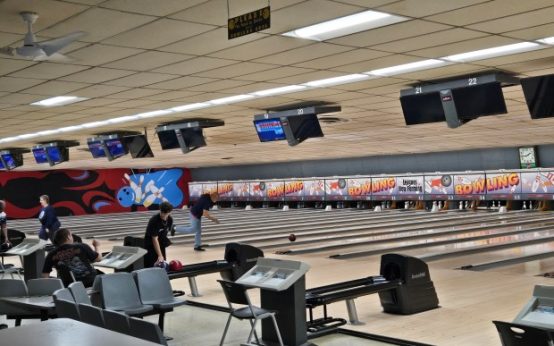 Elgin Lanes: A Bowling Alley Reborn
 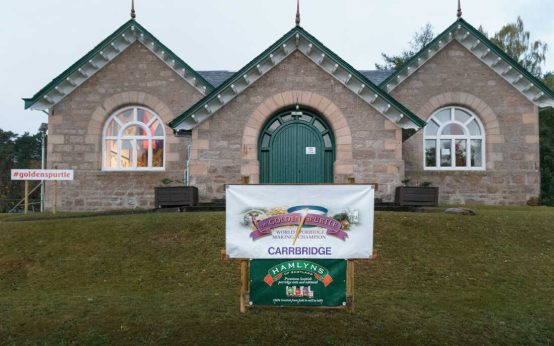 Golden Spurtle World Porridge Making Championships
  ‘Nightcaps’ Sports and Culture Recap
  Lisdoonvarna’s Matchmaking Festival: Tradition Meets Modern Romance
  Suzanne Scott Inducted into Broadcasting+Cable Hall of Fame