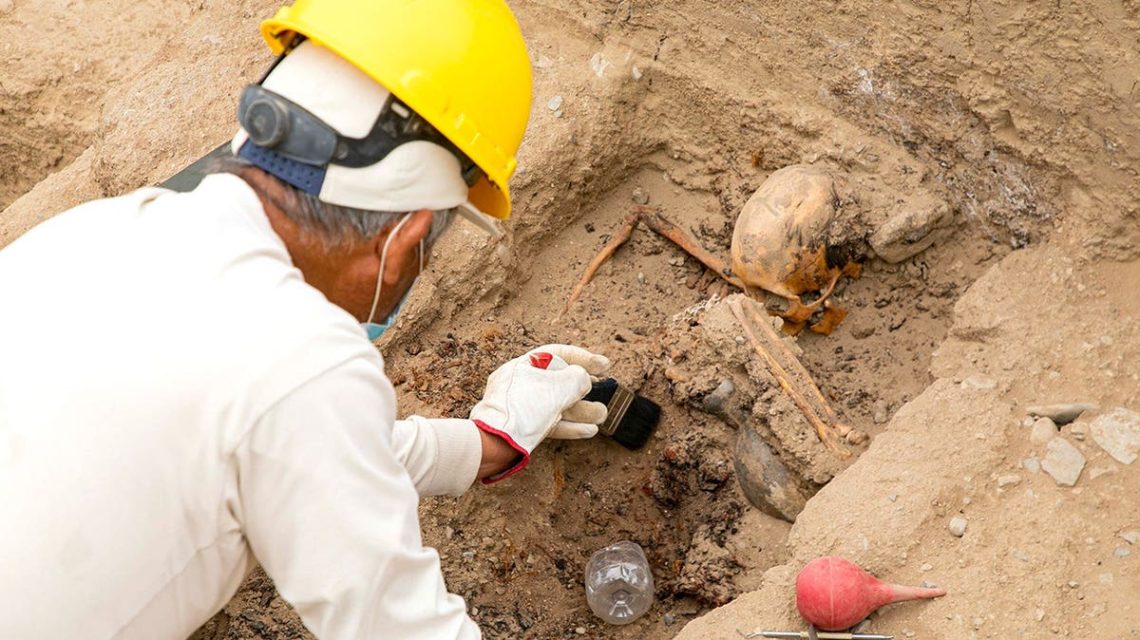
Archaeologists in Peru have uncovered a 600-year-old burial complex in the ancient city of Chan Chan, near Trujillo, roughly 350 miles north of Lima. This site, from the Chimú civilization, contains 38 bodies, including one arranged in an unusual manner, prompting questions about potential human sacrifice.
Peru’s Ministry of Culture announced the discovery in early fall. The site had remained hidden for centuries. Images from the Ministry show a collection of ancient ceramic vessels, decorated jugs, and pottery with sculpted figures. Other photographs reveal the burial complex’s network of chambers, walls, and stairways.
The complex features three chambers. The central chamber housed one individual surrounded by artifacts made from shell and metal. One side chamber contained weapons and metal emblems, while another held 20 bodies. Eighteen more individuals were discovered elsewhere in the complex, totaling 38 bodies.
An exceptional skeleton was found in an unusual, fully extended position, different from typical Chimú burials, which usually had bodies in bent or seated postures. This raises questions about the individual’s death circumstances, suggesting possibilities such as a sacrificial ritual or significant social status difference compared to others buried there, according to the Ministry.
The burial goods included metal headdresses, earrings, necklaces, carved wooden boxes, and ceremonial items made from seashells and quartz. Some buried individuals had red pigment on their heads, a mark used exclusively in high-status burials within Andean societies.
“The skeletal and organic remains are extremely fragile after centuries of deterioration,” the statement from the Ministry noted. “Scientific protocols require thorough examination and documentation before removing evidence from the site.”
Researchers plan to document the site extensively before removing remains and artifacts. Hundreds of photographs will be taken to create a detailed 3D model. The artifacts and remains will then be carefully extracted by hand.
Jorge Meneses, an archaeologist with the Ministry, stated that this discovery offers a unique chance to study Chimú burials in their undisturbed state. Earlier knowledge about elite Chimú tombs came from funerary platforms that were looted and destroyed since colonial times, impacting the archaeological context.
The Ministry plans to publish comprehensive findings in a future book, providing deeper insights into the ancient Chimú civilization and their burial practices. Peru has seen several archaeological finds recently, highlighting its rich historical tapestry. Last year, utility workers in Lima discovered a well-preserved, 1,000-year-old female mummy, and more recently, two ancient tombs were found during a natural gas project.
 Asteroid 2026 QQ8: Earth’s Temporary Mini-Moon
 Meteor Captured by NASA Cameras Over North Carolina and Tennessee
 Understanding Financial Adviser Fees and Political Developments
 Congress Must Act to Preserve Science Careers
 Early Cannabis Use Discovered in Siberian Tomb
 Democratic Candidate Scott Colom Engages Voters Outside Trump Rally