In Pennsylvania’s Columbia County, Camp Cranium provides a unique environment where children with brain injuries find community, support, and fun.
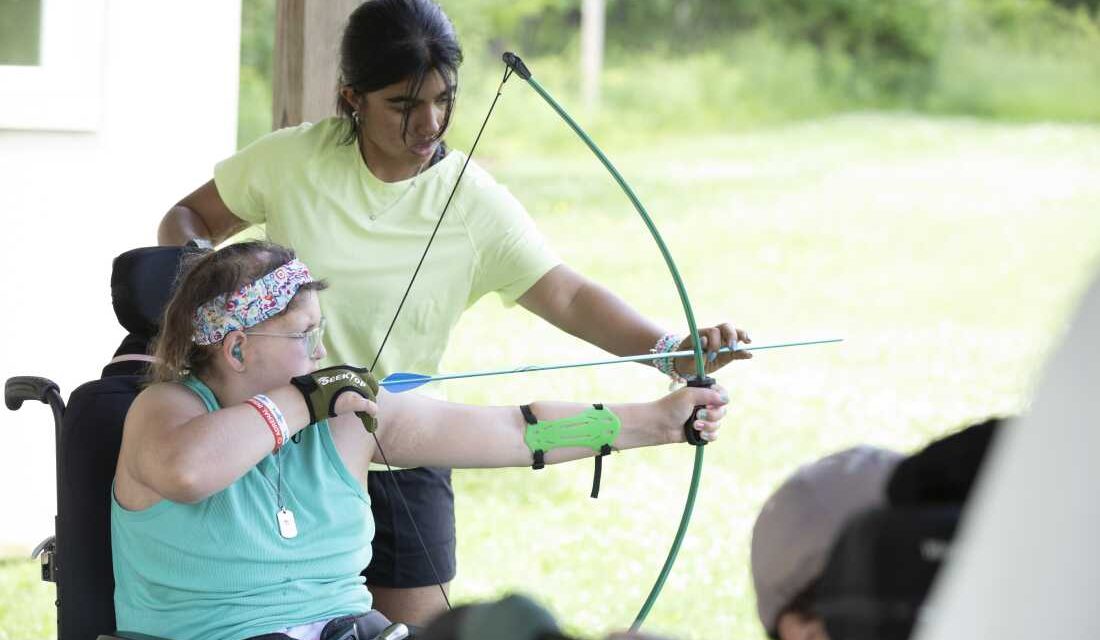
In a quiet field, arrows sailed under the June sky, hitting their targets with precision. Cheers erupted as campers and counselors celebrated archery hour at Camp Cranium, located in Millville, Pennsylvania. The camp’s operations director, Drew Meyer, watched the scene unfold with palpable emotion, tears escaping occasionally from his sunglasses.
“They will surprise you,” said Meyer about the campers, survivors of brain injuries. “They’ll shoot for three hours and start hitting the target.” Camp Cranium, which has been operating since 2008, caters to children aged 10 to 21. Some campers experience severe brain injuries, requiring them to relearn essential skills such as speaking and tying shoelaces. Others rely on wheelchairs or crutches. Yet, the camp offers them opportunities to climb rock walls, swim, and glide down a zip line amidst the lush forest.
Camp Cranium’s existence aligns with a national trend: the survival rate for individuals, including children, facing brain injuries has risen since the 1980s. This improvement stems from seat belt laws and federal investments in trauma centers and research. However, efforts to track and prevent traumatic brain injuries face challenges after Congress did not renew a crucial law and the Trump administration dismissed hundreds of CDC employees, including the team focused on these injuries.
“Brain injury can happen to anyone,” stated Rebeccah Wolfkiel, executive director of the National Association of State Head Injury Administrators. She emphasized the need for more support for the community.
Tracking the prevalence of TBIs
Lucas Hardy, a 14-year-old camper, smiled down at the crowd as he climbed a 30-foot rock wall aided by a hoist. Hardy sustained a traumatic brain injury at the age of three when a tree branch fell on him during a birthday party. Each year, approximately 2.8 million Americans experience a traumatic brain injury, including about 475,000 children, according to the Brain Injury Association of America. The CDC’s data suggests these figures may be higher.
Before a nationwide concussion surveillance system could launch, the firing of CDC employees occurred, affecting efforts to understand TBIs better. Emily Hilliard, a spokesperson for the Department of Health and Human Services, stated the Trump administration’s commitment to preventing these injuries and improving surveillance. She detailed efforts to dedicate funds towards an educational campaign, concussion surveillance, and injury prevention programs.
The impact of federal funding uncertainty
Tony Sadowski, the camp’s executive director, recounted his son’s experience with a brain bleed at age six. “You’re in the emergency room,” he said, “not knowing what version of your son’s going to wake up.” Now 18, his son Bryan has been a longstanding camper at Cranium.
Since 1996, the Traumatic Brain Injury Act provided grants for research, advocacy, and services. Despite bipartisan support, Congress has not reauthorized it since 2024. The lapse complicates the future of brain injury research.
Rick Willis, president and CEO of the Brain Injury Association of America, stated that federal TBI program funding still exists, although Congress appropriated $8.25 million for activities through 2026. In the past, funding reached $23 million annually, with half allocated to concussion research.
Camp Cranium and similar camps remain unaffected by federal funding changes due to being privately funded nonprofits. Moments at the camp include laughter and joyful exchanges among campers.
Brianna Engleman, a camper since 2018, aims to return as a counselor. Her journey includes undergoing hemispherectomy surgery at age five to relieve seizures, despite risks of further brain injury.
Engleman expressed newfound confidence and appreciation for the supportive community at Camp Cranium. “I’ve gotten more confident,” she noted. “It made me realize the goodness in people.” Returning as a counselor remains her goal.
NPR health reporting partners with WVIA and KFF Health News contribute to bringing these pivotal stories to the foreground.
 Federal Surveillance Raises Concerns Over Privacy and Free Speech
  Examining the Impact of Climate Change on Heat Waves
  CTE in Former NFL Players: New Study Reveals Prevalence
  Expanding Women’s Sports Medicine: A Critical Need
  Vitamin D and Cognitive Health: New Insights
  Gut Health Expert Shares Foods to Avoid for Better Digestive Health