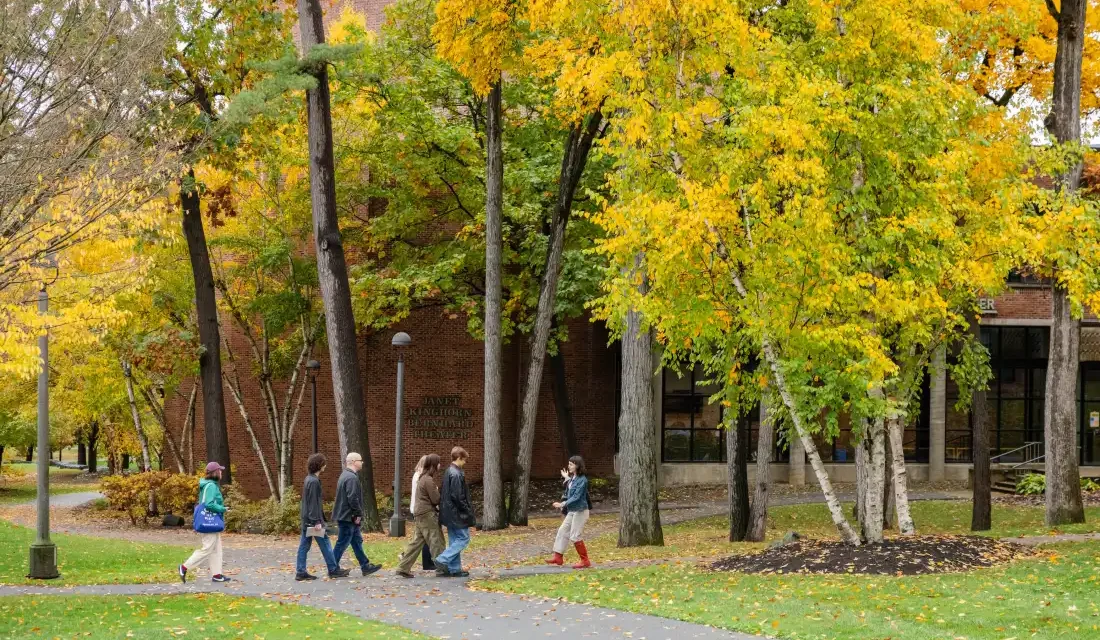
Prospective students and their families recently participated in a guided tour at Skidmore College located in New York. Alex Zaret, a 17-year-old high school senior, described the college admissions process as overwhelming while touring Skidmore College, which marked the fourth institution Zaret had visited, with additional visits planned.
According to Owen Zaret, Alex’s father, managing the college admission requirements has become akin to a full-time job. The task requires considerable effort amid their busy family schedule, filled with employment commitments and an engaged student. Despite the challenges, Owen Zaret noted a shift in the colleges’ approach over time. Initially, the colleges seemed to maintain an exclusive demeanor, but recently, they’ve shifted to actively encourage student applications.
To address enrollment challenges, colleges are redefining admissions processes that were once viewed as intimidating. Examples include waiving application fees and offering additional financial assistance for students who attend campus tours. Public universities in 17 states now offer admission to high school students without requiring an application.
Data from the National Association for College Admission Counseling indicate that the majority of colleges accept most applicants. Even prestigious institutions are experiencing changes, as many universities enlist faculty in student recruitment efforts. By opening classrooms and meeting prospective students, faculties help create a welcoming environment.
The declining number of traditional-age freshmen, projected to decrease by 13% over 15 years, poses a significant challenge for colleges. Recent figures show a decreasing percentage of high school graduates pursuing college education, down from 70% in 2016 to 63% in 2024. The result is greater acceptance rates across the board and a shift in the perception of college admissions difficulty.
Despite rising competition among institutions, the trend isn’t favoring colleges. Nearly nine in ten private universities admit half or more of applicants. Many of these institutions are reaching out for support from their faculty members to aid in admissions, hoping to influence prospective students’ decisions positively.
Data reveals the challenge colleges face in accurately predicting enrollment numbers due to candidates applying to multiple schools. This situation, referred to as yield, has seen a steady decline at both public and private institutions over recent years. Consequently, colleges must extend more admission offers than needed and focus on engaging admitted students to finalize their decisions.
The demand on faculty to support recruitment is evident, yet some initially resisted the shift. Administrators responded by highlighting the financial implications and their connection to program funding and faculty compensation. More institutions are preparing their entire staff to participate in recruitment efforts, emphasizing the impact of each interaction with potential students.
Skidmore College has embraced a proactive mantra and hasn’t suffered the enrollment issues affecting other small, private colleges. Their application numbers remain strong, and their acceptance rate has notably decreased. The collaborative efforts across the campus have seen upwards of 300 individual visits last year where students engaged directly with faculty, although concrete data on subsequent application or enrollment is not available.
Feedback suggests such efforts leave a meaningful impression on prospective students, setting Skidmore apart from its peers.
 Texas School District’s Strategic Approach to a Unique Gift
 Governors and Market Competition in Education
 University Fraternities: Concerns Over Safety and Exclusivity
 Chicago’s Historic School Board Election: What to Know
 National ‘Take Back the Night’ Movement Gathers Momentum
 Employee Granted Religious Accommodation for AI Use