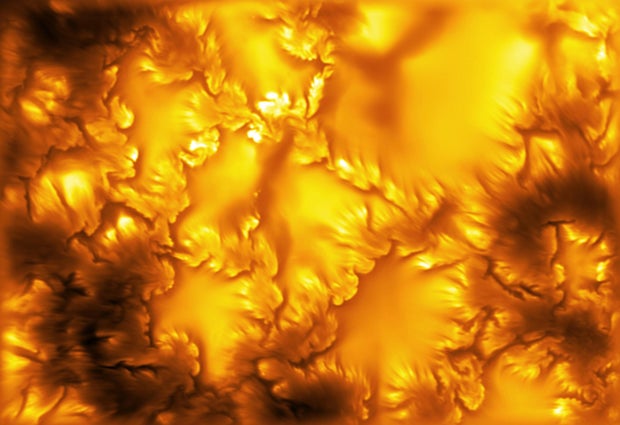
Scientists have recently captured unprecedented images of the sun’s surface. Using the National Science Foundation’s Daniel K. Inouye Solar Telescope in Maui, Hawaii, researchers have observed the solar facade in remarkable detail.
New Discoveries
The purpose of the initial study was to fine-tune the telescope. Instead, it unveiled the sun’s outer shell at a resolution never achieved before. The images revealed curious feathery patterns rippling across the surface.
“The images reveal a solar landscape unlike any that had been seen before, uncovering small-scale and dynamic swirls everywhere at the edges of magnetic areas,” the NSF’s National Solar Observatory stated.
This newfound detail in the solar landscape conjures images of classic art, such as Van Gogh’s Starry Night, according to solar physicist Ruizhu Chen. Although she was not part of the study, Chen highlighted the artistic resemblance of these natural phenomena.
Scientific Significance
Researchers observed instability on the sun’s surface caused by magnetized plasma moving at varying speeds. This phenomenon is similar to the Kelvin-Helmholtz instability observed with waves on Earth and planetary atmospheres like Jupiter and Saturn.
Study co-author Friedrich Wöger noted that this level of observation had not been achieved on the solar surface before. Dr. David Boboltz, deputy director at the National Solar Observatory, emphasized this discovery’s importance in advancing our understanding of solar dynamics.
Solar Weather Insights
The findings, published in Nature, provide crucial insights into solar phenomena. Understanding the sun’s processes is vital to tracking coronal mass ejections, which can lead to solar storms affecting GPS and causing auroras on Earth.
“To understand the dynamic space weather that affects Earth, we have to see the small-scale processes driving it,” said Dr. Jacqueline Keane, program director for the National Solar Observatory.
By using an advanced four-meter mirror and cutting-edge optics, the NSF Inouye Solar Telescope provides the resolving power necessary to discover these details for the first time. These insights allow scientists to explore phenomena previously beyond our grasp.
The pairing of technological innovation with scientific inquiry continues to expand human comprehension of solar activity, setting a new foundation for future research initiatives.
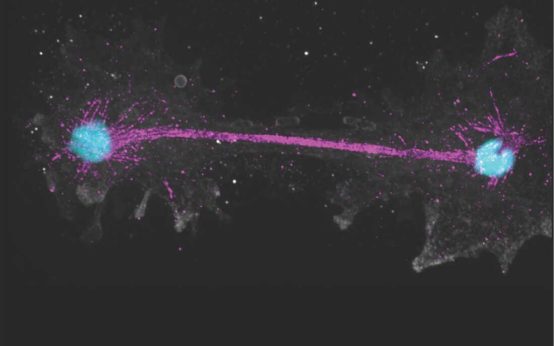 The Discovery of Incendiamoeba cascadensis: A Fire Amoeba
 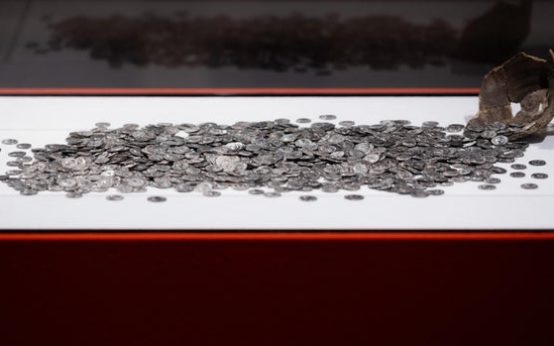 Archaeological Discovery in Germany: Largest Hoard of Roman Coins Found
  Hurricane Formation and Strengthening
 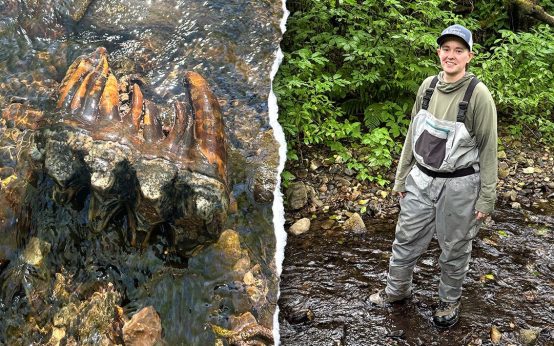 Ancient Mastodon Tooth Unearthed in California Creek
  The Tiny World of the Pumpkin Toadlet
  Chimps and Self-Medication: Insights from Gombe Stream