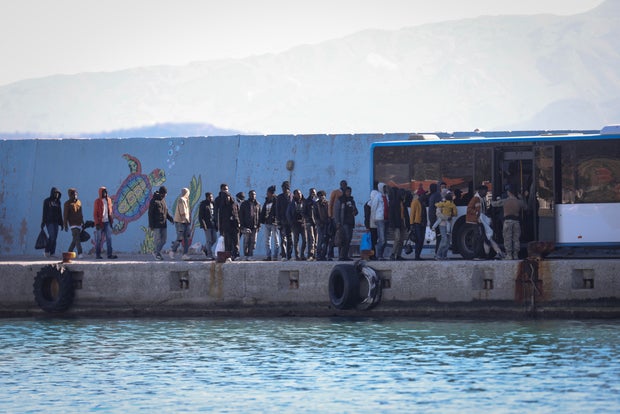
Five European Union countries are advancing plans to deport asylum seekers whose applications are rejected. These deportations might involve transferring individuals to third countries outside the EU, potentially in Africa.
Greece, Germany, Austria, Denmark, and the Netherlands have agreed to create “return hubs” outside the EU. People who have exhausted their legal avenues to stay in Europe may be transferred to these hubs if returning them to their countries of origin is not possible.
The Danish Interior Minister, Morten Bødskov, stated that the progress on return hubs has been promising. He expects that the first irregular migrants could be transferred to a partner country outside the EU by 2027. Greek Migration Minister Thanos Plevris anticipates a pilot project to commence in the first half of the coming year.
No specific destinations for these hubs have been confirmed, but Rwanda has been mentioned as a possible partner. The hubs are intended to be located in safe third countries, particularly in Africa.
The EU is promoting the concept of return hubs to deter irregular immigration. A document published by the EU’s European Council suggested these hubs might encourage voluntary returns, as migrants refusing deportation orders could be transferred to a hub. The policy aims to discourage unqualified asylum seekers from undertaking perilous journeys to Europe.
The newly adopted EU rules establish a legal framework for returns and allow member states to form agreements with non-EU countries. However, any agreement must adhere to international human rights standards, including the principle of non-refoulement, which ensures no individual is returned to a country where they may face harm.
Following U.S. and U.K. Examples
The Trump administration endorsed the use of third-country deportations, transferring more than 100 individuals to several African nations, including Liberia, Rwanda, Eswatini, and Sierra Leone.
Greece’s migration minister praised Trump’s approach to U.S. migration policy, highlighting its influence on European policies.
Britain previously attempted to send asylum seekers to Rwanda for processing, but legal challenges led to the scheme’s abandonment. The U.K. Supreme Court declared it unlawful due to potential risks of returning individuals to persecutory conditions.
A researcher from the University of Oxford’s Migration Observatory, Peter Walsh, warned European governments to expect legal challenges, even with less controversial third-country choices.
He noted that deterrence measures assume a realistic transfer risk, but if few individuals are moved, the deterrent’s credibility diminishes.
The broader lesson from Rwanda’s example is that externalizing migration policies does not avoid challenges. Legal processes, rights protection, administrative capacity, cooperation requirements, and costs remain significant obstacles.
The initiative to establish return hubs mirrors efforts by EU nations to tighten immigration controls due to mounting pressure to remove those without legal residence rights.
Jacob Reynolds, from the Freedom and Sovereignty Initiative Europe, described the EU’s decision as a step towards better border control. However, he cautioned against outsourcing migration issues to third countries, emphasizing the need for more fundamental reforms to address asylum systems within Europe.
 Cornell University Sexual Assault Case Investigation and Legal Actions
  British Police Arrest Dual Citizen Over Suspected Terrorist Plot
  Efforts to End Child Marriage Gain Ground Globally and in the U.S.
  Lisdoonvarna’s Matchmaking Festival: Tradition Meets Modern Romance
  Wisconsin Mosque Leader Faces Deportation on Security Grounds
  Bolivia Faces Security Challenge Amid Shield of the Americas Initiative