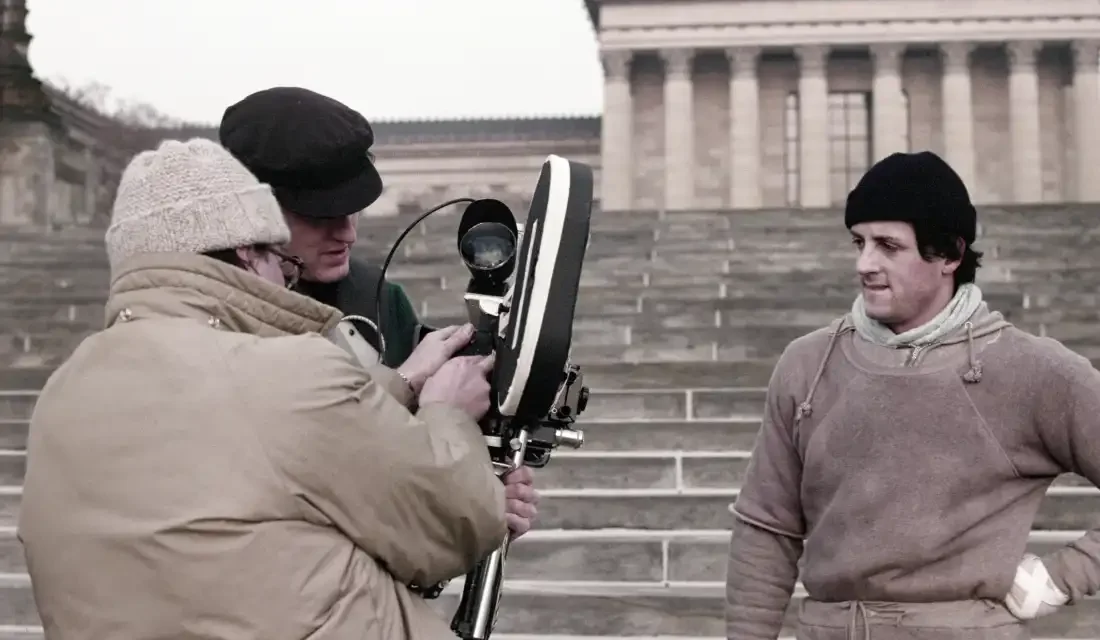
Garrett Brown, the inventor of the Steadicam, was instrumental on the set of Sylvester Stallone’s film, Rocky, which won the Best Picture at the 1977 Academy Awards. The movie’s most iconic scene features Rocky Balboa, played by Stallone, training for a major boxing match. In this sequence, Rocky is seen running through trainyards and a bustling market, shadowboxing, performing push-ups and sit-ups, and punching frozen meat. The climax occurs when Rocky ascends the steps of the Philadelphia Art Museum, celebrating at the top with arms raised.
The new film I Play Rocky not only explores Stallone’s role in writing and starring in his film but also highlights cinematographer Garrett Brown’s innovative work. Brown’s creation, the Steadicam, made its mark as he filmed from within the boxing ring, maneuvered through a meat locker, and followed Rocky up the museum steps. Director Peter Farrelly notes that Brown was not merely holding a camera. He was crafting a narrative, transporting audiences alongside Rocky during his triumphant moment.
“He’s not just holding a camera, he’s telling a story,” says I Play Rocky director Peter Farrelly.
Brown’s Steadicam is a stabilized camera system. It incorporates a harness attached to the user’s chest and a gimbal, allowing for seamless camera movement. Brown humorously recalls the unusual appearance of the setup, which included a fiber optic viewfinder strapped to his head. Despite the odd look, the invention was groundbreaking. In 1978, he received an Oscar for the Steadicam, which remains a staple in modern filmmaking. Brown further contributed to technology with inventions like the Skycam for live sports and several underwater filming devices.
Brown’s beginnings were musical; he was part of the folk duo Brown and Dana. Their song “It Was a Very Good Year” was recorded before Frank Sinatra’s Grammy-winning version. Following a car crash and the rise of The Beatles, Brown shifted from music to filmmaking, creating live-action videos for Sesame Street and inventing innovative filming techniques.
Discontent with bulky dollies and jerky handheld cameras, Brown sought a smoother alternative. Inspired by natural human vision, he developed the Steadicam in 1974. His trial shots, termed “30 impossible shots,” became well-known among filmmakers, leading to his involvement in the 1976 film Bound for Glory and Stallone’s Rocky.
Brown’s influence grew with work on films like Return of the Jedi, where his techniques were used for high-speed scenes in redwood forests, and The Shining, working with Stanley Kubrick. His contributions also include Indiana Jones and the Temple of Doom.
Brown states that the Steadicam mimics the human eye, which naturally stabilizes motion. This design requires a skilled human operator, a feat beyond current AI capabilities. His innovations have left a lasting mark on cinematography, continually shaping how stories are visually told on screen.
 Trump Hosts Dinner Amid Falling Crypto Coin Value
 Jennifer Lopez Discusses Challenges in Hollywood Due to Ethnicity
 Elevated Risk of Technology Outages Due to Software Vulnerabilities
 Taylor Swift Supports Husband Travis Kelce at Chiefs-Cardinals Game
 Taylor Swift Attends Chiefs-Cardinals Game with Family
 WNBA’s Sophie Cunningham Sparks Bond Girl Buzz