The House Select Committee on the Chinese Communist Party (CCP) is requesting a briefing from the Department of Homeland Security (DHS) regarding the enforcement of the Uyghur Forced Labor Prevention Act (UFLPA). This legislation aims to prevent the import of Chinese goods made with forced labor. The committee’s letter to DHS was shared exclusively with Fox News Digital.
The UFLPA was enacted in 2021 to combat the importation of products into the United States that are manufactured using forced labor in China. Human rights organizations have highlighted issues related to the oppression and forced labor imposed on Uyghurs, a Muslim ethnic minority residing in Xinjiang Uyghur Autonomous Region (XUAR) in China.
Concerns Over Forced Labor
Representative Ro Khanna, a member of the House Select Committee on Strategic Competition between the United States and the CCP, discussed the importance of the UFLPA. He highlighted that Uyghurs are facing political persecution, being forced to abandon their religion and assimilate into Chinese culture. Many are compelled to work under harsh conditions with low or unpaid wages, often for extensive hours.
“The Uyghurs are being politically persecuted in Xinjiang, China. They are forced to give up their religion, assimilate into Chinese culture, and endure harsh labor conditions,” Khanna stated.
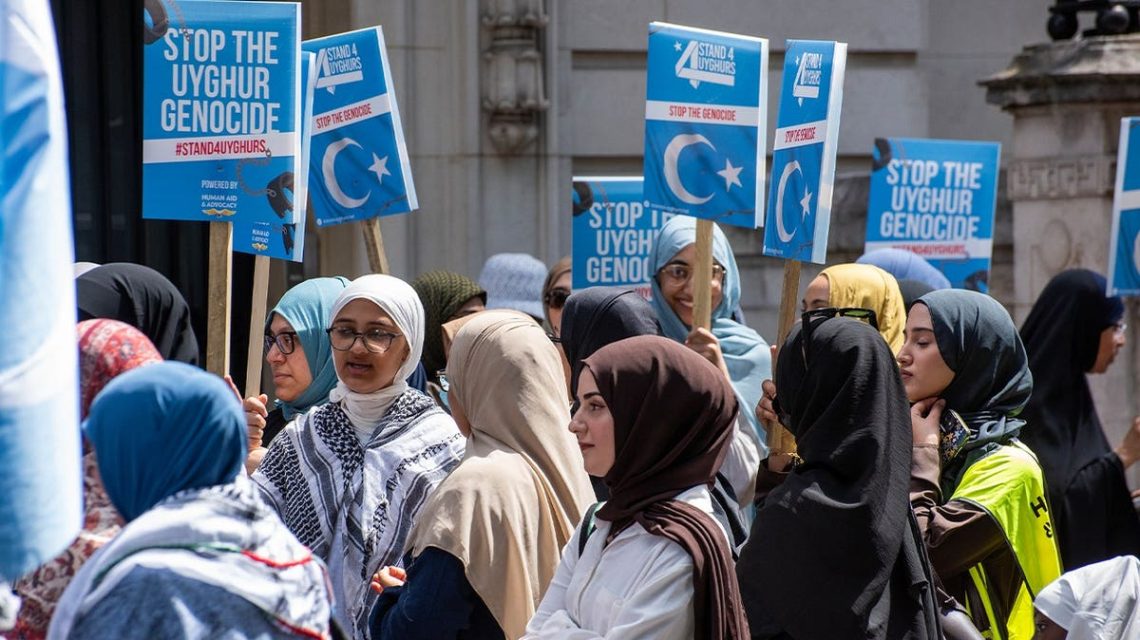
Protests have erupted, demanding China dismantle its internment camps and respect religious freedoms.
The UFLPA as a Moral and Economic Issue
Khanna emphasized that the UFLPA is both a human rights and economic issue for the United States. By flooding U.S. markets with cheap products made through forced labor, Chinese manufacturers create unfair competition for American industries. Khanna stated that American companies like U.S. Steel and Cleveland Cliffs struggle to compete with goods produced under such conditions.
Khanna and other lawmakers have signed a bipartisan letter to DHS Secretary Markwayne Mullin, outlining concerns and requesting a comprehensive update of the UFLPA Entity List, which includes companies known to use forced Uyghur labor. The list experienced an update in July with 43 new companies.
Product Sources and Trade Discrepancies
The committee suspects that products from XUAR, including textiles and materials essential to technology production, are still reaching U.S. consumers. These concerns were highlighted by a report indicating that cotton in “Labubu” dolls originates from forced labor.
“A lot of textiles come from Uyghurs in China,” Khanna noted. “It’s a prominent location for enforced labor participation.”
Khanna explained that avoiding import bans, China often outsources production to other countries.
“China uses outsourcing in places like Malaysia or Vietnam to evade trade tariffs,” Khanna commented, highlighting the complexity of tracing the origins of products.
Bipartisan Support and Call for Fair Trade
The push for stronger enforcement of the UFLPA is backed by lawmakers from both parties, emphasizing the need for fair trade and the protection of human rights.
“It’s about fair trade and human rights,” Khanna stated, reflecting the bipartisan concerns.
He clarified that while Americans support trade, competing with slave labor undercuts fair market conditions.
Inquiries for comments were sent to DHS, Customs and Border Protection, the Chinese Embassy, and Pop Mart, the producer of Labubu. The outcome remains pending.
 El-Sayed Faces Challenges with Michigan Voters, Linking to Hasan Piker
  Michigan Democratic Senate Hopeful Faces Criticism for Campaign Choices
  Veterans Request Court Intervention on Trump’s Proposed Arch
  Lawmakers Call for Investigation into Veterans Education Fraud
  NYC Mayor Faces Criticism Over 9/11 Remarks
  Addressing Social Issues in the Black Community