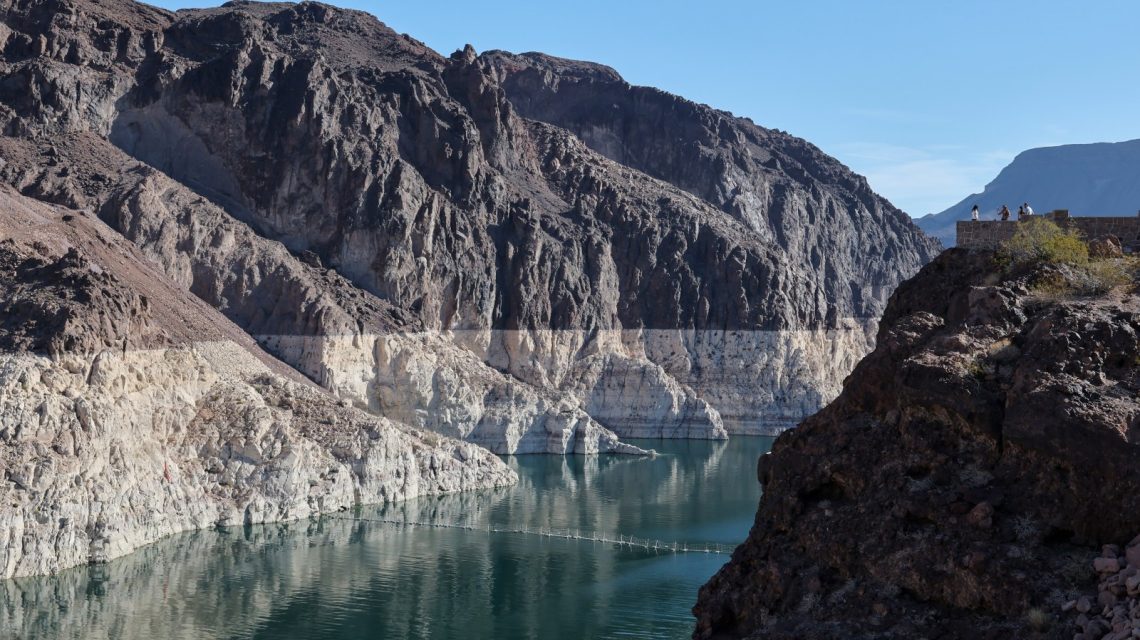
Lake Powell and Lake Mead, the United States’ two largest reservoirs, have reached unprecedented low water levels. A recent report highlights this as a crucial moment in the ongoing water supply crisis in the West.
Record Low for Combined Storage
On July 12, the combined live storage in these reservoirs dropped to 12,675,509 acre-feet. This broke the previous record low of 12,677,161 acre-feet recorded on March 14, 2023. An acre-foot is the volume of water needed to cover an acre of land to a depth of one foot.
Lake Powell’s surface elevation was at 3,524.32 feet, accounting for 5,505,869 acre-feet of live storage on July 12. Simultaneously, Lake Mead stood at an elevation of 1,042.77 feet, equating to 7,169,640 acre-feet.
The report notes that this is the lowest combined water level since May 23, 1957, when 12,668,000 acre-feet were stored entirely in Lake Mead, prior to Lake Powell’s creation.
Connected Reservoir System
The report emphasizes that these reservoirs should be considered as a unified system. Lake Powell, located in the Upper Basin, and Lake Mead, in the Lower Basin, form an interlinked storage system. Though separated by the Grand Canyon, they operate as one reservoir due to minimal consumptive uses there.
Storage Losses Accelerated in 2026
The decline in water levels is accelerating, with projections extending into 2026. Since March, nearly 16,000 acre-feet of combined storage have been lost daily, except in May, when the loss slowed to 11,000 acre-feet per day due to Rocky Mountain snowmelt and releases from Flaming Gorge.
The report alerts that until new runoff from winter snow begins next spring, each day is expected to set a new low in combined storage.
Depletion rates varied: 2,626 acre-feet per day in January, 6,494 in February, 15,733 in March, 16,861 in April, 11,001 in May, 16,230 in June, and 16,661 from July 1 to July 13.
Importance of the Colorado River
The Colorado River plays a vital role in North America’s water system. It supports water supply, hydropower, recreation, and habitats in several states including Arizona, California, and Nevada. Agriculture demands about 70 percent of the river’s water, while 35 to 40 million people depend on it for municipal supply.
Potential System Crash by 2028
Scientists warn that by 2028, reservoir levels could fall so drastically that normal operations, such as water deliveries and hydropower generation, may cease. This potential ‘system crash’ threatens essential infrastructure and the economies dependent on the Colorado River.
Upcoming Management Decisions
Several operating agreements are set to end soon, making upcoming decisions crucial. The federal government plans to require Arizona, California, and Nevada to reduce their river usage by about 20 percent in 2027 and 2028. Deeper cuts might follow.
Arizona Governor Katie Hobbs has expressed opposition to what she deems unreasonable cutbacks for her state.
Currently, Lake Mead’s storage is at 27 percent capacity with 7,061,904 acre-feet, while Lake Powell is at 22 percent with 5,424,836 acre-feet, based on the Bureau of Reclamation’s data.
 The Growing Threat of Glacial Lake Outbursts and the Urgent Need for Mitigation
  Collapse of Hawaii’s Holei Sea Arch Highlights Nature’s Impact
  Decrease in Atlantic Hurricanes: A 2026 Outlook
  Keurig Dr Pepper Introduces Eco-Friendly Coffee Pods to Cut Waste
  Drought Drives Bears Closer to Human Habitats
  Viral Video Captures Elk Smashing Car Window in Colorado