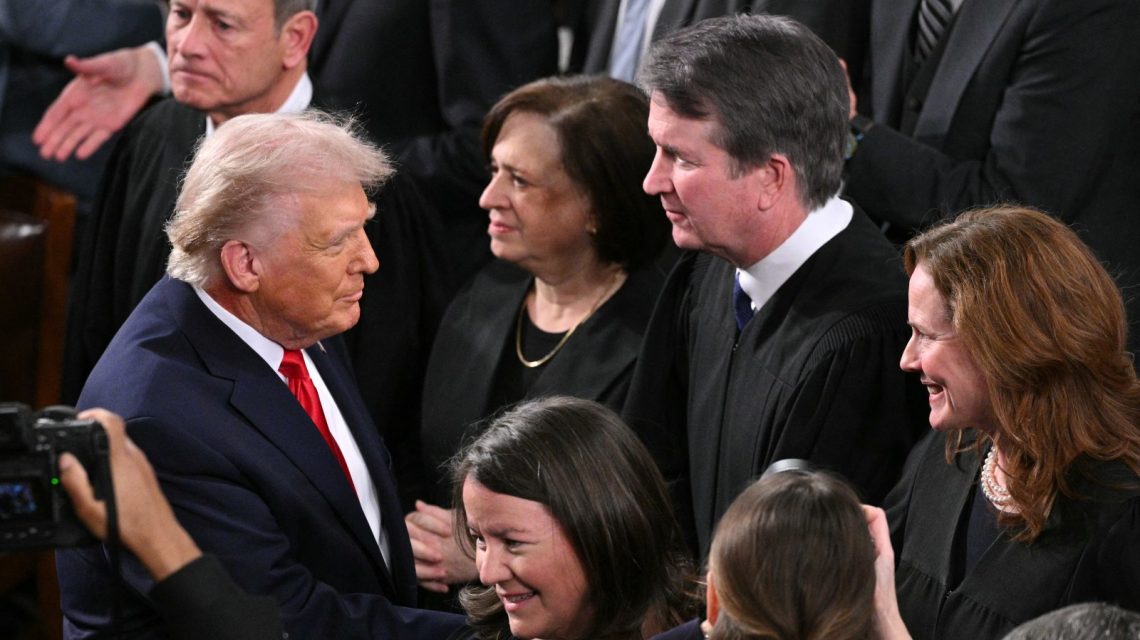
A recent Economist/YouGov poll highlights growing concerns about the perceived bias of the Supreme Court towards President Donald Trump. Nearly half of registered voters, 44 percent, believe the Court favors Trump, according to the poll conducted from September 4-8 among 1,469 registered voters. Conversely, only 12 percent feel the Court is biased against him. The poll has a margin of error of 3.4 percent.
Political affiliations strongly influence these perceptions. Eighty-one percent of voters who backed Vice President Kamala Harris in the 2024 election think the Court leans toward Trump, compared to a mere 9 percent of Trump supporters. Among Democrats, 77 percent perceive the Court as favoring Trump, while 20 percent of Republicans feel the Court is biased against him. Additionally, about half of Republicans believe the Court treats Trump fairly. Among independents, 44 percent view the Court as biased towards Trump.
The Supreme Court has not yet commented on these perceptions.
Approval ratings for the Supreme Court’s overall performance have dropped significantly. Currently, 56 percent of registered voters disapprove of its handling of responsibilities, compared to 34 percent who approve. This marks a decline from July figures, where disapproval stood at 50 percent. Furthermore, there has been a perceived increase in the Court’s conservative stance, with 49 percent labeling it as conservative in the latest survey, up from 44 percent in July.
The Court’s involvement in several high-stakes election issues before the upcoming midterms may influence public opinion further. For instance, the Court recently opted not to reinstate a Republican-favored congressional map in Missouri, among other rulings impacting the Trump administration.
Regarding the Court’s recent decisions, 47 percent of voters expressed that rulings have excessively empowered Trump. Meanwhile, 30 percent believe the decisions granted the right amount of power, and 8 percent feel they offered too little. Notably, 73 percent insist that the president must comply with Court orders, irrespective of personal disagreements, highlighting the public’s emphasis on judicial obedience.
The July Economist/YouGov poll had provided insights into individual justices’ favorability. Justice Amy Coney Barrett saw a 23 percent favorable rating, with a 38 percent unfavorable view. Clarence Thomas received 29 percent favorable and 41 percent unfavorable ratings. Chief Justice John Roberts had a 25 percent favorable score, and Justice Ketanji Brown Jackson received 34 percent favorability. Compared to previous data, the favorability of Justices Thomas, Barrett, and Kavanaugh has decreased, indicating shifting public sentiment.
 Texas Governor’s Race: A Close Contest Amidst National Political Dynamics
  Trump Defends Thune Amid Republican Convention Boos
  Senator Fetterman’s Political Stance Draws Attention
  James Talarico Discusses Key Issues in Texas Senate Race
  Tom Homan Opposes Calls to Abolish ICE Amid Record Border Enforcement
  Sen. John Fetterman’s Surprising Video at Republican Convention