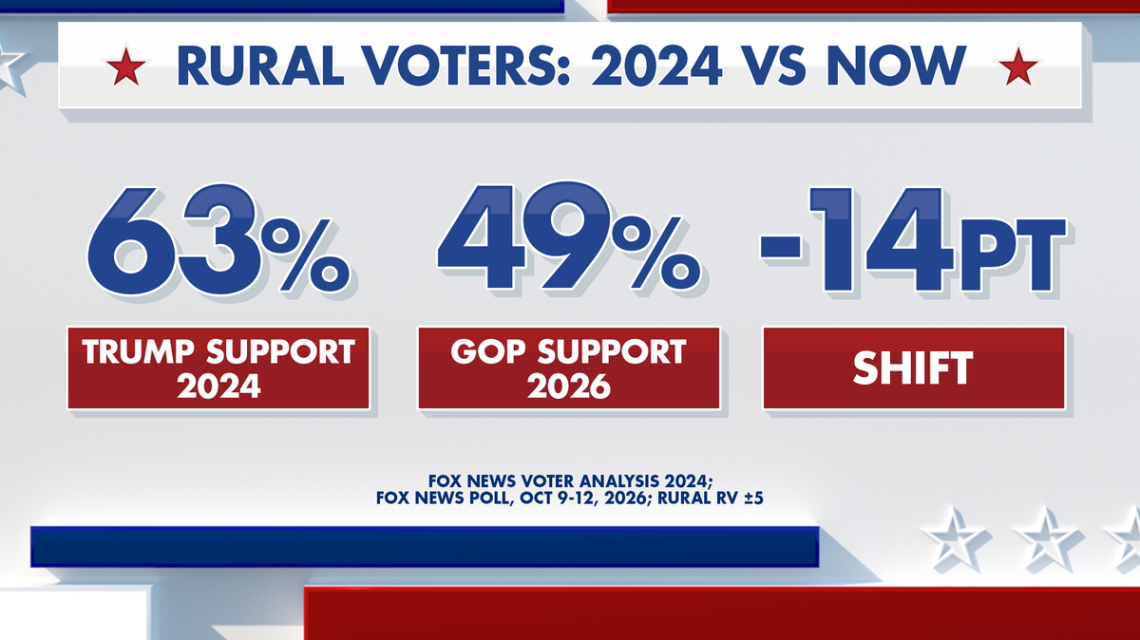
Republicans have faced both triumphs and setbacks in recent elections, yet they have consistently relied on rural America as a stronghold. Historically balanced, rural voters have increasingly favored Republicans over the past two decades. In the 2024 election, nearly two-thirds of these voters supported President Trump.
Currently, less than half of rural voters indicate a willingness to back the GOP in upcoming elections. Their concerns mirror those of many other Americans, with 19% identifying the rising cost of living as their primary economic issue, closely followed by concerns over gas and energy prices.
The Trump administration has attempted to address these worries by highlighting job growth and technological advancements. However, rural voters remain anxious about economic conditions. Less than a quarter believe the economy is thriving, and unemployment issues persist as significant concerns.
Data centers have emerged as a noteworthy economic concern, with 2% citing them as their biggest problem—a higher figure than expected when compared to issues like housing or jobs. These factors have weakened Republican prospects in areas traditionally considered safe, such as Ohio and Iowa. Some rural districts, where Trump previously had substantial victories, are now seeing tighter races.
The rural vote shows signs of fragility beyond polling data. In Wyoming, political advertisements are bypassing mentions of Trump or the wider Republican Party. This indicates challenges ahead, given Trump’s overwhelming win in previous elections. Potential shifts in voter turnout could influence election outcomes in states like Florida, Mississippi, and South Carolina.
A complicating factor emerges with independent candidates challenging Republicans in Senate races across Idaho, Montana, Nebraska, and South Dakota. These candidates advocate for anti-establishment policies, like term limits and lobbying bans. The focus on corruption, highlighted as a top concern in recent polling, and their commitment to independence from traditional party politics could sway discontented voters.
With Democrats largely stepping back in three of these states, frustrated voters have the option to support independent candidates. This dynamic could tighten margins more than usual.
Over the past decade, these states have experienced competitive political landscapes. In Montana, former Senator Jon Tester maintained his seat as a Democrat. Republicans secured narrow wins in South Dakota and Nebraska, while Idaho’s 2014 gubernatorial race culminated within a 15-point differential.
Recently, gubernatorial races in Florida and Nebraska have intensified as elections approach. In Florida, the influence of the ‘MAGA’ movement and Trump, coupled with Gov. Ron DeSantis’s significant victories, have provided Republicans some advantages. However, Hispanic voters’ shifting allegiance away from the GOP poses challenges, impacting the race.
In Nebraska, Gov. Jim Pillen seeks reelection amid uncertainties. Despite a previous substantial victory, changes in voter sentiment could make this a challenging race. Additionally, the presence of independent Senate candidates like Dan Osborn might galvanize Democratic voters.
Further factors affecting Nebraska’s political scene include local dissent over state budget cuts proposed by Pillen and the ballot listing of Brett Lindstrom as a third-party candidate. Lindstrom’s emergence adds complexity to the race, pointing to diverse political shifts within the state.
 Controversies Surrounding Trump’s Former Press Secretary and Ambassadors
 Trump Administration Intensifies Efforts to Combat Fraud
 Economic Challenges in the Midterm Elections: Analyzing the Impact on American Voters
 Scrutiny on Voter Fraud Claims in California
 Economic Challenges Influence Upcoming 2026 Midterm Elections
 Signs of Strain in Trump Administration as Fox News Criticism Surges