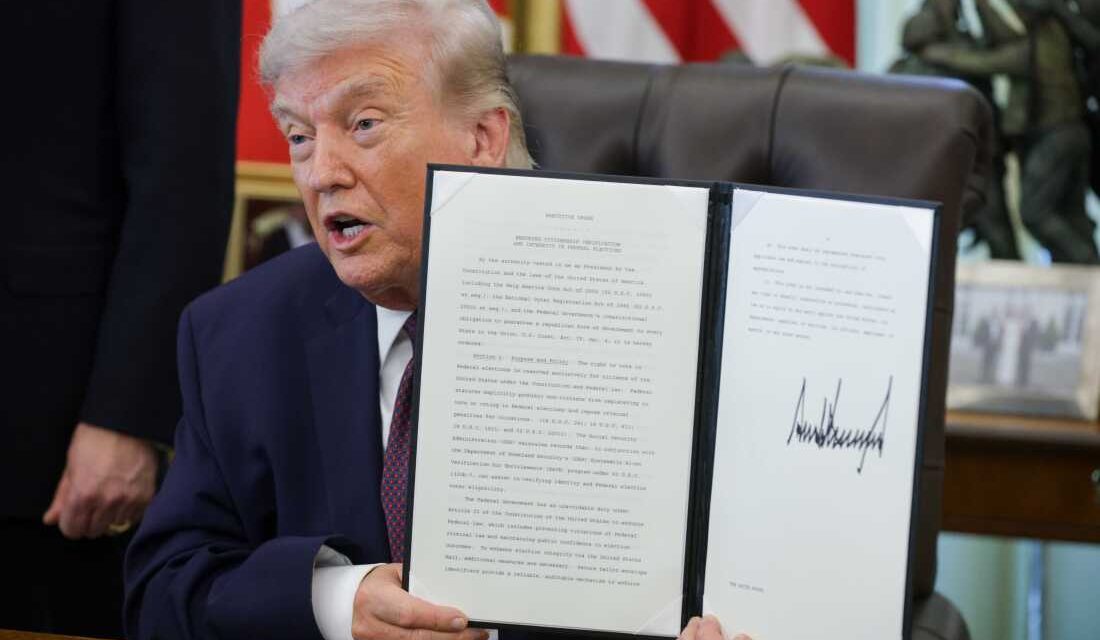
The Supreme Court has temporarily halted a lower court’s decision that blocked key components of President Trump’s executive order intended to restrict mail-in voting for the upcoming midterm elections in several states and Washington, D.C. This comes as absentee voting for the midterms is set to begin soon, presenting challenges for federal agencies like the U.S. Postal Service in implementing Trump’s directives.
Issued on Monday, this executive order represents the latest legal development in Trump’s efforts to influence electoral processes. Despite this, a separate ruling by U.S. District Judge Indira Talwani in August continues to prevent the Postal Service from executing Trump’s directives nationwide.
The Supreme Court did not address the legality of Trump’s order, which has not yet affected the ability of eligible absentee voters to vote by mail. Judge Talwani had previously blocked significant parts of Trump’s order in June for 23 states, mostly led by Democrats, and Washington, D.C., after concluding that Trump had exceeded presidential authority under the Constitution. The Constitution delegates electoral regulation powers to state legislatures and Congress, which Talwani noted in her ruling.
Trump’s executive order requires the Department of Homeland Security to develop state lists of adult citizens and directs the Postal Service to obtain lists of eligible mail voters from states, delivering ballots only to those individuals listed. Mail ballot envelopes must include specific barcodes, according to the order. The Postal Service has released a final federal ballot mail rule in response.
Trump has stated that the aim is to prevent illegal voting by non-U.S. citizens, an occurrence research indicates is extremely rare. Despite the restrictions blocked by Talwani, Trump’s order has momentarily halted, pending further legal developments.
As legal challenges progress, the impact on eligible mail-in voters remains uncertain. The administration recognized the limited timeframe available to enforce Trump’s order prior to the midterm elections. U.S. Solicitor General D. John Sauer expressed concerns in July about the feasibility of resolving legal disputes swiftly enough to implement the directives effectively, noting that preparation activities might need to start early to mid-August to be ready for the 2026 election.
Editor’s note: USPS financially supports NPR.
 U.S. Strategy Focuses on Economic Pressure Over Military Action in Iran
  Democratic Candidate Christina Bohannan Campaigns in Iowa
  Historic Opportunity for a Female UN Leader Faces Challenges
  Supreme Court Decision on Trump Administration’s Mail-In Ballot Order
  Clarence Thomas Rejects Racial Expectations on Political Views
  Michigan Senate Candidate Abdul El-Sayed Faces Backlash Over Remarks