Imagine if during World War II, attempts were made to halt the production of crucial wartime supplies like tanks and planes. Similarly, consider hypothetical restrictions on American industrial efforts just before Pearl Harbor. Disruptive actions like these would have only served the interests of adversaries.
Today, a different conflict unfolds. The U.S. faces a technological competition with China focused on artificial intelligence (AI). The objectives in this AI battle are starkly different. U.S. entities, including private companies and the Trump administration, view AI as a key to enhancing prosperity and personal freedom. Conversely, China aims to leverage AI to exert control within its borders and shape global influence according to its desires.
“China and the U.S. are uniquely positioned to lead in AI development. Together, they hold control over 90% of the AI computing potential worldwide.”
The U.S. remains dominant in generative AI and continues to innovate rapidly, striving to strengthen its position in industrial and military applications.
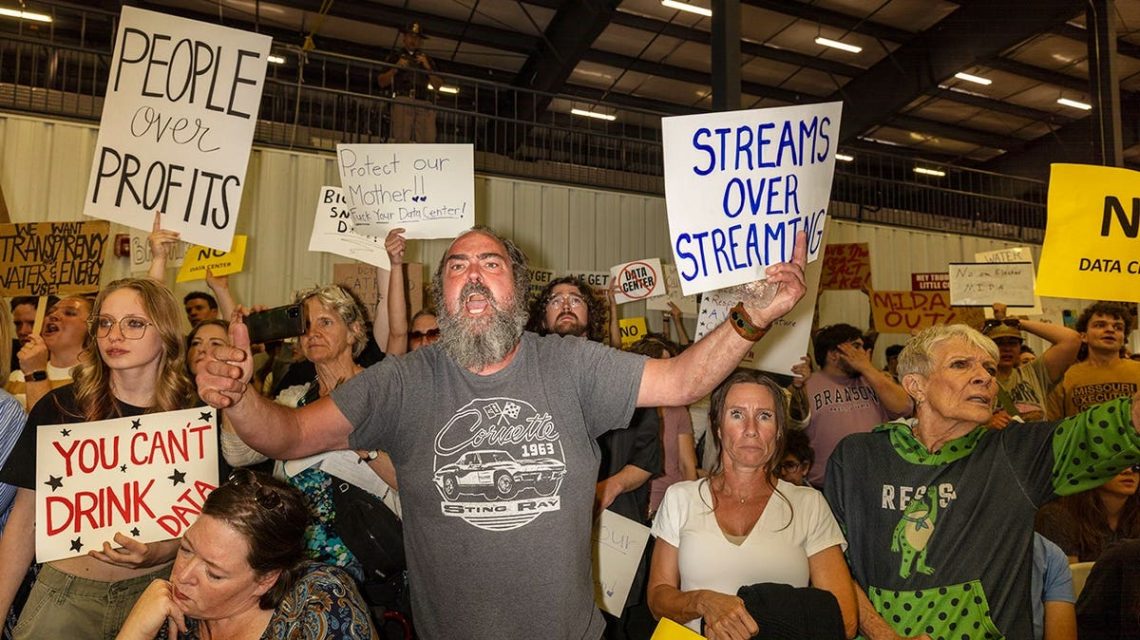
Protests erupted in May 2026 as the Box Elder County Commission approved a large AI data center project in Tremonton, Utah. Activists cited concerns over water usage, energy demand, and environmental impacts as vital issues in their opposition to the proposed 40,000-acre development.
Across the country, a movement seeks to halt the expansion of data centers. Currently, 78 jurisdictions have implemented temporary moratoriums or bans. New York leads with an enacted moratorium, while states like Florida, Oklahoma, and Georgia consider similar actions. If political backing strengthens these prohibitions, China’s advantage may grow.
There are significant economic risks attached to such bans. In Georgia, a potential data center ban could eliminate 552,000 jobs and $850 million in annual tax revenue. The impact extends to national security concerns and argues against personal freedoms, rooted in inaccurate perceptions of data center repercussions.
Opponents argue data centers increase electricity costs. In reality, they can reduce costs by spreading them over higher demand. Misconceptions also exist around water usage: data centers often consume minimal water compared to golf courses.
The Brookings Institution discovered economic benefits upon data center introduction: an 11% rise in construction jobs, and a 22% increase in information sector employment. Wages improve by 3% to 4% for both existing workers and new hires, while tax revenues expand.
AI offers economic growth, supporting competition from startups and small businesses in growing sectors. Expected contributions from AI and accompanying data centers may boost the U.S. economy by 1.5% to 3.7% annually.
The strategic importance of AI includes military and intelligence applications. It enables detection of cyber threats, enhances intelligence processing, and optimizes logistics for military readiness. These technologies streamline U.S. defense manufacturing, preparing it for challenges from China.
Choices made now regarding data centers will shape the future of freedom. Ensuring decisions benefit the U.S. and its economic and security posture remains crucial.
 Protecting Your Finances from Increasing Cyber Threats
  Nvidia CEO Jensen Huang Talks AI, U.S.-China Competition, and Data Centers
  Legal Battles Over Sports Betting and Addiction Claims
  Concerns About Rapid Advancements in Artificial Intelligence
  Leading AI Companies Face Antitrust Lawsuit for Alleged Coordination
  Documentary Critiques Elon Musk’s Ambitions