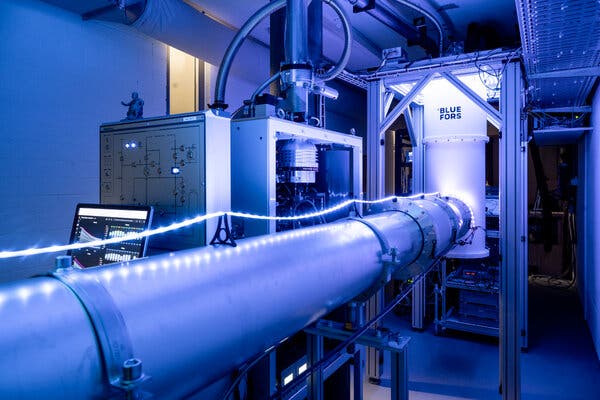
Encryption systems depend heavily on random numbers. However, traditional computers struggle with creating true randomness. Recent research has demonstrated that quantum physics can achieve a higher degree of randomness.
At ETH Zurich, researchers spent a decade working on this project with a budget of $12 million. Their findings were published in Nature recently, resulting in truly random numbers.
Random numbers play a crucial role in protecting digital information. This data traverses the internet through systems of public and private keys. Private keys are made up of hundreds of bits, represented as zeros or ones, created by computers. Although computers can nearly reach true randomness, they are inherently driven by a process. Any process, even if complex, can be predicted if its workings are understood.
“If you knew what the computer was calculating, you would be able to predict it exactly,” explained Morgan W. Mitchell, a quantum physicist at the Institute of Photonic Sciences in Barcelona.
Hackers often exploit mathematical techniques to identify weak randomness within encrypted systems, which can give them access to private keys. The research team in Switzerland aimed to address this issue through a technique called randomness amplification. This method enhances lower-grade random numbers using quantum physics. As a result, the random numbers produced are “effectively perfect,” according to Dr. Mitchell, who was not affiliated with the Swiss project.
Other groups have made strides in random number generation, often relying more heavily on computing. In contrast, the Swiss team’s experiment provided validation that didn’t depend on processing power.
“We are, in a sense, trusting physics,” Dr. Mitchell noted.
Roger Colbeck, a professor of quantum information theory at King’s College London, remarked that the published work “represents the most convincing demonstration to date that high-quality randomness can be produced from quantum processes.”
 Understanding Dog Behavior After Grooming
  Empire State Building: An Airship Dream That Defined a Skyscraper
  Unusual Cold Snap Brings Frost and Snow to Western U.S.