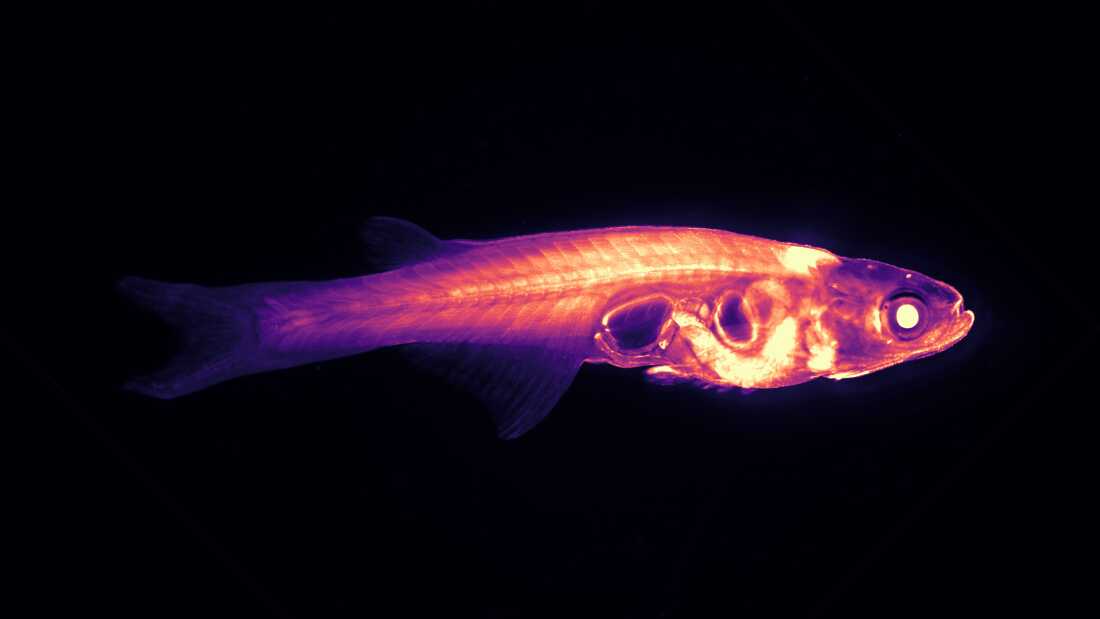
Researchers are gaining new insights into brain processes by studying the Danionella fish, known for its transparent body that makes internal functions visible. At the Howard Hughes Medical Institute’s Janelia Research Campus near Washington, D.C., scientists are using artificial intelligence to explore how the brain governs complex behaviors, such as social interactions.
Gerry Rubin, Janelia’s founding executive director, refers to this endeavor as a substantial risk that promises to deliver fascinating outcomes. By expanding their research facilities significantly to accommodate more Danionella fish, the institute aims to increase the number of scientists working on this project from about 10 to over 100.
Nelson Spruston, Janelia’s executive director, cites the evolutionary link between humans and fish, suggesting significant brain similarities. These commonalities drive the research’s potential impact on understanding human brain functions.
The Unique Advantage of Danionella
The Danionella fish provides unique advantages over other laboratory animals, such as rodents. Unlike most creatures whose brains are obscured by skull and skin, Danionella’s brains are easily observable due to their partly exposed skulls and transparent skin. Although not as well-known as other fish models like zebrafish, Danionella cerebrum offers promising research prospects. Formally identified as a distinct species only in 2021, its use in neuroscience is rapidly increasing. Matt Lovett-Barron of the University of California, San Diego, highlights its potential by noting the practical benefits of an animal with a clear head and body for neuroscience studies.
Expanding Research from Flies to Fish
Historically recognized for its advancements using fruit flies, which included mapping 54.5 million brain connections, Janelia Research Campus is embarking on a new venture with Danionella. As articulated by Erin O’Shea, HHMI President, the study’s aim is addressing the brain-behavior question: understanding the transition from physical brain activity to complex thoughts like decision-making and memory.
According to Rubin, answering this fundamental question requires a comprehensive view of all neuronal activities. Danionella provides a pathway for this ambition, though it involves managing data from a significantly larger number of neurons compared to fruit flies. Utilizing artificial intelligence becomes crucial for data analysis in this context, Rubin notes.
Innovating Scientific Tools and Techniques
Janelia plans to develop tools for global scientific study of Danionella, including creating a neural map akin to that developed for fruit flies. This also involves enhancing collaborative efforts with artificial intelligence for expeditious research breakthroughs. Current practices often involve immobilizing Danionella for study; however, Spruston aims to conduct experiments with freely moving subjects, which necessitates overcoming various engineering challenges.
For Lovett-Barron, advancements could enhance studies on how Danionella utilize visual information to coordinate activities during schooling. His team immerses the fish in virtual reality setups to observe brain responses, aiming for faster and more effective research with new tools.
O’Shea envisions understanding at least one complex behavior in Danionella within the next decade. She describes ongoing progress at Janelia, including monitoring multiple neurons simultaneously, as a positive trajectory toward achieving these goals. The ambition is to upscale techniques proven effective with larval zebrafish, which possess fewer neurons than adult Danionella fish, ultimately leading to insights applicable to the human brain, which features around 86 billion neurons.
 Archaeologists Discover Ancient Beams in Jerusalem Linked to Solomon’s Temple
  Scientists Capture Unprecedented Images of the Sun’s Surface
  Detailed Solar Surface Images Offer New Insights
  Unplanned Lunar Collision Highlights Space Debris Challenges
  High-Resolution Video Reveals Detailed Structures on the Sun’s Surface
  Rocket Debris from SpaceX to Impact Moon’s Surface