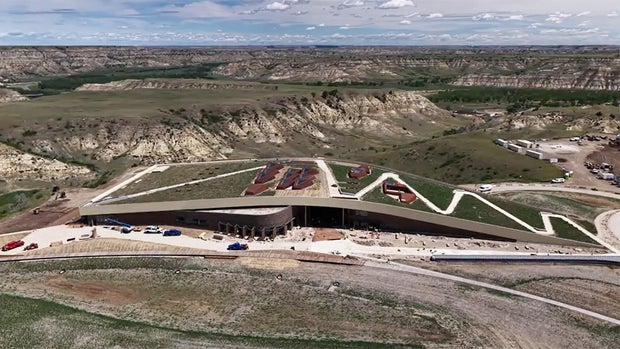
Theodore Roosevelt remains one of the most popular U.S. presidents, ranking among the top five. Now, 107 years after his passing, he finally receives his own presidential library. Surprisingly, this library is not located in his native New York, but in the North Dakota Badlands. The 96,000-square-foot library stands as a tribute to Roosevelt amid the prairie grass.
Architect Craig Dykers designed the library with subtlety, drawing inspiration from Roosevelt’s likeness on Mt. Rushmore. Dykers noted that nature is transformative in the Badlands, impacting both Theodore Roosevelt and future visitors to the library. The building features a gently sloping roof with walking paths covered in native grasses, allowing visitors to enjoy commanding views of the nearby Theodore Roosevelt National Park.
The form emerging from the Earth felt primitive, as if it naturally arose from the land.
Inside, the library employs skylights and compressed earth walls to create natural illumination. The interior design blends seamlessly with the surrounding landscape. At $450 million, the project marks a significant milestone for Medora, North Dakota.
The library’s location reflects Roosevelt’s transformative experiences in the Badlands, which he credited for shaping his presidency. Edward O’Keefe, CEO of the library and author of “The Loves of Theodore Roosevelt,” explains that Roosevelt spent time in North Dakota after losing his wife and mother on the same day. These events drove him westward, seeking solace and healing in the rugged landscape.
O’Keefe highlights Roosevelt’s resilience and determination to live a life beyond privilege. He emphasizes the library’s focus on engaging visitors with Roosevelt’s adventurous spirit, using AI and interactive exhibits to offer immersive experiences like speaking with an avatar of Roosevelt.
This library aims to be more than a traditional museum. It offers visitors unique opportunities, such as nature walks and horseback rides, with a focus on adventure and exploration. Roosevelt’s legacy, however, is not without its complexities. The library confronts Roosevelt’s historical views and ensures inclusion of indigenous perspectives through collaboration with local tribes.
Preserving Roosevelt’s legacy necessitates acknowledging both the achievements and shortcomings of his time.
The library possesses a statue removed from the American Museum of Natural History due to critiques of its symbolism. While immediate contextualization is postponed, plans for future representation are underway.
Ultimately, the Theodore Roosevelt Presidential Library stands as a beacon of courage and resilience in the face of tragedy and failures. O’Keefe underscores Roosevelt’s disdain for critics and his admiration for those who strive despite setbacks. The library’s message urges visitors, especially children, to embrace the power of action and change in the world.
 Rose Friedman: A Dedicated NPR Journalist Remembered
  Notable Lost Stories and Objects
  Fat Bear Week: Celebrating Resilient Giants and Ecosystem Conservation
  Controversial Sneaker Ad Sparks Backlash
  New Pub Opens at the British Embassy in D.C.
  Sir Don McCullin’s Lasting Legacy Through the Lens of War