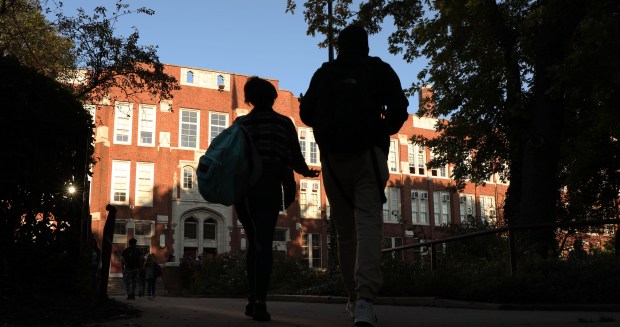
Principal Karen Calloway of Kenwood Academy continually seeks new revenue sources to support her school. Recently, she has allowed churches, nonprofits, and sports leagues to use the school’s facilities and initiated fundraising efforts through a parent group. This has effectively enhanced the school’s funding beyond the regular allocation from Chicago Public Schools (CPS). In fiscal year 2025, Kenwood spent $418,983 from external sources as opposed to approximately $90,000 in 2021, according to a collaborative analysis by Chalkbeat and the Chicago Tribune.
Kenwood Academy, a predominantly Black school where approximately half of the students are from low-income families, has utilized these funds for athletic gear, student clubs, and college tours. According to Calloway, principals should aim to create alternative revenue sources for their schools through flexible budget management.
Private fundraising is traditionally associated with well-off communities, often funding extracurricular activities. However, amidst growing financial challenges, many Chicago schools are now relying on parent donations, rental income, and cell tower revenue to cover essential expenses, including staffing. The Chalkbeat and Chicago Tribune analysis found that district-managed campuses spent a total of $48 million in independently raised revenue in fiscal year 2025, marking a 78% increase since 2021.
While North Side schools continue to lead in outside funding, several higher-poverty schools on the South and West Sides, like Kenwood, are also becoming more competitive. Though principals value the additional funds gained, they acknowledge that managing fundraisers and rentals can detract time from instructional improvement efforts.
Larger Schools Depend on Fundraising
Initially, Amundsen High School utilized fundraising dollars for non-essential items like computer carts and classroom materials. At that time, around 90% of their students were low-income and almost 60% were Latino. However, following a push to attract wealthier families from Lincoln Square, the student demographics have shifted, resulting in reduced budgets.
The school faced increased financial constraints in 2024, losing federal dollars allocated for high-concentration low-income students. In response, Amundsen spent $894,000 from external sources in 2025, which accounted for roughly 5% of its budget, covering staff salaries, and operational costs.
“We aren’t using (fundraising) because our kids need iPad 10s instead of iPad 9s. This isn’t frivolous. We’re not using it for things that aren’t 100% necessary,” said Bob Farster, a Local School Council representative.
Fundraising Efforts Among Low-Income Schools
Historically, parent fundraising in Chicago highlighted divisions between resource-rich and resource-poor schools, potentially exacerbating inequities in a segregated district. Prominent selective enrollment schools often rake in substantial funds through “Friends of” groups. For example, Friends of Payton raised $786,000 for Walter Payton College Prep’s 2023-24 year, more than any other city school.
The situation has evolved, however, as larger high schools in affluent areas with diverse student bodies increasingly depend on external revenue for essential expenses. Some school leaders admit they struggle to balance the books without this income.
Across CPS, independent revenue constitutes about 1% of total school budgets for 2024-25. Nonetheless, in certain schools like Lincoln Park High School, it can represent up to 6% of the budget.
Overall, 77 teacher and staff positions district-wide received funding from external sources this school year, an increase from 67 in 2024-25.
Challenges and Initiatives in Raising Revenue
School leaders mention that acquiring independent revenue is both time-intensive and unpredictable. Renting facilities involves significant effort, including weekend commitments and addressing vendor issues. Meanwhile, several South and West Side schools are amplifying their own fundraising activities.
During Kenwood’s eighth-grade graduation, Friends of Kenwood offered “spiritwear,” including sweatshirts and tote bags, as part of their fundraising. The parent group started amid COVID-related financial challenges and has continued strong post-pandemic.
Ramona Burress, a parent and former head of the Local School Council, has worked to enhance parent participation and launched a network to bring more fundraising strategies to Kenwood. While their yearly earnings reached $55,000 last year, significantly less than wealthier schools, the group seeks to increase funds by connecting with alumni and local businesses.
The Chalkbeat/Chicago Tribune analysis indicated that South and West Side schools have substantially boosted their independent revenue, largely reliant on a mix of rentals, cell tower income, student fees, and fundraising.
Increasingly, these funds permit schools in impoverished areas to provide experiences and resources typically reserved for affluent campuses. Gunsaulus, a magnet school, has used cell tower revenue and fundraisers for various needs, though its community confronts significant financial limitations.
District Encouragement and Observations
CPS has encouraged schools to maximize external revenue sources and has begun charging a fee for facility rentals to support building maintenance costs. The district redistributes a portion of cell tower revenue across all schools.
Despite taking a “neutral stance” on independent revenue generation, CPS appears keen to aid struggling campuses in enhancing their fundraising approaches. Principals express appreciation for these funds given the recent budget reductions.
As Linda Sartain from the Federal Reserve Bank of Chicago cautions, external revenue is unlikely to adequately address all student needs but remains a crucial help during financial pressures.
Schools are grateful for these resources, considering recent budget constraints. Friends of Whitney Young are funding teaching positions for the first time this year as external revenue becomes indispensable.
 Impact of Removing Tax-Exempt Status from Private Schools
  AFL Investigates Fairfax County Schools’ 9/11 Teaching Guidance
  Challenging the ‘Trust the Experts’ Narrative in School Libraries
  Implications of AI in College Admissions
  Preparing Students for an AI-Shaped Workforce
  Concerns Over Racism and School Funding Inequality Discussed by ‘The View’ Co-Host