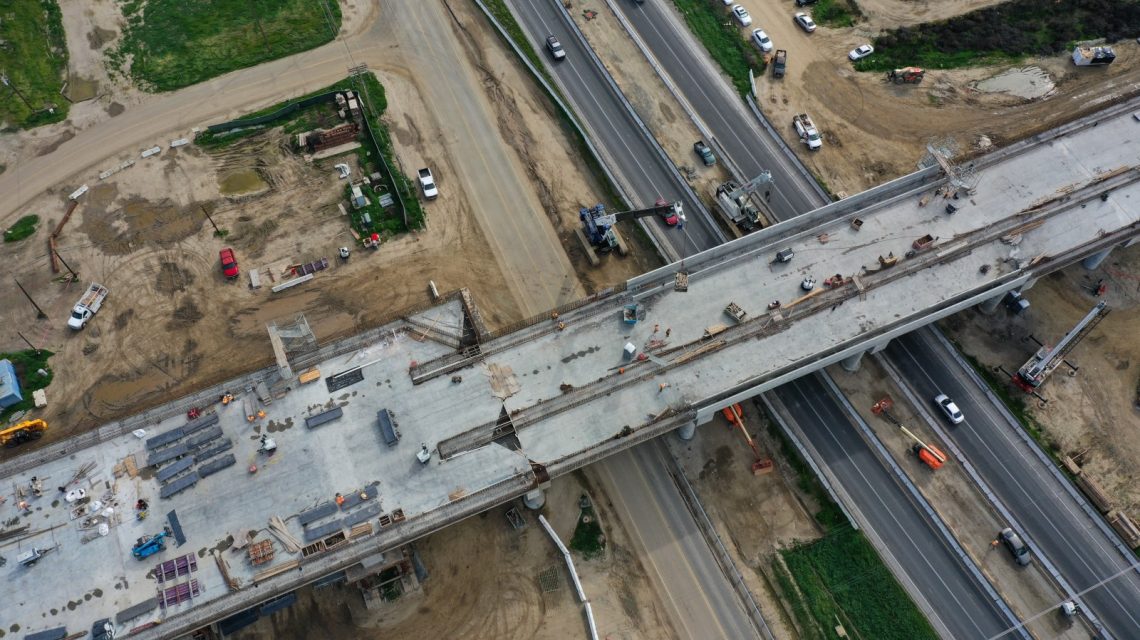
California’s long-awaited high-speed rail project is being repositioned as a potential data center corridor. Revenue from this infrastructure is being considered to help fund the project, which has struggled to secure sufficient public funding.
Background and Challenges
The high-speed rail project, publicly funded, aims to carry passengers between Los Angeles and San Francisco at speeds of up to 220 mph. However, it has encountered years of delays, funding gaps, and escalating costs. Voters approved it in 2008 with an expected completion date in 2020, but the project remains unfinished.
Strategic Asset Commercialization
The California High-Speed Rail Authority (CHSRA) has advanced an asset commercialization strategy to develop energy and technology projects along the high-speed rail right-of-way and on surplus land. By leveraging state-owned land for commercial development of solar farms, battery storage, data centers, and fiber optic and transmission lines, CHSRA can generate new business income sources before operations while benefiting communities along the corridor.
The 2026 revised draft business plan states, “By leveraging state-owned land for commercial development, the Authority can create new business income sources before operations.”
Analysis revealed several opportunities in renewable energy and technology infrastructure. Solar farms and data centers could exploit high voltage direct current transmission and technology corridors, enhancing investment returns and operational efficiency.
CHSRA’s strategy has raised concerns, according to The San Francisco Chronicle. A resident, Joseph Mello, expressed his opinion during a board meeting on June 1, saying he does not wish to ride through a valley of data centers. Public comments focused on data centers and high-speed rail, with concerns over water use, pollution, noise, fire risks, and impacts on farmland.
CEO’s Commitment to Transparency
Transparency concerns have been addressed by California High-Speed Rail CEO Ian Choudri in an interview with KRCA 3. He expressed his willingness to discuss project details more openly. “We improve every day,” Choudri said. “If there is someone who comes and says ‘hey, this is the information we’re looking for and you guys aren’t providing it,’ I would like to know.”
Choudri emphasized that every penny spent is posted on their website and urged his team to share as much information as possible. He acknowledged the importance of transparency, especially given the project’s past challenges.
“My goal really is to let the public see we can build it,” Choudri stated, according to KRCA 3.
Choudri noted that while the project would mark the first high-speed rail system in the Western Hemisphere, its progress is slowed by federal and state regulatory hurdles, unlike China’s network advancement.
Political Perspectives
California’s gubernatorial candidates have also weighed in on the high-speed rail project. Democrat Xavier Becerra proposed overhauling the current plan to ensure completion on schedule. “I’m going to scrap the current configuration, and I’m going to make sure we finish,” Becerra stated to Fresno voters.
A campaign spokesperson mentioned that 80 miles of the guideway are complete, including bridges, viaducts, and overpasses, with tracks soon to follow. Becerra’s focus is on cutting through delays and bottlenecks to prevent further setbacks.
Conversely, Republican candidate Steve Hilton expressed skepticism about the project’s compliance with legal standards. He suggested reallocating funds toward alternative infrastructure projects.
For further details, contact Newsweek editors Ben Kelly and Gray R. Thomas.