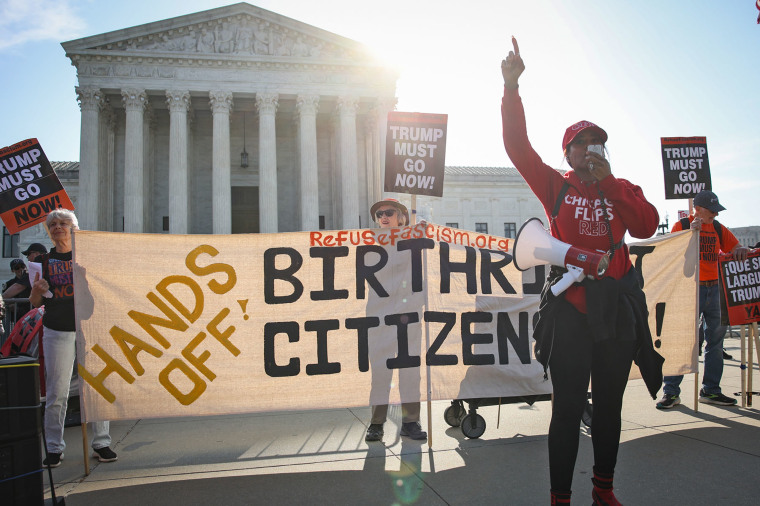
The Supreme Court has delivered a significant legal setback to President Donald Trump’s agenda by blocking his effort to limit birthright citizenship for those born on U.S. soil. The decision, made by a 6-3 majority, declared the executive order Trump issued on January 20, 2025, unlawful.
Five justices determined that Trump’s order conflicted with the 14th Amendment of the Constitution, which has historically granted citizenship to nearly everyone born in the United States. Justice Brett Kavanaugh agreed the order violated federal law but not the Constitution.
This ruling marks the third major Supreme Court loss for Trump in recent months. Previously, the court invalidated his tariffs and prohibited him from firing Lisa Cook from the Federal Reserve. Despite a 6-3 conservative majority, including three justices appointed by Trump, the court has ruled against him in this and other significant cases.
Writing for the majority, Chief Justice John Roberts noted a lack of evidence supporting Trump’s administration’s reinterpretation of the law, stressing that ‘Citizenship then and now was the right to have rights — to freely participate in our political community.’
He emphasized that the 14th Amendment, established after the Civil War, aimed to guarantee rights for everyone, including formerly enslaved individuals. Roberts affirmed, ‘We keep that promise today.’
Justices Clarence Thomas, Samuel Alito, and Neil Gorsuch were the three conservatives who sided with Trump’s plan, arguing the 14th Amendment supported his proposal. Trump’s proposal sought to restrict birthright citizenship to those with at least one U.S. citizen or permanent resident parent, excluding babies born to temporary visitors or those entering unlawfully.
In a dissenting opinion, Justice Thomas claimed the 14th Amendment was meant to ensure citizenship for formerly enslaved Black people, stating, ‘Blacks were entitled to citizenship because they were Americans. They had no other homeland.’
The controversial executive order was never in effect, having been swiftly blocked by lower courts following its signing by Trump. Legal director for the American Civil Liberties Union, Cecillia Wang, highlighted the court’s decision as a reinforcement of the promise that birth in the U.S. grants citizenship and that a president cannot alter the Constitution through executive actions.
Over the past century, the 14th Amendment has been interpreted to apply broadly to anyone born in the U.S., with specific exceptions for diplomats’ children. The 1898 Supreme Court decision in United States v. Wong Kim Ark established precedence by granting citizenship to a man born in San Francisco to Chinese parents.
Trump’s executive order faced numerous legal challenges from civil rights organizations and liberal states. Courts consistently ruled against the Trump administration. The Supreme Court’s decision to hear the New Hampshire case was met with support from groups like the American Civil Liberties Union, representing individuals who could have been affected by the order.
 Trump and NYC Mayor Mamdani: Political Divides and Collaborative Efforts
  Rep. Jared Golden Endorses Mike Lawler for Reelection
  Seattle Protects Nonmonogamous Relationships from Discrimination
  Democratic Lawmakers Criticize Trump’s $5,000 Payout Promise
  Judge Assigned to White House Press Access Case
  Hasan Piker Faces Backlash Over Controversial Comments