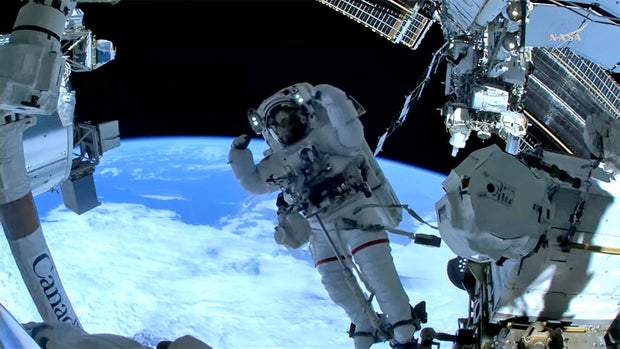
By June 30, 2026, two NASA astronauts undertook a significant repair mission aboard the International Space Station. They replaced a malfunctioning 200-pound ‘wrist’ joint on the station’s 58-foot-long robotic arm. The mission highlighted the importance of maintaining the station’s critical systems.
“That is a good install, you guys. I know that was tough. Wonderful work,” Canadian astronaut Jenni Gibbons commented from mission control as the seven-hour, 20-minute spacewalk drew to a close.
Flight controllers had earlier noticed an anomaly with the Canadian-built arm. One joint was drawing more current than usual and wasn’t moving correctly. After reviewing the telemetry data, NASA and Canadian Space Agency experts determined the joint needed replacement. They utilized one of two spare joints available on an external stowage platform, a testament to the arm’s modular design.
In the Quest airlock, astronaut Jessica Meir embarked on her fifth spacewalk. Her colleague Chris Williams, who was making his second, joined her. They officially began the spacewalk at 8:20 a.m. ET by switching their suits to battery power. Their mission marked 2026’s third spacewalk and the 280th overall for the ISS.
Williams and Meir first prepared the spare joint. They then removed the arm’s ‘hand,’ the latching end effector (LEE), and two other joint components. The 900-pound assembly was temporarily stored on a shelf to access joint No. 5, the wrist joint. The new joint was installed four and a half hours into the spacewalk.
“We’ll remove the failed joint five, replace it with the spare joint, and reassemble the arm,” flight director Fiona Antkowiak explained. “Our last major task will be reattaching the LEE cluster.” Five and a half hours into their spacewalk, the astronauts successfully reattached the LEE. Flight controllers verified electrical connections.
“Today we confirmed that Canadarm2 has two operational strings of power and data,” NASA commentator Sandra Jones stated. “The wrist surgery was successful.” The astronauts returned to the airlock, bringing the failed joint back. It will be sent to Earth for repairs and then relaunched as a spare.
This robotic arm plays a critical role in ISS operations. It captures incoming cargo ships like those from Northrop Grumman and assists in maintenance operations by moving components and astronauts. Despite the ISS’s planned retirement in 2030, NASA continues to maintain the arm, underscoring its operational importance.
“There’s not a time where we say hey, we’re just done repairing the arm,” ISS operations and integration manager Bill Spetch mentioned, highlighting the enduring need for the arm’s maintenance.
 Rising Demand for Data Centers Driven by AI Development
  Hurricane Formation and Strengthening
  Understanding AI’s Impact Compared to Historical Threats
  Debate Over AI’s Governance Amidst Fearful Predictions
 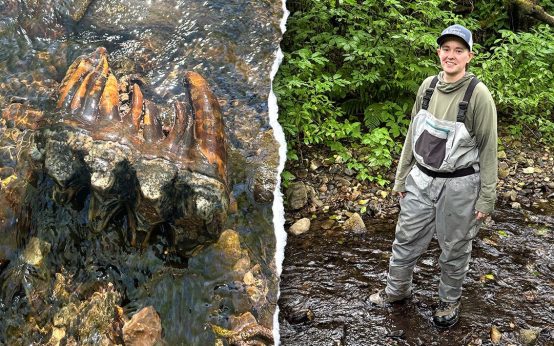 Ancient Mastodon Tooth Unearthed in California Creek
  Navigating AI Responses: A Personal Experience with Google’s New Approach