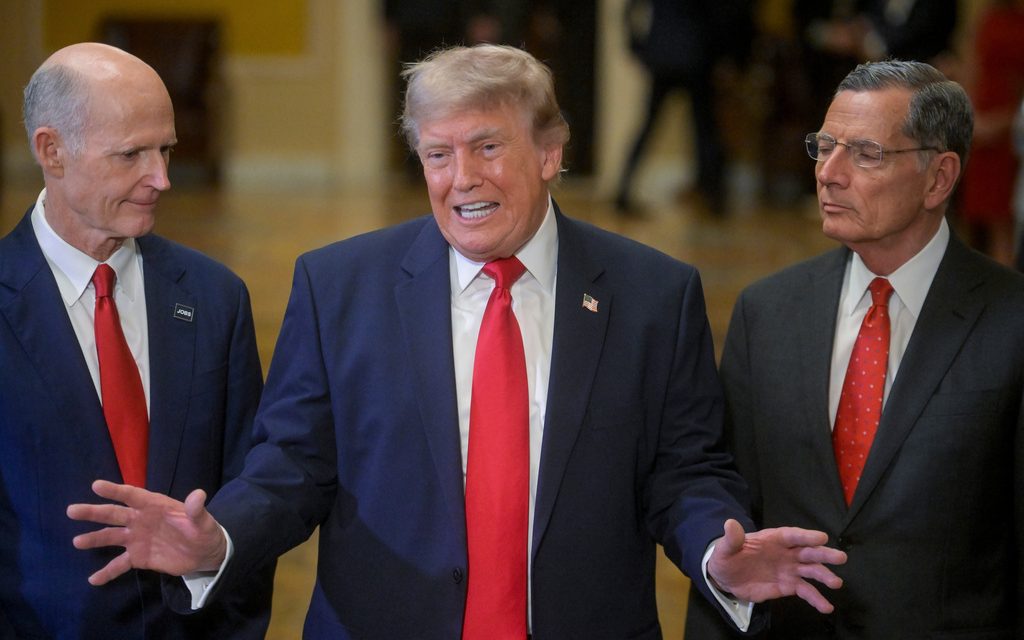
President Donald Trump recently attended a closed-door lunch with the Senate Republican Conference. During this meeting, he criticized four GOP senators who supported a House resolution to limit U.S. military actions against Iran. This resolution had narrowly passed in the Senate with a 50-48 vote.
Senator Bill Cassidy, who had lost a primary to a Trump-backed candidate, openly challenged the president during the lunch. He questioned Trump’s transparency with the public and the lack of progress on original objectives, noting that a mission intended to last four weeks was now in its fourth month. This led to a heated exchange between Cassidy and Trump.
The administration argues that the resolution is unconstitutional, citing the 1983 Supreme Court decision in Immigration and Naturalization Service v. Chadha. This case emphasized that legislation must be approved by both houses and presented to the president. The ruling also questioned laws that allowed one- or two-house legislative approvals without the president’s involvement, leading Congress to revise many such laws.
Senator Tim Kaine aimed to advance his own Senate joint resolution that required presidential approval or veto, to halt further military action in Iran. However, the motion failed with a 47-50 vote, as Cassidy voted against it and Senator Rand Paul voted ‘present’.
Simultaneously, the Senate was under pressure from the president to vote on the SAVE America Act, relating to election law changes. Trump tied the passage of this act to his potential endorsement of a bipartisan housing affordability bill. The needed votes for the election law changes were not secured, leading to an early recess.
In a separate move, Trump delayed the confirmation hearing for Jay Clayton, his nominee for Director of National Intelligence, until his successor for the U.S. district court attorney position was confirmed. This strategy of delaying nominations and legislation until demands are met has complicated congressional scheduling.
This approach has created tension with congressional leaders who value structured planning. The intervention has disrupted processes, as highlighted by comparisons to the film “The Man Who Came to Dinner,” with Trump seen as insisting on control.
Don Wolfensberger is a 28-year congressional staff veteran, ultimately serving as chief of staff of the House Rules Committee in 1995. He authored “Congress and the People: Deliberative Democracy on Trial” and “Changing Cultures in Congress: From Fair Play to Power Plays.”
Copyright 2026 Nexstar Media Inc. All rights reserved. This material is not for reproduction without permission.
 Trump and NYC Mayor Mamdani: Political Divides and Collaborative Efforts
  Rep. Jared Golden Endorses Mike Lawler for Reelection
  Seattle Protects Nonmonogamous Relationships from Discrimination
  Democratic Lawmakers Criticize Trump’s $5,000 Payout Promise
  Judge Assigned to White House Press Access Case
  Hasan Piker Faces Backlash Over Controversial Comments