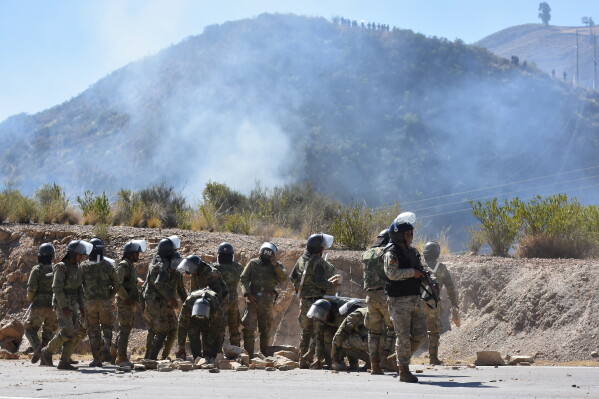
On Thursday, Algerians participated in parliamentary elections overshadowed by concerns about living costs and the disqualification of candidates challenging the government. Nearly 25 million voters in Africa’s largest country selected from 1,235 candidates to fill 407 seats in the lower house of Parliament, each serving a five-year term.
Voter turnout emerged as a crucial concern since many had largely ignored campaign events. The government declared Thursday a paid national holiday to encourage participation. Many citizens seem more focused on everyday issues like purchasing power and declining public services, amidst a backdrop of decreasing political, media, and union freedoms.
In addition, football fans in Algeria were keenly interested, as their national team faced Switzerland in a World Cup match early Friday for a spot in the knockout stage. The outgoing majority, aligned with the government, holds around 300 seats, with the Islamist party MSP as the second political force, holding 64 parliamentary positions.
Some MSP candidates were among the 269 barred from running, alongside former leaders and activists from the pro-democracy Hirak movement, which played a key role in ousting the autocratic leader Abdelaziz Bouteflika in 2019. Under President Abdelmadjid Tebboune, who secured a second term in 2024, the government has increasingly restricted freedoms.
The electoral authority stated that the disqualified candidates were banned due to “links with illicit financial networks” and “suspicious political activities.” Prior to the elections, security measures were implemented at voting centers in the capital, Algiers. Voting in southern regions and the Sahara Desert began 48 hours early to accommodate nomadic populations using government all-terrain vehicles escorted by police in Land Rovers.
The Algerian diaspora, totaling approximately 854,225 registered voters, especially in France where the largest foreign community resides, voted on Saturday and Sunday at various consular offices. According to the state news agency APS, there was high turnout and a “family atmosphere.”
The government also advanced end-of-year school exams to free up classrooms and teachers, who are typically used to manage polling stations in exchange for a daily stipend. Amid mostly empty campaign venues, parties and independent candidates opted for “grassroots meetings” with citizens in streets, markets, and popular cafes.
In a widely circulated video, a political party leader unsuccessfully attempted to persuade a young person to vote. Yet, parties continued campaigning. The presidential majority, led by the veteran FLN party, sought broad participation to strengthen Algeria’s internal position amidst geopolitical challenges.
The opposition Workers’ Party, with a Trotskyist orientation, campaigned for higher pensions and wages and against mining sector reforms favoring foreign investors. Meanwhile, the leader of the Socialist Forces Front, the main democratic movement party, calls for the release of political prisoners and more press freedom, arguing that boycotting the elections only aids the government.
The electoral authority based candidate disqualifications on an anti-corruption law that had previously allowed some parliamentary seats to be bought with money linked to drug trafficking, corruption, and tax evasion. Disqualified individuals claim that the law was unfairly or politically motivated against them.
“I myself voted for this virtuous law aimed at cleansing the political scene, but clearly, it has deviated from its goal and been used as a mass exclusion weapon,” said Abdelahab Yagoubi, an Islamist lawmaker representing the Algerian diaspora who could not seek reelection.
Said Oulhadj, a 62-year-old primary school principal in a mountain village, wanted to run with the independent Thagmats (Fraternity) party but was vetoed. “I have nothing to do with dirty money,” he told The Associated Press. “The electoral authority has damaged my reputation and honor. How will my students, their parents, and my colleagues view me?”
Electoral authority president Karim Khelfane defended the institution, stating that nearly 70% of the submitted candidacies were accepted and that some legislators who voted for the anti-corruption law cannot seek a second term.
 Trump Administration Reverses Fuel Economy Standards Amid Rising Oil Prices
  Discussion on U.S. Government Spending and Voter Opinions
  President Trump and AI Executives Convene at White House
  Scrutiny on Attorney General’s Political Appearances
  Discussion on Political News and Analysis
  Political Push for Insulin Price Cap