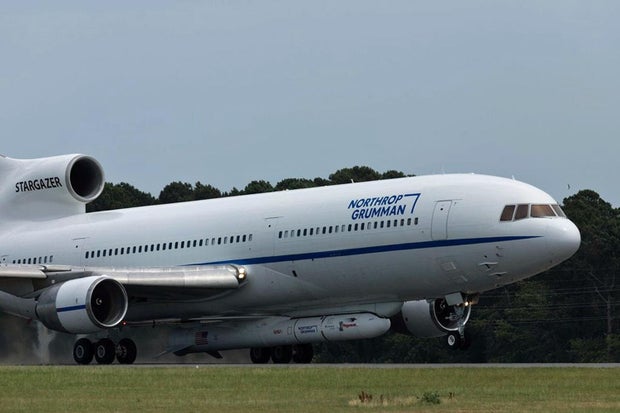
By July 3, 2026, CBS News reported a collaborative effort between a small company, NASA, and Northrop Grumman to launch an experimental space tug. This mission aims to secure and save a descending space telescope, the Neil Gehrels Swift Observatory, from catastrophic reentry into Earth’s atmosphere. The space tug intends to elevate the telescope back to a safe operational altitude.
The observatory, valued at $250 million, plays a crucial role in detecting violent cosmic explosions. If the mission succeeds, it will be granted an extended operational life, contributing further to observing such phenomena.
Mission Details and Partnerships
The mission employs Northrop Grumman’s last L-1011 transport plane to deploy a Pegasus XL rocket carrying Katalyst Space’s LINK space tug. This endeavor, executed from NASA’s Wallops Island facility, incurred a modest $30 million, including design, testing, building, and launch.
Despite initial delays due to weather and software issues, the LINK and its booster were released above the Marshall Islands, achieving orbit as planned. Flight controllers are set to inspect the LINK’s systems before initiating a rendezvous with the Swift Observatory.
Technical Aspects of the Mission
The LINK space tug, equipped with small robot arms and efficient ion thrusters, aims to reboost the Swift telescope. Additional testing will ensure LINK’s readiness for this challenging task. The mission expects completion within 10 to 12 weeks.
“The swift execution of this project in just eight months is remarkable,”stated Ghonhee Lee, CEO of Katalyst Space.
The Scientific Significance of Swift
The Swift Observatory, operational since 2004, identifies gamma ray bursts and aids in confirming theories about cosmic events and elements. Despite extending well beyond its expected two-year mission, Swift requires reboosting due to atmospheric drag.
Gamma ray bursts, momentary flashes of intense energy, have illuminated our understanding of heavy element formation. Swift’s ability to detect over two thousand such occurrences has deepened our knowledge of the universe’s origins.
Challenges and Future Prospects
Swift is currently losing altitude rapidly, and it faces increasing risks as atmospheric drag intensifies. The mission hopes to mitigate these dangers and restore the observatory’s position.
Katalyst Space recognizes the Swift reboost as a testbed for future initiatives. The company envisions using similar technology to refuel, repair, and reposition satellites, eliminating the notion of disposable space assets. This concept could extend services to prominent equipment like the Hubble Space Telescope.
“Katalyst is setting the stage for an era that negates the throwaway culture in space operations,”remarked Robert Lamontagne, Vice President of Strategic Partnerships at Katalyst.
 The Discovery of Incendiamoeba cascadensis: A Fire Amoeba
  Archaeological Discovery in Germany: Largest Hoard of Roman Coins Found
  Hurricane Formation and Strengthening
  Ancient Mastodon Tooth Unearthed in California Creek
  The Tiny World of the Pumpkin Toadlet
  Chimps and Self-Medication: Insights from Gombe Stream