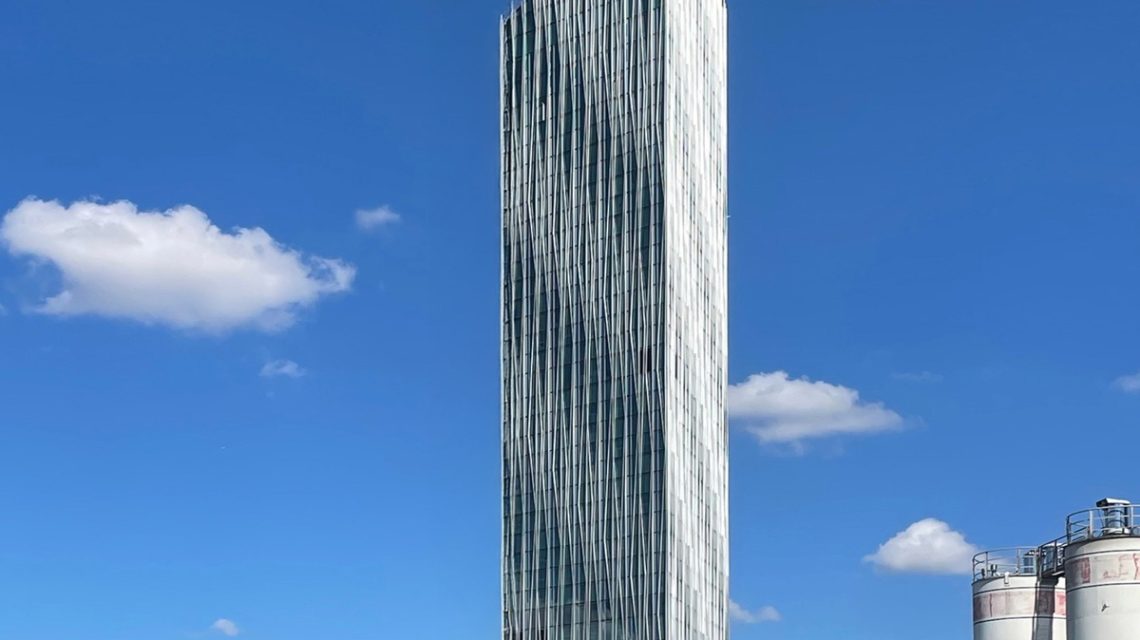
Berlin will soon achieve a significant milestone in its architectural landscape with the completion of the Estrel Tower. Standing tall at 577 feet (176 meters), it will become the German capital’s tallest nontechnical structure and its first true skyscraper. According to the Council on Vertical Urbanism, skyscrapers typically rise above 150 meters (around 492 feet), placing the Estrel Tower as Berlin’s inaugural addition in this category.
Scheduled for public opening by late 2026, the tower will offer a mix of hotel accommodations, workspace, a gallery, a restaurant, and a bar. Designers envision it as a new urban hub in the Neukölln district. This project, designed by the Berlin-based architecture firm Barkow Leibinger, departs from the city’s tradition of low-rise development and strict height regulations.
Sustainability vs. New Construction
The completion of Berlin’s tallest tower comes amid discussions about the construction of new buildings versus adapting and reusing existing ones. Adapting older structures is seen as a way to retain embedded carbon and extend their lifespan.
Gordon Gill, the architect of the Jeddah Tower, the future tallest in the world, shared with Newsweek that significant opportunities for architectural innovation exist in increasing the sustainability and efficiency of current buildings. Other architects have raised concerns that Germany might lose part of its historic character if it favors demolition over preservation.
Frank Barkow, founder of Barkow Leibinger, argues that carefully designed tall buildings can contribute to a sustainable urban future. While initially larger carbon footprints, high-risk constructions offer long-term benefits like compact development and efficient land use. They can accommodate numerous functions within a single structure.
A Beacon in Berlin’s Urban Landscape
The Estrel Tower was envisioned not as part of a skyscraper cluster but as a unique landmark. “Berlin has traditionally followed a 22-meter cornice height, except for church spires,” said Barkow. He explained that this tower was designed as a solitary structure among lower buildings, echoing historical city contexts.
Unlike cities like New York or Frankfurt, which have entire districts of tall buildings, the Estrel Tower is intended to serve as a unique landmark. Its location across from the existing Estrel Hotel forms a “new gateway to the city,” according to Barkow, with surrounding lower structures forming an integrated development.
The design incorporates geometric forms, akin to a Tangram puzzle. Freedom from historical neighborhood constraints allowed the team to experiment with shapes like triangles and parallelograms. This resulted in a dynamic composition engaging with the city.
Sustainability and Construction Challenges
The tower features a visually striking façade with metal fins for solar shading, smart glazing, and operable windows. It will incorporate low-carbon energy sources, water-retention systems, and a green roof, aiming for LEED Platinum certification, the top environmental standard from the U.S. Green Building Council.
A significant challenge was logistics. Constructing a building of this scale in Berlin required extensive concrete pouring, including a three-meter-thick foundation slab. Components such as the façade and atrium roof were manufactured off-site, allowing simultaneous construction phases.
Critics suggesting high carbon footprints for tall buildings receive a counter: “Short-term impacts may be substantial, but long-term benefits include greater compactness and energy efficiency than urban sprawl,” Barkow told Newsweek. High-rise structures also offer programmatic flexibility, supporting various uses over time, like hotels, housing, and workspaces, under one roof.
A New Era of Tall Buildings?
Estrel Tower’s true test remains whether it becomes an outlier or the start of a new trend in Berlin’s skyline. Barkow suggests it could be the beginning of a shift toward more skyscrapers in Berlin. “We believe it sets a precedent,” he said, advocating for diversity and mixed-use development in Berlin’s future.
“Berlin can balance height with its historical scale,” added Barkow. “That balance represents the future of the city.”
Do you have an architectural or design story to share? Let us know via [email protected], and your story could be featured by Newsweek.
 A Family’s Journey Through Cancer and Loss
  The Unlikely Intrigue of a 1990 NBA Trading Card
  Celebrating Day of the Dead: Students Craft Calaveras in Pilsen
  Family Conflict over Sentimental Necklace
  Cindy Crawford’s Son Presley Gerber Dies at 27
  Navy Veteran Generald Wilson Reflects on Emotional National Anthem Performance