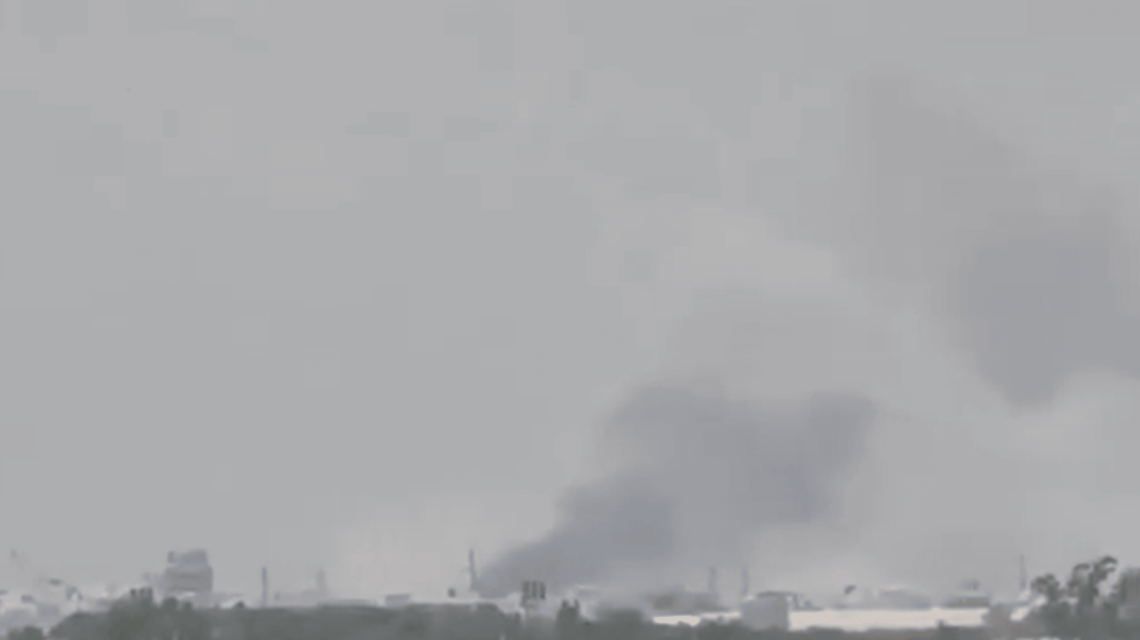
The United States has initiated military strikes on various sites in Iran, a move that has triggered retaliatory attacks and heightened fears of resumed hostilities in the Middle East. This situation has disrupted the truce between Washington and Tehran.
Retired U.S. Vice Admiral Robert Murrett told Newsweek that the new phase in U.S.-Iran conflict marks a significant change in relations between the two nations. Over recent days, the U.S. military’s Central Command reported targeting Iran’s coastal defense systems, missile and drone sites, and maritime capabilities. These strikes, acknowledged by Tehran, have not included any damage assessments from Iran.
The Strait of Hormuz has resurfaced as a focal point of tension. Iranian sites along this strategic passage could be central to an escalation of further military actions. Footage shared online depicted explosions in Bushehr, Iran on July 14, 2026, reflecting the intensifying situation. Reports also noted explosions in Bandar Abbas, another southern Iranian city, with Iran threatening retaliation against American military sites in the region, putting nations like Bahrain, Jordan, Kuwait, and Oman at risk.
The Islamic Revolutionary Guard Corps (IRGC) announced on Tuesday that it targeted sites in Bahrain and Jordan, alongside three tankers navigating the strait—a crucial conduit for one-fifth of the world’s oil and gas. Murrett explained they chose targets strategically to avoid direct U.S. casualties, but noted this might not be a limiting factor for IRGC actions.
Attacks involving the ships Mombasa and Al Bahiyah, affiliated with the United Arab Emirates, resulted in one fatality and eight injuries. The UAE defense ministry has signaled potential retaliation and is now engaged in discussions with the Pentagon.
Bahrain’s Ministry of Interior issued multiple warnings for residents to shelter due to IRGC’s targeted strikes on weapon depots, satellite communication hubs, and facilities housing U.S. forces and radar installations. Jordan reported intercepting multiple missile threats from Iran, as reported by the Associated Press.
Recent tensions have effectively nullified the Memorandum of Understanding (MOU) from June 17, aimed at reopening the Strait of Hormuz post-closures by Iran and the U.S. Iranian officials, spurred by the death of Ali Khamenei and other leaders, urge for the MOU’s termination and advocate for continued retaliation. The Iranian parliament is assessing negotiations with the U.S. while supporting sovereignty exercises over the Strait of Hormuz.
President Donald Trump has declared the reimposition of a blockade on Iranian ports, enforced by U.S. Central Command, scheduled for Tuesday afternoon. Trump also suggested charges for safe passage through the strait, challenging Iran’s prior toll attempts.
In parallel, Iranian-influenced Houthi forces in Yemen could become embroiled in broader conflict as they launched missile and drone attacks on the Abha airport in Saudi Arabia. This activity disrupts the post-2022 truce following a prolonged conflict involving northern Yemen’s Tehran-aligned leadership and persuasive Arab nations.
Vice Admiral Murrett noted Saudi Arabia has efficiently managed tensions with Iran compared to other Gulf countries. However, the recent targeting of Sanaa highlights continuing unresolved conflicts with Yemen.
Trump has raised the prospect of targeting Iranian infrastructure, emphasizing military sites around the Strait of Hormuz but not civilian facilities. U.S. Central Command confirmed strike actions against Iranian defense systems, communication networks, radar sites, and missile capabilities.
However, any threats against civilian installations such as desalination plants face criticism, as they fall under civilian protection outlined by the Geneva Conventions, unless exclusively linked to military supply.
“The electric plants where they make their electricity—we will, if we have to, take them out,” expressed Trump, showcasing potential U.S. escalation steps. He emphasized restraint, in compliance with international humanitarian law.
Legal experts warn that targeting civilian infrastructure could violate international law unless solely linked to military usage.
 Haitian Community in Maryland Faces Uncertainty After TPS Ends
  Strait of Hormuz Deal Near Amid Tensions
  Trump Warns Iran of Strong U.S. Response if Talks Fail
  Taiwan Launches Significant Military Drills Amid Rising Tensions
  Deadly Russian Missile Strikes in Kyiv Region
  Ongoing Strife in Gaza: Challenges and Stakeholders’ Responses