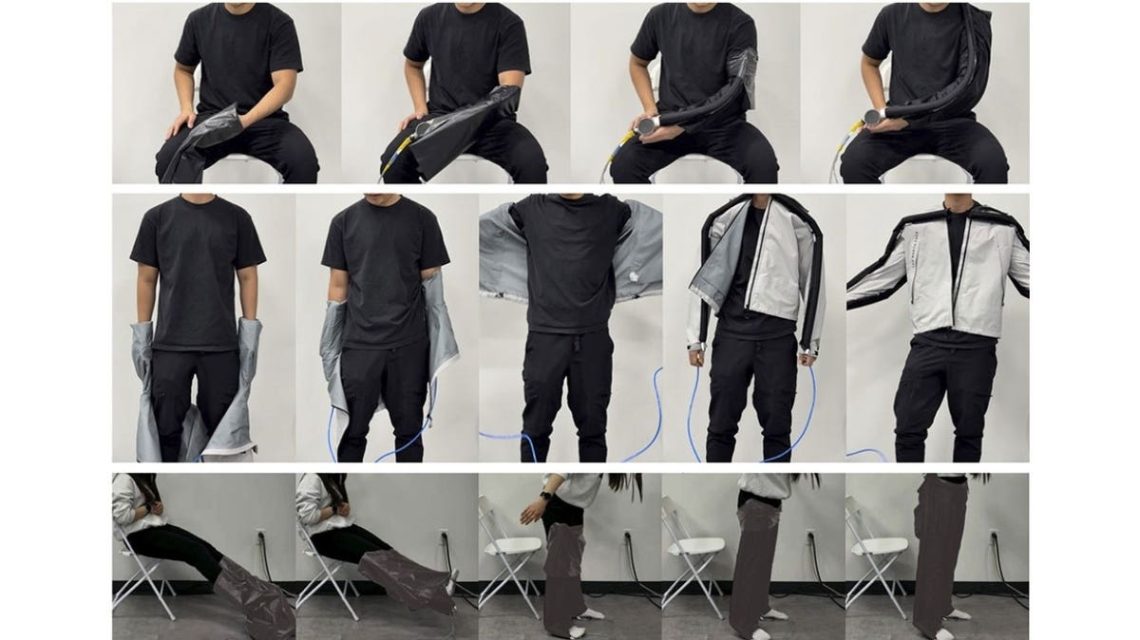
Most people put on clothes daily without much thought. But those with limited mobility can find this task challenging. This issue has led to an innovative development by researchers from South Korea’s KAIST and Stanford University.
Revolutionary Self-Dressing Clothes
They have designed clothes with air-powered robots integrated into the fabric. When activated, these clothes guide themselves onto the body, adjusting to the wearer’s movements. Although the technology is still in early research, it holds promise for allowing older adults to get dressed with less help, supporting their independence.
The Technology Behind the Innovation
This system, named SWAG (Self-Wearing Adaptive Garment), avoids using large robotic arms. Instead, it incorporates soft robotic tubes into the clothing. Increased air pressure causes these tubes to grow and move along the body. This movement inverts the clothing, allowing it to glide over skin with reduced friction.
This method helps the garment follow body curves easily. For example, a jacket takes about 13 seconds to move into place, while pants take around 21 seconds. The goal is to simplify the necessary hardware and avoid complex control systems.
Potential Uses and Benefits
The primary beneficiaries of this technology are older adults and those with disabilities. It could also assist patients needing rehabilitation or may have industrial applications. In cleanroom environments or emergency scenarios, such garments could ensure swift and minimal-effort dressing.
Challenges and Future Directions
The prototype relies on a pneumatic base station. Researchers need to create solutions for variable body shapes, portability, and garment maintenance. Future models might include adjustable sheaths for fitting diverse body types. Critical clinical trials are essential to ensure the products are comfortable and effective.
Some questions remain, such as the garment’s removal process. Developing a convenient way to take clothes off is a key area for further research.
Implications for Independence
This innovation hints at a future where assistive technology enhances daily life. For those with limited mobility, self-dressing clothes could mean more privacy and independence. These clothes could postpone the need for assistance solely for dressing, though dependability and affordability remain factors for widespread adoption.
Ultimately, the success of this technology will rely on its practical testing, adaptability, and user comfort.
 Urban Innovations: New City Concepts
  AI and Human Control: A Turning Point
  OpenAI’s AI Agents and the Growing Call for Regulation
  Scaling Generative AI and Overcoming Operational Challenges: Insights from the AI Impact Forum
  Debate Over OpenAI’s Solution to Navier-Stokes Equations
  Florida Startup Develops AI Bot to Reduce Construction Dispute Costs