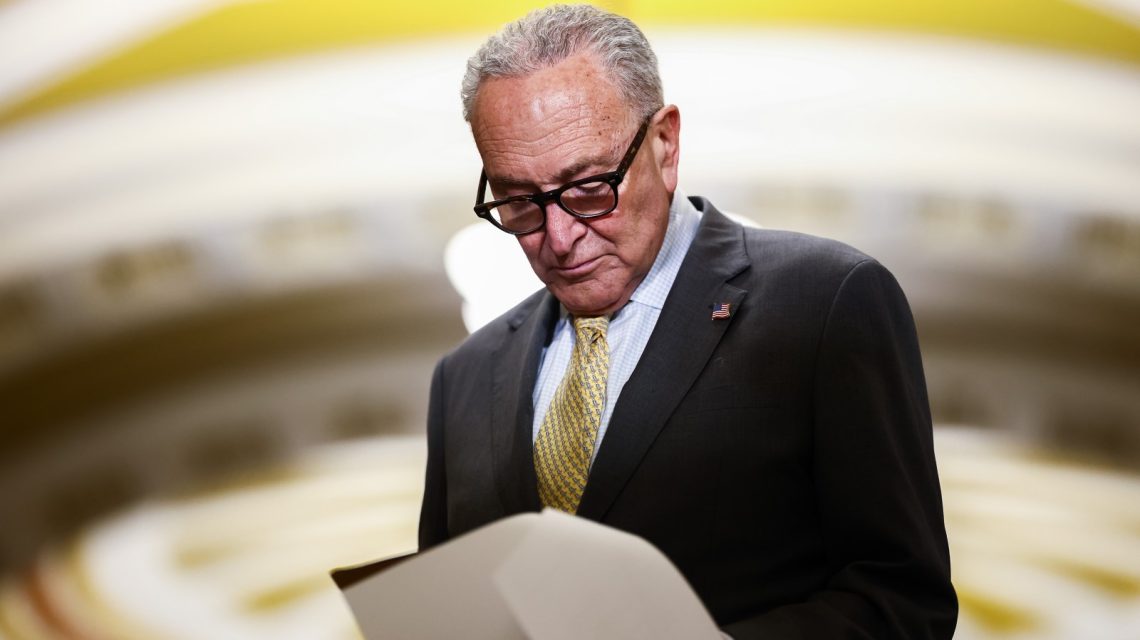
Last week, Senate Democrats met privately for two hours to plan their response to possible election interference by the Trump administration during the upcoming midterm elections. Led by Senate Minority Leader Chuck Schumer from New York, the group held tabletop exercises to consider scenarios that might impact the vote.
These scenarios included AI-generated videos meant to spread false information during and after Election Day, and the potential presence of National Guard troops or immigration agents near voting sites. “We have to prepare,” Schumer stated in an MS NOW interview, emphasizing the importance of preparedness to prevent illegal actions.
Persisting in his denial of his 2020 election defeat to Joe Biden, Trump inspired his supporters to storm the U.S. Capitol on January 6, 2021, attempting to stop the election’s certification. Schumer’s office noted that Trump’s recent comments on election integrity triggered the latest exercise, marking the second such session this year.
Participating in the exercises was Marc Elias, a seasoned Democratic election attorney, who clarified their intent was not to incite fear but to prepare for potential threats following Trump’s 2020 actions. Elias remarked on Trump’s past lies and instigation of violence, asserting the need to seriously consider these risks in anticipation of the 2026 midterm elections.
One exercise scenario considered the response of local authorities if federal immigration agents were stationed close to voting locations in states like Texas. “Our approach involves collaborating with local police departments in cities such as Houston, Dallas, and San Antonio to preemptively address this,” Schumer explained.
A joint statement from the Democratic Governors Association, with 24 Democratic governors including Kentucky’s Andy Beshear and Michigan’s Gretchen Whitmer, responded to Trump’s remarks. “It’s deeply alarming that President Trump continues to try to undermine free and fair elections,” they stated, adding that lies and conspiracy theories cannot overshadow the security of the nation’s elections.
Democratic officials highlight that, under the U.S. Constitution, states are responsible for organizing federal elections. Rick Hasen, a UCLA law professor, noted that a president legally lacks the power to cancel or delay federally scheduled elections. Nonetheless, pressure on state officials to manipulate election outcomes remains a concern.
An incident in January 2021 involved Trump urging Georgia Secretary of State Brad Raffensperger to “find” additional votes to reverse his defeat in Georgia. Various officials have also raised concerns about deploying National Guard or immigration officers near polling places, an action not ruled out by multiple Trump administration officials.
Ari Mittleman of Keep Our Republic, a bipartisan group focused on election integrity, commented on these potential threats, although not participating in the Senate exercises. “Confusion, potential litigation, delays in certification, or undermining public trust represent realistic threats,” Mittleman shared.
American elections are controlled locally, each jurisdiction runs its own process. Altering official outcomes would require overcoming many independent safeguards, including local election personnel, paper records, audits, and state certification procedures. Delay might involve fewer participants but would likely prompt rapid, extensive litigation.
Mittleman remains confident in local officials’ professionalism despite unprecedented circumstances. “Guardrails are real but rely on courts’ actions, officials’ compliance with laws, and politicians’ refusal to promote baseless claims,” he emphasized.
Barbara McQuade, a law professor at the University of Michigan, views voter suppression as a more significant threat than fraud. “Voter suppression, using rhetoric, lawsuits, and pressure to change voting rules, is the most probable risk,” McQuade explained, targeting Democratic voters like students, minorities, and women.
Achieving actual voting changes is difficult due to state and local administration. McQuade noted that interference is challenging without the SAVE Act, which mandates national proof-of-citizenship requirements. Nonetheless, rhetoric might erode trust in electoral processes.
According to a Yahoo News and YouGov poll, only 23% of Americans are confident the midterms won’t be “rigged.” Meanwhile, 33% hold the belief the vote will be rigged and 44% remain uncertain.
A separate survey by NPR, PBS News, and Marist shows declining faith in fair elections, down to 66% confidence from 76% in October 2024. Concerns of voter fraud, misinformation, and voter suppression are prominent among respondents.
Americans favor state over federal control in election administration. A YouGov and CBS News poll indicated 71% of respondents believe states should oversee elections, instead of federal involvement.
States United Action, a nonaligned group monitoring candidates denying the 2020 election results, reported over 50 such candidates seeking statewide office in two dozen states. “The election denial movement, starting in 2020, is stronger than ever, backed by the White House and federal entities,” said Joanna Lydgate, expressing concerns regarding attempts to govern state offices crucial for election oversight.
 Controversy Surrounds ‘Pod Save America’ Over Deleted Clip
  New York Judge Halts Controversial Tax Rollout by NYC Mayor
  Massachusetts Expands Abortion Access With New Legislation
  Abdul El-Sayed Criticizes U.S. Sports Culture and Traditional Masculinity
  North Carolina GOP Names Jennifer Balkcom for House Race After Edwards’ Withdrawal
  Indiana State Senate Recount Alters Primary Outcome in GOP Contest