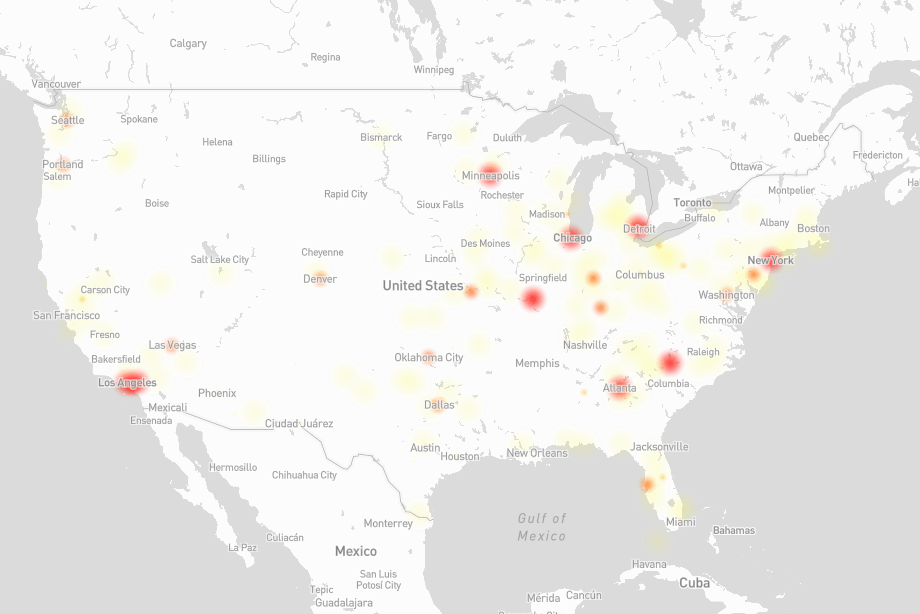
On Monday, T-Mobile and Verizon users reported widespread mobile service disruptions. Many customers received SOS messages, indicating a loss of service. By 8:40 p.m. ET, the number of reports had dropped to under 7,000, a significant decrease from more than 60,000 reported to DownDetector at 5:06 p.m. ET. The most complaints came from areas including New York City, Columbia, South Carolina, Springfield, Ohio, Chicago, Detroit, and Minneapolis.
Verizon users also experienced service issues, although to a lesser extent than T-Mobile. Verizon stated on social media that their network was functioning normally and suggested that users experiencing difficulties might be affected by T-Mobile’s outage. AT&T users submitted reports of problems as well, but these declined as quickly as they appeared. T-Mobile responded by saying, “Our teams are actively working on the reports of technical challenges impacting some customers.” Their statement highlighted the importance they place on connectivity.
“Our highest priority is resolving the service impacts,” T-Mobile added.
Newsweek sought comments from T-Mobile and Verizon but had not received responses by the time of publication.
Understanding SOS Signals
When an iPhone shows “SOS” or “SOS Only,” it indicates that the phone is disconnected from its usual cellular network. In this mode, users can still make emergency calls via another carrier. This feature ensures that emergency services, such as 911, can be reached even if regular network service is lost. The alert can appear in areas with poor reception, due to network outages, or when facing issues with SIM cards or network settings. Typically, regular calls, texts, and data usage are unavailable until reconnection occurs.
Outage Patterns and Maps
Maps provided by DownDetector illustrated major cities suffering significant service outages. Comments on the website reported issues in areas including Seattle, West Sacramento, California, Irvine, California, Albuquerque, Orlando, and St. Louis. Similar maps for Verizon displayed clusters of problems, with scattered complaints over the past day.
DownDetector indicates a potential service interruption when complaint volumes far exceed the norm. This points to a disruption rather than typical activity fluctuations.
Expert Analysis
Roger Entner, an analyst and founder at Recon Analytics, suggested that such widespread outages often indicate a core network issue. Localized outages would not affect such a broad area. Entner posited the cause could have been network upgrades that spread issues throughout the system.
“Initial efforts by T-Mobile engineers would involve identifying changes and stopping them from spreading,” Entner said. “These networks are mainly software now, similar to our computers, and rollbacks of changes are possible.”
Entner noted that from a consumer perspective, differentiating between a local and core outage can be challenging, as the result is often the same: lack of connectivity. Outages, although rare, affect every carrier periodically.
“Outages occur infrequently at every carrier,” Entner stated. “They happen every few years, but they are not common.”
 First Lady Melania Trump’s AI Education Push Amid Concerns
  Expansion of Data Centers Fueled by AI Development
  Beijing’s Tactical Undermining of U.S. Supremacy Through AI
  Controversy Surrounds Automated License Plate Readers Across the U.S.
  Trump and Harp Sued Over Truth Social Subscriber Program
  Implications of AI in College Admissions