
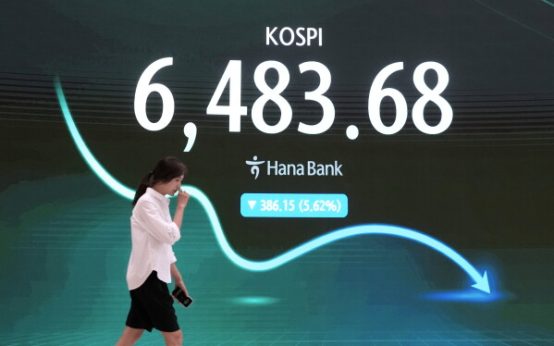
South Korea’s Kospi index experienced an unprecedented surge on Friday, rising nearly 18% due to gains on Wall Street. This leap followed a resurgence in artificial intelligence-related stocks. U.S. futures went up by 0.5%, while oil prices saw a decline of over 1%.
The Kospi opened with significant momentum before stabilizing. It ended the day with a remarkable increase of 17.9%, reaching 6,695.45. This marks the largest single-day gain on record. Key players like Samsung Electronics saw a 28% rise in shares, and SK Hynix’s shares soared by 30%.
Despite Friday’s surge, the Kospi remains below its June peak of over 9,000. In the past three days, the index had dropped more than 17%, primarily due to a sell-off in technology stocks driven by concerns over an AI bubble and stiff competition from Chinese companies in the chipmaking sector. Historically, the previous record single-day gain was close to 12% during the global financial crisis in October 2008.
This rally also followed Microsoft’s report of better-than-expected profits for the last quarter, signaling that heavy investments in AI are yielding returns. Microsoft’s shares saw their best day in nearly 18 years with a 15.5% jump. This drove traders to re-enter the market, seeking tech stocks that had recently dipped.
In European trading on Friday, Germany’s DAX rose by 1% to 25,870.09, Paris’ CAC 40 climbed by 1% to 8,570.48, and Britain’s FTSE increased by 0.8% to 10,983.31. In Asia, Tokyo’s Nikkei 225 jumped 4% to 64,362.02. SoftBank Group saw a 13.8% increase, and Tokyo Electron rose 6.2%.
Stephen Innes of SPI Asset Management commented that the market shifted from dismissing AI stocks to aggressively investing in them. The U.S. dollar recovered after a sharp decline against the Japanese yen, increasing by 0.5% to 160.28 yen. Speculations arose about intervention from Japanese and U.S. regulators following prolonged levels of the dollar over 160 yen.
The Bank of Japan kept interest rates unchanged after their policy meeting. Analysts speculated on possible interventions to curb speculative movements tied to the bank’s decisions. Jonas Golterman of Capital Economics noted the potential for a persistent yen level around 160 this year, with predictions of a significant rebound next year.
The Federal Reserve also maintained its benchmark rate, with interest rate disparities between Japan and the U.S. being a crucial factor in the yen’s depreciation. The euro slightly decreased to $1.1509 from $1.1524.
Taiwan’s Taiex index surged 8%, bolstered by a 10% rise in TSMC. Australia’s S&P/ASX 200 edged up 0.1% to 8,976.80. Hong Kong’s Hang Seng increased by 0.1% to 25,884.83, and the Shanghai Composite index climbed by 0.7% to 3,832.26.
China’s factory activity showed a contraction in July, a first in five months, attributed to weak domestic demand and recent weather events. China’s economy grew at its slowest annual rate in over three years during April-June, at 4.3%. Thursday’s Politburo meeting had minimal effect on the markets without major policy shifts.
Oil prices dropped due to U.S.-Iran tensions affecting the Strait of Hormuz, critical for oil transport. Brent crude, the global standard, fell 1.4% to $85.70 per barrel, and U.S. benchmark crude dropped 1.6% to $82.23 per barrel. ING commodities analysts noted increased oil flows through the Strait, easing supply pressures as tanker crossings slightly rose.
Wall Street reflected positive movements with the S&P 500 increasing by 1.7%, the Dow Jones up by 1.2%, and the Nasdaq composite advancing 2.8% on Thursday.
 Maximize Savings with New Interest Rate Hikes
  Maximizing Returns with Short-Term CDs
  Debate Over Mortgage Accessibility Continues Amid Lender Standards
  Maximize Savings with the Right Interest-Bearing Account
  Wall Street Dips as AI Stocks Decline
  Wall Street Awaits Key Financial Updates from Major Retailers and Fed Meeting Insights