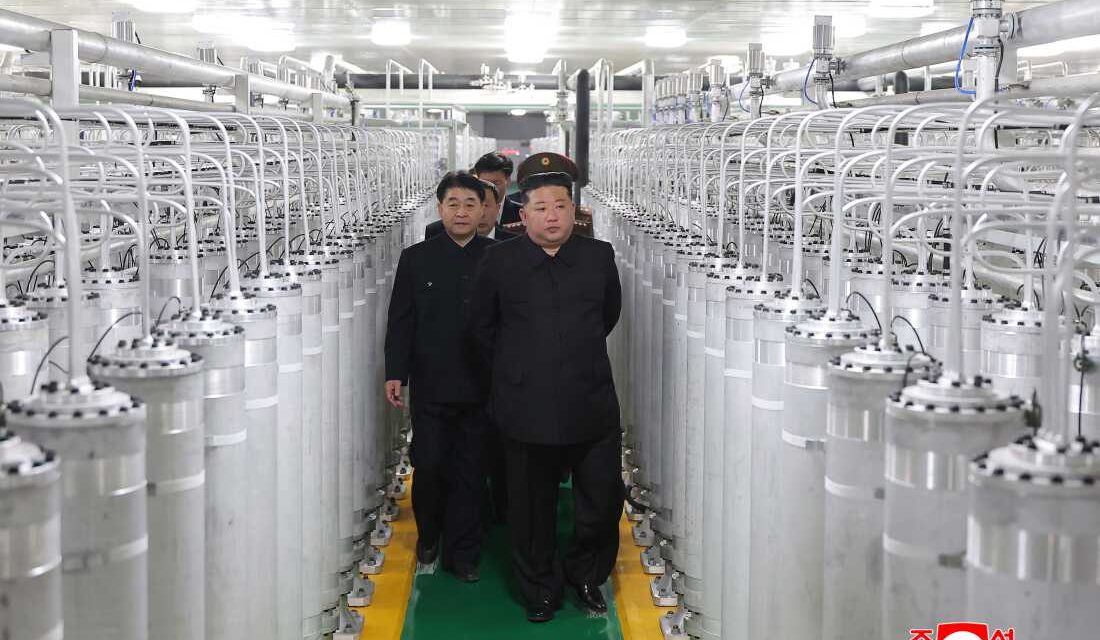
Kim Jong Un, the leader of North Korea, recently visited a facility dedicated to producing nuclear bomb fuels, as documented in a photo released by the North Korean government. The exact location of this facility remains undisclosed, and the content of the image is unverified.
In a policy shift, South Korea is reassessing its goal of complete and immediate denuclearization of North Korea. On July 23, Unification Minister Chung Dong-young announced that the focus will now be on freezing North Korea’s current nuclear program. This approach involves negotiations aimed at halting the production and advancement of nuclear weapons before addressing the dismantlement of the existing arsenal.
This policy change emerges as North Korea strengthens its alliances with Russia and China. On July 25, Ukraine’s President, Volodymyr Zelenskyy, reported that Russia is planning to receive an additional 30,000 North Korean troops to aid its conflict with Ukraine. Meanwhile, international pressure on Pyongyang appears less united. Since reclaiming the U.S. presidency, Donald Trump has referred to North Korea as a “nuclear power,” diverging from previous U.S. policy, although Washington has not formally recognized North Korea as a nuclear state.
China’s stance on denuclearization seems less vocal now. During a visit to Pyongyang in June, President Xi Jinping did not mention denuclearization, differing from China’s typical support for a nuclear-free Korean Peninsula.
North Korea has become more assertive in its stance against denuclearization. In June, Kim Jong Un’s sister, Kim Yo Jong, declared their pursuit of a more powerful nuclear arsenal as an “irreversible final conclusion.” She recently dismissed calls for denuclearization from the ASEAN Regional Forum, asserting that the concept has lost its practical significance.
“The political and military cost for reversing its nuclear program would be too huge for North Korea,” says Lee Ho-ryung, a senior researcher at the Korea Institute for Defense Analyses (KIDA).
Kim Jong Un has embedded North Korea’s nuclear status within its constitution, marking a key achievement that sets him apart from previous leaders, according to Lee. With reduced international sanctions pressure, maintaining nuclear armament is less costly for North Korea.
“The denuclearization-first policy of the past was feasible only with China and Russia’s involvement in sanctions,” says Yang Moo-jin, a professor emeritus at the University of North Korean Studies in Seoul. Reports indicate that China and Russia are allegedly violating UN sanctions by supplying North Korea with refined petroleum and importing its coal, though both countries deny these claims.
North Korea has bolstered its nuclear capabilities. In June, Kim Jong Un claimed a significant increase in North Korea’s production capacity for weapons-grade fissile material. Estimates from the Stockholm International Peace Research Institute suggest the country holds 60 nuclear warheads and possesses enough fissile material to produce at least 30 more.
The expanded arsenal is not limited to quantity alone; North Korea has also diversified its delivery systems, enhancing both naval and tactical capabilities.
Despite South Korea’s pragmatic policy changes, experts remain skeptical about Pyongyang’s willingness to negotiate for peace and stability on the Korean Peninsula. The South Korean administration under Lee Jae Myung hopes to reduce military tensions and eventually persuade the North towards denuclearization.
However, KIDA’s Lee suggests the policy shift is more rhetorical than substantive, unlikely to entice North Korea to engage in talks. Emboldened by a growing partnership with Moscow, North Korea has little incentive to negotiate. Russia has openly supported North Korea’s right to maintain a nuclear arsenal, with Foreign Minister Sergey Lavrov stating that the denuclearization of North Korea “no longer makes any sense.” Russia’s stance has been consistently reflected in international forums, including the recent ASEAN meeting.
 Venezuelan Leadership at the United Nations
  Ontario Synagogue Shooting During Yom Kippur Leaves One Officer and Shooter Injured
  Pope Leo XIV’s Upcoming Visit to Latin America: An Overview
  Ukraine Deploys Ground Robots in ‘Operation Vivaldi’
  Understanding AI’s Impact Compared to Historical Threats
  State Department Alerts on Middle East Travel Amid Rising Tensions