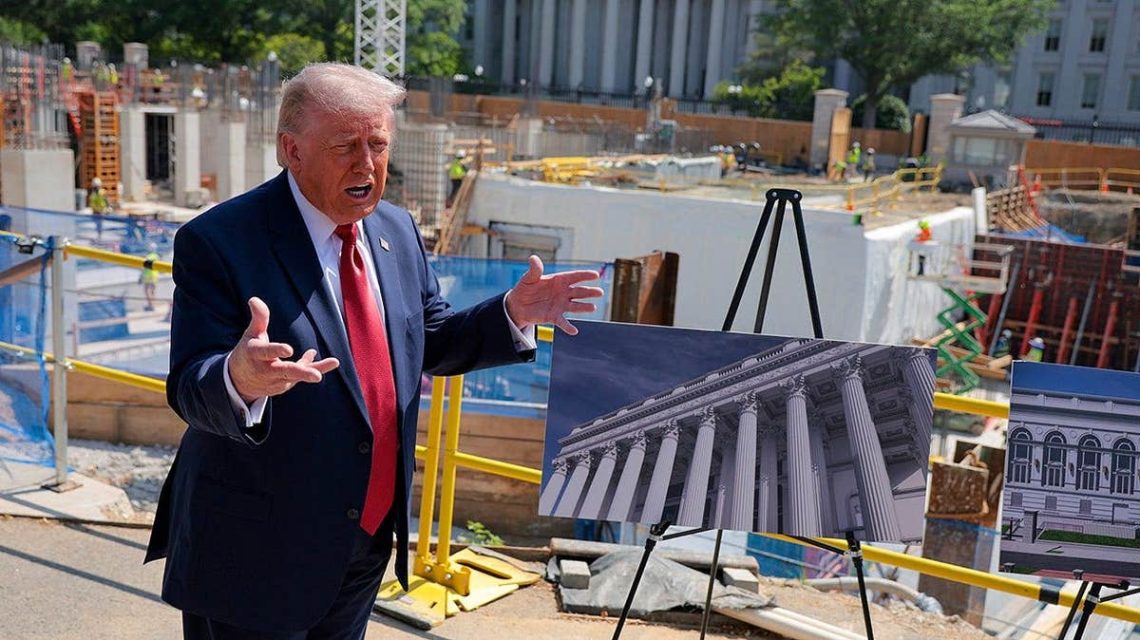
President Donald Trump might succeed in his legal battle over a proposed White House ballroom. Two legal experts suggest the U.S. Supreme Court could resolve the case without addressing the core constitutional issue.
Trump announced on social media his intent to take the dispute to the Supreme Court. This followed a D.C. Circuit court decision upholding a lower court order that blocked the ballroom’s above-ground construction. The 2-1 ruling stated the project requires Congressional approval before proceeding.
Trump cited Judge Neomi Rao’s dissenting opinion as the basis for his appeal. Appointed by Trump, Rao argued the plaintiffs, the National Trust for Historic Preservation, lack the legal standing necessary for the case.
The National Trust anchored its legal standing on Alison Hoagland, a member residing near the White House. Hoagland claims her enjoyment of the President’s Park would diminish due to the ballroom’s design overshadowing the White House.
“The district court elevated the aesthetic displeasure of a passerby over the government’s security interests,” Rao wrote. She emphasized the risks posed by leaving an open construction site at the President’s residence.
Former Justice Department attorney Abhishek Kambli agreed with Rao’s stance. He pointed out that the National Trust must demonstrate that its lawsuit aligns with its interests, despite authority granted by Congress. He added that proving aesthetic injury would be challenging.
“Normally, aesthetic standing requires intention to use the space,” Kambli explained. “Simply passing by doesn’t suffice.” A similar issue arose in a case involving the America 250 UFC event at the White House, where the plaintiffs failed to meet the aesthetic harm standard.
Hans von Spakovsky, a senior legal fellow at Advancing American Freedom, expects Trump to win on appeal. “A mere passerby claiming aesthetic injury lacks actual injury under Supreme Court precedent,” he noted.
Experts believe the Supreme Court might dismiss the case based on the lack of standing, avoiding a ruling on the administration’s authority to build the ballroom. Von Spakovsky suggested Congress might have standing, but partisan divides make this unlikely.
The National Trust argues that federal law mandates Congressional approval for new federal construction in Washington, D.C. Conversely, the administration claims existing law grants the president authority to alter and improve federal properties. Kambli concurs with Rao, stating terms like “alteration” and “improvement” reflect real-property language.
“An extension or alteration isn’t a new property but rather an improvement,” Kambli clarified. “The statutory authority logically supports this interpretation.”
Elaine Mallon contributes to Fox News Digital, focusing on national politics.
 Federal Appeals Court Decision Against Trump’s ‘Third-Country’ Deportation Policy
  President Trump’s Controversial Ban on Media Outlets Sparks Press Freedom Concerns
  U.S. Security Agreement in Greenland Sparks Optimism and Concerns
  Cook County’s Property Tax Bridge Loans
  A Controversial Stance on Immigration Policies Sparks Debate in South Carolina
  Trump Administration Challenges In-State Tuition for Undocumented Students