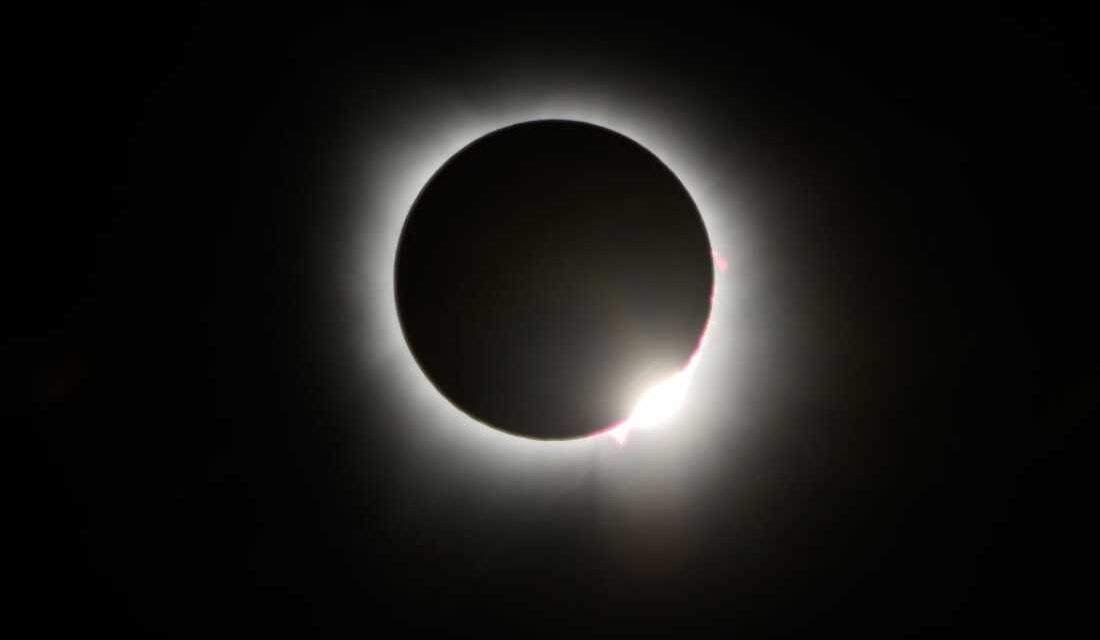
On April 8, 2024, a total solar eclipse will be observed at Lake Monroe, Indiana. Edward M. Pio Roda captured this moment for Getty Images. Europe and parts of the U.S. will have the chance to witness a solar eclipse on Wednesday.
According to astronomers, Iceland, Greenland, northern Russia, Spain, and parts of Portugal will experience a total eclipse. This occurs when the Moon fully obscures the Sun by passing between the Earth and the Sun. NASA reports that northern U.S regions, including areas from Alaska to North Carolina, will see a partial solar eclipse.
During a partial eclipse, the alignment of celestial bodies causes only segments of the Sun to be covered. This results in a crescent appearance of the Sun. In Washington, D.C., the partial eclipse will start around 1:17 p.m. ET, with the Moon covering up to 4% of the Sun, according to NASA.
In Reykjavík, Iceland, the total eclipse will start at 5:48 p.m. local time. In León, Spain, totality will begin at 8:28 p.m. and last for two minutes. The European Space Agency notes this is the first solar eclipse visible from mainland Spain since 1905.
Safety Precautions
Observers of both total and partial eclipses require special gear for eye protection. Eclipse glasses or handheld viewers with special filters are necessary. Regular sunglasses offer no protection against eye damage during an eclipse. The American Academy of Ophthalmology warns that staring at the Sun even briefly can lead to severe eye injuries, including permanent vision impairment.
Scientific Research Opportunities
While the eclipse allows the public to observe this rare event safely, scientists will seize this chance to research the Sun further. NASA plans to deploy scientific balloons and a high-altitude jet to study atmospheric impacts when the sky darkens momentarily.
From our unique perspective on Earth during a total solar eclipse, scientists can study the Sun’s corona in a way we can’t from anywhere else in the solar system,stated Kelly Korreck, NASA’s eclipse program manager.
The forthcoming partial solar eclipse in the U.S. will occur on August 2, 2027, with totality visible in Spain, the Middle East, and parts of North Africa. A total solar eclipse will be visible across parts of the contiguous U.S. on August 23, 2044.
 NASA Collaborates with Boeing to Launch Unpiloted Starliner Test
  Winter Weather Forecasts for 2026-2027
  Underwater Discoveries: Exploring the Lost Town of Shipden
  Virginia Tech Researchers Investigate Black Bear Hibernation
  Significant Viking Age Silver Hoard Discovered in Finland
  Dogs Use Similar Language Recognition Techniques as Human Infants