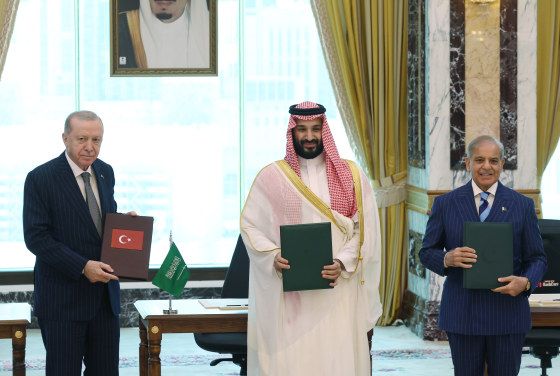
The recent signing of a trilateral defense agreement between Saudi Arabia, Turkey, and Pakistan has garnered significant attention. Despite its collective-defense provision, defense analysts in Islamabad urge against equating this agreement with NATO.
On August 7, Turkish President Recep Tayyip Erdogan, Saudi Crown Prince Mohammed bin Salman, and Pakistani Prime Minister Shehbaz Sharif convened in Mecca, Saudi Arabia, to sign the landmark Mecca Joint Defense Agreement. This was done as the three nations aim to enhance security cooperation amidst increased tensions with the United States and Iran.
Pakistan’s Foreign Minister, Ishaq Dar, clarified that the agreement is not targeted at any country. It remains open to other nations that wish to join, provided they support its principles and seek peaceful conflict resolution. According to Dar, the deal reflects a mutual intention to boost strategic security cooperation.
The Foreign Minister’s remarks, shared on the platform X, were echoed by Turkish Foreign Minister Hakan Fidan, who also emphasized that the agreement is not aimed at Iran or any other country.
The agreement includes a condition stating, “Any armed attack against one of the three states will be seen as an attack against all.” This aligns with Article 51 of the U.N. Charter, which upholds the right to individual and collective self-defense.
Dar stated that Pakistan will continue engaging with regional countries to promote lasting peace and stability. He assured that the Mecca Accord does not override existing agreements between these states or with other countries.
Following the agreement’s signing, public celebrations took place overnight, with landmarks in Islamabad and Saudi cities illuminated in the flags’ colors of the three countries.
Each nation involved brings unique strengths to the partnership. Pakistan provides significant military experience and is the only nuclear-powered country in the Muslim world. Saudi Arabia contributes substantial economic resources and regional influence, while Turkey, a NATO member, offers a sizable military force and an advanced domestic defense industry.
Defense analyst Abdullah Khan advised caution when interpreting the agreement as equivalent to NATO. Although signed amid regional tension, it should not be considered against Iran or others. Pakistan’s military relationship with Saudi Arabia spans decades, marked by a mutual-defense agreement signed in September 2025. Pakistan and Turkey have also expanded military cooperation recently.
 AI Concerns and International Relations: Bill Gates Urges Oversight Amidst Global Summit
  Europe’s Modern Warfare Preparedness and Democratic Stability
  Federal Appeals Court Decision Against Trump’s ‘Third-Country’ Deportation Policy
  Ed Sheeran’s Philadelphia Concert Amid Controversy
  U.S. Secures Strategic Control Over Greenland
  U.S. Security Agreement in Greenland Sparks Optimism and Concerns