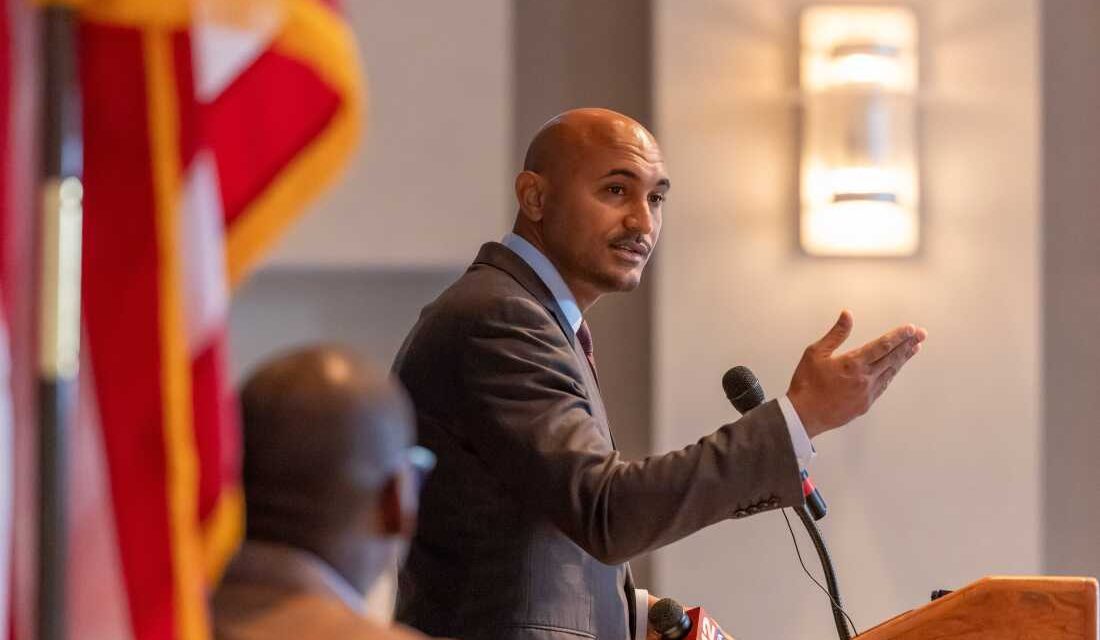
HOPE HULL, Ala. — Willie Dixon and Mary Gatson were in the fellowship hall of Beulah Primitive Baptist Church in Lowndes County. They awaited a Congressional town hall, discussing last-minute changes in Alabama’s voting landscape. “Create enough chaos, and people will give up and go home,” Dixon predicted.
Today, voters in parts of Alabama head to the polls for the second time this primary season. The U.S. Supreme Court ruled against drawing district lines based on race, dismantling a key section of the 1965 Voting Rights Act. Afterward, Alabama rushed to redistrict before the mid-term elections, aiming to consolidate Republican power.
Less than two weeks before the May primary, Alabama’s Republican-controlled legislature reconfigured four of the state’s seven districts. This reshaping impacted a largely-Black district drawn in response to prior court rulings.
Dixon and Gatson came to hear Alabama’s two Black members of Congress speak at a local church. They worried confusion about congressional boundaries and primary dates might discourage Black voters.
Dixon thought she was in the same district until Gatson informed her of the change. Anyone who voted in the first primary had their votes voided. “With these two primaries coming close, some will not show up because they think they’ve already done it,” Dixon said.
Lowndes County is in Alabama’s rural Black Belt, known for its rich soil. Dixon and Gatson fear the changes will disperse and discourage Black voters, typically voting Democratic. “I think it’s inappropriate,” Gatson remarked. Dixon added, “That’s not fair.” Historical struggles for representation continue.
Democratic Rep. Terri Sewell spoke about fair representation, stating, “It’s unacceptable to live in an era where states can redraw maps even if it discriminates against minorities.” Black people comprise over a quarter of Alabama’s population. The state’s Congressional delegation includes two Black Democrats, with the remaining five as white Republicans.
The new map poses challenges for Rep. Shomari Figures. Elected first in 2024, Figures secured a district with mostly Black cities like Mobile and Montgomery after federal courts mandated redistricting. His hometown Mobile is no longer part of the district. “While portrayed as a lost cause, the seat was never majority Black,” Figures stated. He remains confident in his record and representation.
Republican Opportunity
Hampton Harris was initially the only Republican candidate for Alabama’s 2nd Congressional District. Redrawn maps prompted five additional Republican challengers. “Running in essentially half the state caused confusion,” Harris noted.
Concerns about voter turnout extend beyond political confusion, reaching into practical considerations. “It’s really going to play into voter turnout,” said Harris, considering the August heat.
At a Republican Party event, candidate Joshua McKee and local officials welcomed the new map. Barbour County Commission President Jerry McGilvray expressed relief over separation from Mobile. “Whoever thought we had anything in common with Mobile, Alabama?”
Barbour County is part of Alabama’s wiregrass region, aligned with rural interests. McGilvray worried about voter apathy, especially with state Democrats urging their voters to influence Republican primaries.
The frontrunner in the 2nd Congressional District is state Rep. Rhett Marques, supported by President Trump and Alabama Senators. After redistricting, Marques switched from the 1st to the 2nd district. “The Republicans regaining the seat is great for Alabama and Congress control,” he claimed.
 Biden Administration’s Role in Gaza Examined
  Oregon’s Wildfire Crisis Calls for New Solutions
  The U.S. DOGE Service and Government Dysfunction
  Selective Accountability in Education Raises Concerns
  Democratic Candidates Bring Faith to Their Congressional Campaigns
  Republicans Face Challenges in Upcoming Midterm Elections