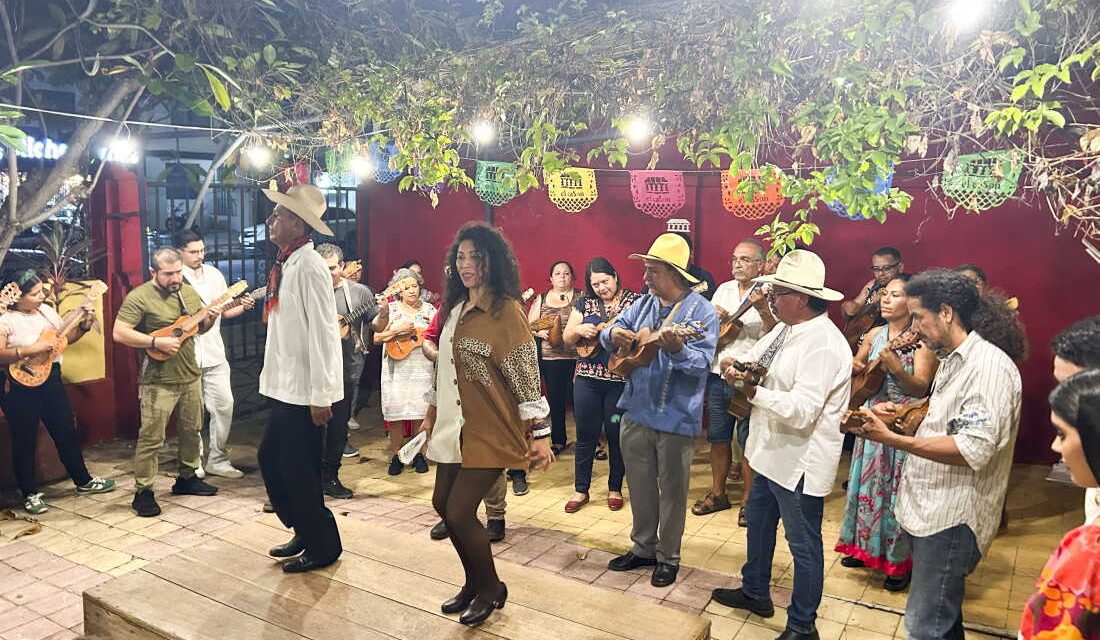
Veracruz is a historic city on the Gulf of Mexico, celebrated for its rich musical tradition. Every hour, the central plaza’s clock tower plays the original “La Bamba,” not the rock hit by Ritchie Valens, but the version rooted in Veracruz’s heritage. Renowned as the hymn of the region, “La Bamba” is a prominent song in the son jarocho genre, played during vibrant community festivals known as fandangos.
The fandango is a cultural fiesta born from the diverse mix of European, Caribbean, and Indigenous influences along the Gulf Coast. Its origins trace back to the early 1500s when Hernán Cortés established Veracruz as Mexico’s first port. This lively music and dance tradition has been celebrated for over 300 years, and while its popularity is now global, the authentic experience remains in Veracruz.
On a Saturday night in August, the heat lingers as couples dance on a wooden platform. A woman’s floral dress flares as her heels pound, accompanied by a man in a jarocho straw hat and sweat-soaked tropical shirt. Nearby, a musician plays a quijada, a donkey’s jawbone, producing rhythmic rattles that enhance the scene. As the night progresses, the audience joins the musicians, transforming the event into a mass jam session with players strumming the local eight-string guitar known as a jarana. “La Bamba” becomes an extended performance, echoing for 15 minutes.
Grammy-winning jarocho musician and luthier, Tacho Utrera, notes that in Tlacotalpan, fandangos can feature 80 musicians and last for hours. Despite a decline in the 60s and 70s, when son jarocho was viewed as low-brow, the genre has revitalized, driven by a search for authenticity and soul. Gilberto Gutierrez, a prominent figure in son jarocho, recalled its days as family gatherings, perceived as the music of “drunken people.” Now, son jarocho flourishes globally, heard across Mexico, Argentina, Europe, Asia, and major U.S. cities.
Every weekend in Veracruz, fandangos celebrate life’s occasions, hosted by the caSon Cultural Center, founded by Gutierrez. He emphasizes the sense of community among musicians, dancers, singers, and cooks who make these events possible, saying humanity craves belonging. The zapateo, a type of tap dancing, is crucial for keeping rhythm. Ada Veronica, a seasoned dancer, explains that stepping onto the wooden taríma requires skill and respect.
Classes teaching jarocho music and dance at El caSon are popular, attracting young Mexicans alongside other modern genres. Paloma Rizo, an amateur jarana player, describes the fandango as an experience that beckons participation. The essence of these gatherings is captured in the term convivencia, a concept meaning to coexist or live together actively.
 Maren Morris Reflects on Healing Journey and Career
  Exploring Recommended Reads from Diverse Authors
  Digital Divide: America’s Two Economies
  Rose Friedman: A Dedicated NPR Journalist Remembered
  Notable Lost Stories and Objects
  Fat Bear Week: Celebrating Resilient Giants and Ecosystem Conservation