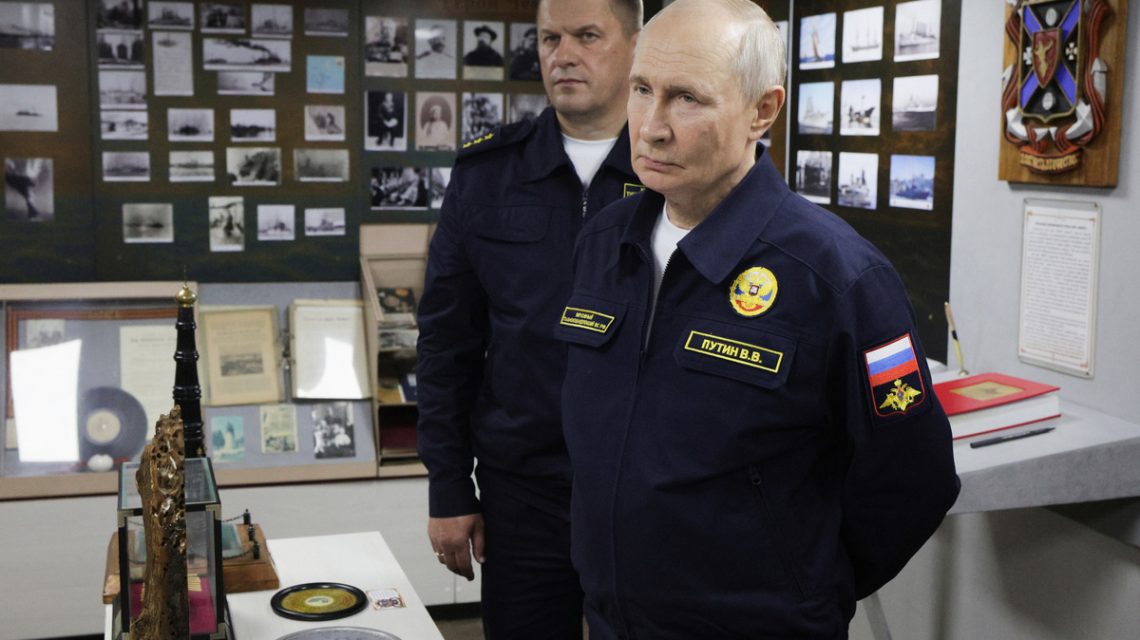
Russian President Vladimir Putin announced on Wednesday that NATO plans to introduce new weapons to the Pacific, posing a potential threat to Russia in the region. According to state media, Putin noted the increasing potential for conflict, stating, “NATO is making inroads here.” He did not specify which weapons were involved, but the shift in focus by the United States, a leading NATO member, towards the Indo-Pacific is part of a response to China’s expanding military.
The United States has made significant deployments in the region. In late March, it stationed advanced F-35 fighter jets permanently in northern Japan, marking a first for the area. These jets can utilize some of the most sophisticated weapons in the U.S. arsenal. Furthermore, in May, the U.S. conducted test-firing of a long-range missile from the Typhon system in the Philippines. Known as the Mid-Range Capability, this system launches Tomahawk cruise missiles with a range of approximately 1,000 miles, alongside the U.S.’s shorter-range SM-6 missile.
In 2023, other NATO members have also increased their presence in the Pacific. Italy dispatched an air defense ship to the region in early May. Moreover, 30 countries, among them NATO allies, conducted joint exercises with the U.S. Pacific Fleet, which concluded in July.
Despite previous tensions during President Donald Trump’s administration, factors like North Korea’s nuclear and missile program advancements and Russia’s relationship with North Korea have encouraged nations such as Japan and South Korea to escalate their defense spending while maintaining strong ties with the United States.
Putin stated that “new weapons systems that also create threats to our country are being deployed and are planned for deployment here.” However, a NATO spokesperson emphasized to Newsweek that the alliance remains purely defensive and does not pose any threat to Russia.
Putin observed Russia’s Pacific Fleet conducting drills near Yuzhno-Sakhalinsk, Sakhalin Island’s largest city located just north of Japan. Recent defense measures include the deployment of anti-drone nets at the Rybachiy submarine base on the Kamchatka Peninsula, the primary hub for Russia’s Pacific Fleet. This base houses many of Russia’s nuclear submarines experts see at risk from operations similar to Ukraine’s aerial assaults on Russia’s Black Sea naval infrastructure.
Ukraine has demonstrated its offensive capabilities with operations like the “Spiderweb,” which involved remotely detonating drones to damage Russian aircraft. One mission, lasting 18 months, reportedly resulted in damage to 41 Russian aircraft. Recently, President Volodymyr Zelensky confirmed Ukraine’s overnight strike on the Novorossiysk naval base utilizing jet-powered drones, Neptune cruise missiles, and unmanned boats. This base, located over 180 miles from Ukraine’s front lines, is Russia’s last major Black Sea stronghold.
Frequent attacks on the Sevastopol base prompted the Kremlin to reposition its fleet to Novorossiysk, though still within the Black Sea. Moscow annexed Crimea from Ukraine in 2014; Ukraine remains committed to reclaiming the region.
In March 2024, the British Defense Ministry released satellite images showing Russia employing decoys for its Kilo-class submarines at Novorossiysk to reduce the effectiveness of Ukrainian strikes.
 Dutch Euthanasia Case for Child with Disabilities Sparks International Debate
  Heroism Averts Disaster on FlyDubai Flight
  Illegal Immigrant Crimes Stir Policy Debate in Fairfax County
  Emergency Landing of Flydubai Plane Highlights Cockpit Security
  Passengers Prevent Mid-Air Crisis Amid Pilot Stabbing Incident
  Sensitive Discussions During Trump’s National Archives Visit with Xi Jinping