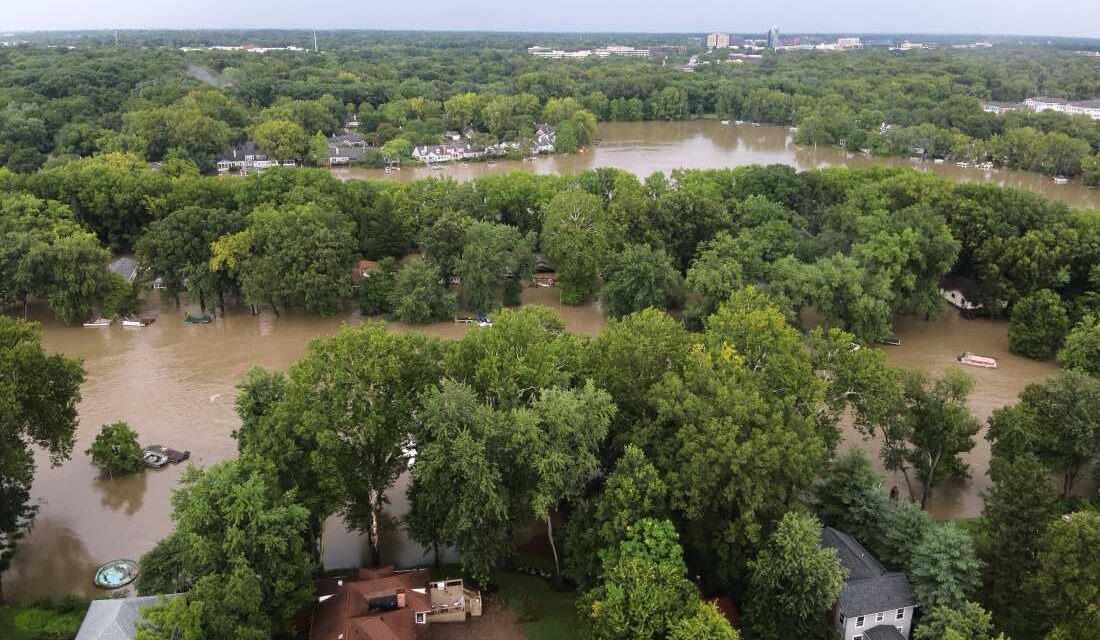
Persistent thunderstorms have unleashed severe flooding across the Midwest, with further heavy rain expected through at least Sunday, according to the National Weather Service (NWS). Regions including the Ohio Valley, Midwest, and central Appalachians are bracing for more precipitation in already waterlogged areas.
As of Saturday afternoon, the extreme weather has claimed three lives and left over 150,000 people without power. Indiana and Ohio bear the brunt, experiencing more than 11 inches of rainfall in some locales over the past week.
The White River in Anderson, Indiana, has reached a historic high of 24.9 feet, overtaking the previous record set in 1913. Flash flood warnings are active in central Illinois and central Indiana, while flood watches extend from Iowa and Missouri to central West Virginia.
“I will do everything in my power to protect Hoosier lives and livelihoods as we respond to this historic severe weather,” stated Indiana Governor Mike Braun. He has requested federal aid through FEMA, declared a Statewide Disaster Emergency, and deployed the Indiana National Guard.
In addition to the relentless rain, parts of Indiana have experienced tornadoes and a derecho recently. In New Castle, Indiana, the Cornerstone Campground and Retreat Center faced five feet of floodwater, as told by owner Cyndee Gillmore.
“I’m standing in my house right now and it smells, but it’s just stuff,” Gillmore expressed. “The community’s support is uplifting, and we’re keeping our focus on faith.” Despite the solidarity, she expressed concern over recovery prospects without flood insurance, which she and her neighbors lack. “My heart breaks. Nobody has the money to fix all of this,” Gillmore added.
Lacking flood insurance poses a severe financial threat. FEMA manages flood insurance, necessitating it for those with federally backed mortgages in designated areas. However, many homeowners remain unaware of their flood risk due to outdated FEMA maps that ignore rainfall and flash flooding, focusing on coastal and river surge threats instead.
A study by First Street, a New York-based climate risk modeling firm, highlights more Americans live in flood-prone areas than indicated by FEMA maps, leading to insufficient insurance coverage. The outcome was stark in 2024 during Hurricane Helene when 98% of damaged homes in North Carolina fell outside FEMA floodplains, leaving them uninsured.
The Midwest faces similar challenges. The National Oceanic and Atmospheric Administration foresees varying flood levels, while NWS reports almost 10 inches of rain in Washington Municipal Airport, Iowa; nearly 8 inches in Glouster, Ohio; and over 6 inches in Elkhorn Creek, Kentucky. As water moves downstream, it heightens flooding risks, compounded by the forecast of more storms.
 Plans for Fort Hood Shooter Nidal Hasan’s Execution
  Columbia University Faces Backlash Over Dining Menu on Terror Attack Anniversary
  Hurricane Isaias Approaches U.S. Gulf Coast
  Navigating Friendship and Road Safety
  Jack Smith Faces Senate Judiciary Committee Over Trump Probes
  Students Rally Against Sexual Violence