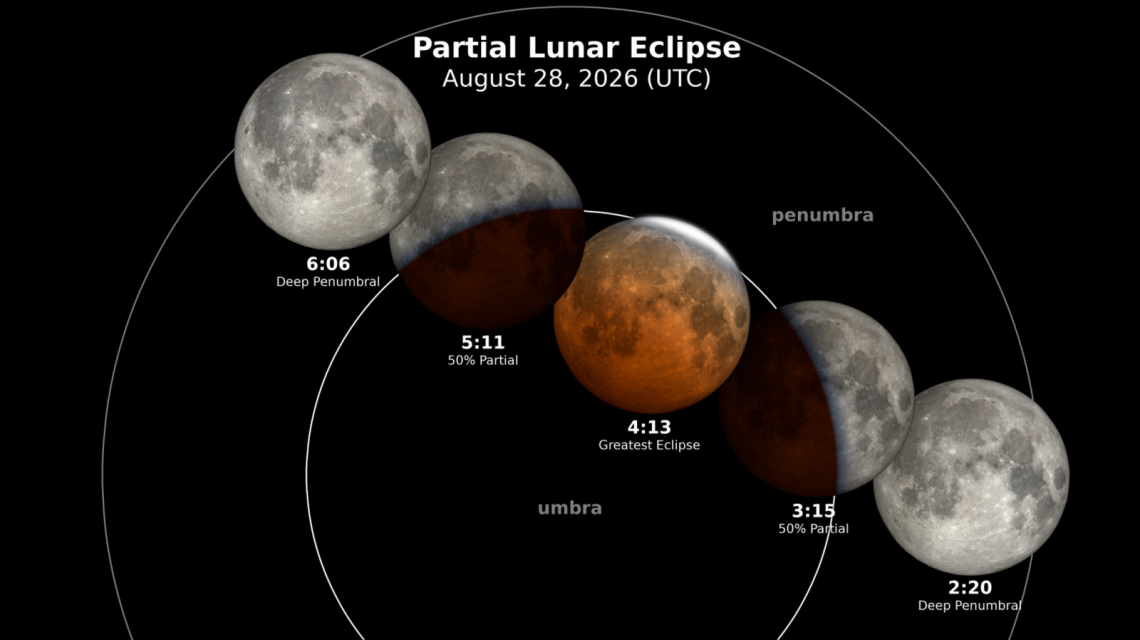
Skywatchers in much of the United States will soon witness a rare deep partial lunar eclipse. Earth’s shadow will cover over 96% of the moon during this dramatic event. NASA reports that this will occur overnight between August 27 and 28. As the Earth aligns between the sun and the full moon, it casts a shadow known as the umbra. During the peak, 96.3% of the moon will be in shadow.
Why Is This Event Rare?
Partial lunar eclipses happen fairly often, but such deep partial eclipses are rare. This one is part of Saros 138, a series of eclipses repeating every 18 years. The last similar eclipse was on August 16, 2008. The next won’t be until September 7, 2044. Astronomers are excited because it resembles a total lunar eclipse; most of the moon may appear reddish or coppery.
What Will Observers See?
As the eclipse unfolds, a shadow will move across the full moon. Early on, a dimming occurs as the moon enters Earth’s penumbra, the outer shadow. As the partial phase continues, the umbra takes a growing ‘bite’ out of the moon. Near peak, the sunlit part shrinks to a crescent, and the shadowed section may glow in red, orange, or copper hues. This happens because Earth’s atmosphere bends and filters sunlight toward the moon.
Timing of the Eclipse
The eclipse peaks at 4:13 a.m. UTC on August 28. This translates to:
- 12:13 a.m. EDT (U.S. East Coast)
- 11:13 p.m. CDT
- 10:13 p.m. MDT
- 9:13 p.m. PDT (U.S. West Coast)
Visibility Across the U.S.
Most of the U.S. will have great viewing conditions. NASA and Time and Date indicate that North America will have clear views. On the West Coast, the eclipse can be seen in the evening, while East Coast viewers will see the peak around midnight. Cities like Los Angeles, Portland, New York, and Jacksonville will witness the event well. It will also be visible in South America, and parts of western Europe and Africa.
How to Watch the Eclipse
Unlike solar eclipses, lunar eclipses are safe to view without special glasses or filters. EarthSky advises finding a spot with minimal light pollution for the best experience. While no equipment is necessary, binoculars or telescopes can enhance the view, showing more detail. Weather plays a crucial role in viewing quality. For those missing the chance to see it in person, Time and Date will offer a live webcast from various locations worldwide.
 NASA’s Nancy Grace Roman Telescope Prepares for Launch
  China Delays Chang’e-7 Lunar Mission Plans
  Lunar Eclipse Set to Grace the Skies Over Much of the World
  Astronauts Experience Northern Lights and Culinary Delights in Space
  James Webb Space Telescope Uncovers Early Universe Surprises
  Total Solar Eclipse of 2026: Where and When to Watch