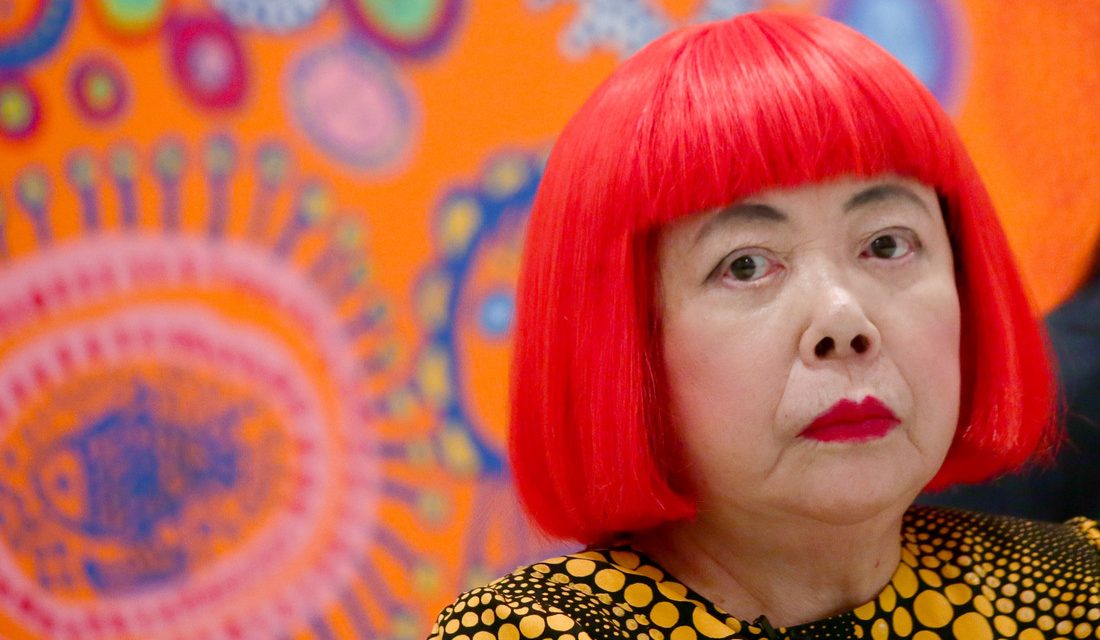
Japanese artist Yayoi Kusama, renowned for her distinct polka dot sculptures and shimmering ‘Infinity Rooms,’ has passed away at 97. Her representative, David Zwirner, announced that she died from multiple organ failure at a Tokyo hospital on August 14.
Kusama’s imaginative work explored themes of obsession. Her art featured repetitive brushstrokes on dotted canvases known as infinity net paintings, and vibrant polka-dotted pumpkins. She also created enclosed rooms with mirrored walls and lights, providing viewers an endless visual experience. Fluorescent paintings and sculptures were part of her repertoire, with the artist often describing her work as a form of survival. For audiences, her pieces offered perspective on one’s place in the universe. Kusama wrote, ‘Our earth is only one polka dot among a million stars in the cosmos.’
Yayoi Kusama was born in Matsumoto, at the foot of mountains in Central Japan. Her family operated a seed nursery. During World War II, she worked in a parachute factory alongside other children. Her lifelong struggle with hallucinations began during childhood. In her autobiography, she described drawing her visions in sketchbooks to manage the fear of these experiences. Although her mother disapproved, Kusama persisted in her art.
Upon discovering a book of Georgia O’Keeffe’s paintings, Kusama reached out to the iconic artist seeking guidance. O’Keeffe responded, advising her of the challenges in making a living as an artist in the U.S. but encouraged her to pursue her passion. In the late 1950s, Kusama relocated to New York and immersed herself in the avant-garde art scene.
During the Vietnam War, Kusama staged public ‘happenings,’ painting polka dots on protestors’ bodies. She wrote a provocative open letter to President Richard Nixon. In it, she offered to engage in intimate relations with him if he would end the war, highlighting her advocacy for peace through creative expression.
Her work during this period included perplexing and mesmerizing ‘Infinity Rooms.’ One such installation was covered in phalluses, while another featured blinking colored lights and a Beatles soundtrack. Richard Castellane, her dealer in the 1960s, recalled people being ‘mesmerized and overwhelmed’ by her works, which defied spatial comprehension.
Despite gaining recognition, Kusama faced difficulties as a female artist in a male-dominated art world. Curator Mika Yoshitake noted the challenges she encountered, being exoticized in part due to her unique presentation and attire.
Financial and health struggles persisted. She returned to Japan in the early 1970s, checking herself into a psychiatric institution, where she stayed for the remainder of her life. Despite these challenges, Kusama’s popularity grew globally, with exhibitions at institutions like the Smithsonian’s Hirshhorn and the Tate in London. In 2017, she achieved a milestone with the opening of the Yayoi Kusama Museum in Tokyo.
Kusama’s work extended beyond galleries; her designs appeared on products like cellphone cases, Lancôme lipsticks, and Louis Vuitton accessories. Well into the 2000s, she continued to create art from her studio near the mental hospital.
Yayoi Kusama consistently viewed creating art as essential. She expressed the hope that, even a century later, someone might see her art and recognize the value in her legacy. In her autobiography, she wrote, ‘Art, for me, is a creed.’