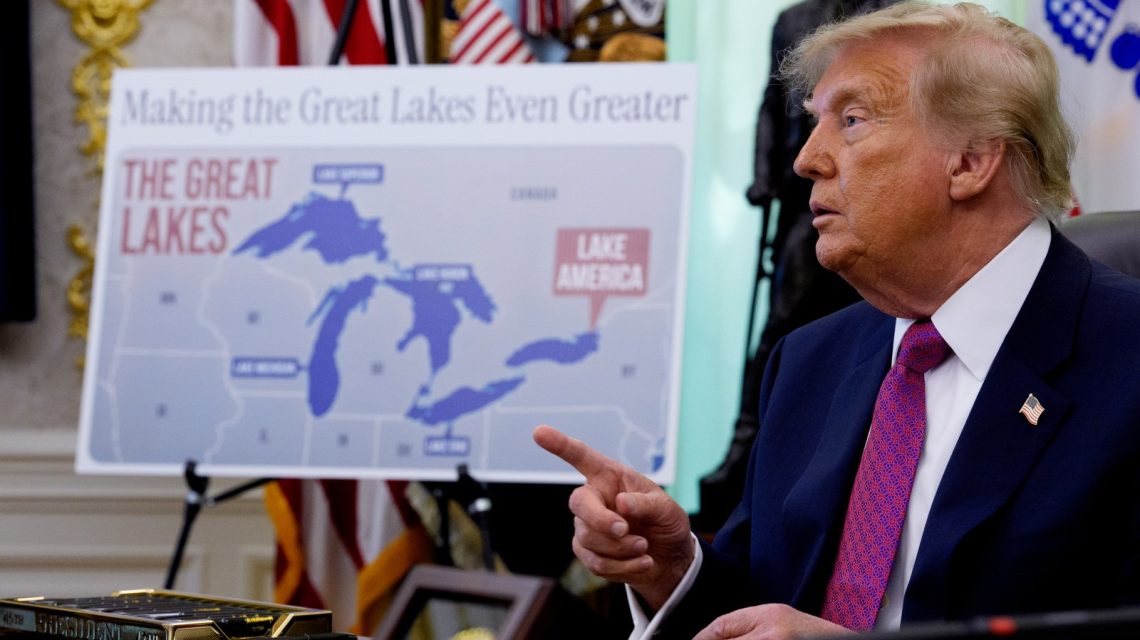
MapQuest will not be changing the name of Lake Ontario following President Donald Trump’s order to call the body of water ‘Lake America’ for U.S. federal use. The mapping service posted on X Thursday that it would continue to identify one of the Great Lakes as Lake Ontario. This post, which quickly went viral, was accompanied by a screenshot showing the unchanged name.
MapQuest further engaged users by launching a name generator, allowing them to rename the lake themselves. In their post, they assured users, ‘We’re not changing the name of Lake Ontario. Name it whatever you want at your leisure,’ along with an image labeled ‘Lake Are We Doing This Again?’
As of Friday evening, the original post had accumulated more than 4.7 million views, bringing the service back into the spotlight. This attention raised questions about whether Google Maps would follow Trump’s order.
Reasons Behind Trump’s Decision
President Trump signed an executive order on Thursday to rename Lake Ontario as ‘Lake America’ for U.S. federal use. This decision stemmed from increasing tensions after trade talks between the United States and Canada fell through. Trump had suggested the idea before the order’s announcement.
In comments, Trump criticized Canada’s trade practices, labeling them as ‘the worst.’ He argued, ‘They feel entitled and we can’t have that.’
The order emphasized the significance of Lake Ontario to American exploration, commerce, and defense. It underlined the U.S.’s investment in protecting the Great Lakes. The order highlighted Lake Ontario’s historic role as an essential route for American trade, commerce, and military logistics. The lake also plays a vital role in shipping, manufacturing, agriculture, and energy.
On Friday, the White House shared a message from U.S. Geological Survey Director Ned Mamula, confirming the agency had officially designated the body of water as Lake America in its electronic documents.
According to Mamula, ‘As of 4:30 pm today the U.S. Geological Survey has officially designated the former Lake Ontario to be renamed as Lake America in all official USGS electronic documents.’
The change was also made in the Geographic Names Information System (GNIS), and users should see it in printed documents soon. The order applies to U.S. federal usage but does not compel Canada or private companies to adopt the new name. The move mirrors Trump’s previous decision to rename the Gulf of Mexico as the Gulf of America for U.S. federal use.
Responses to MapQuest’s Stance
Founded in 1996, MapQuest became a cornerstone of online directions before the emergence of Google Maps. Their response to Trump’s executive order drew widespread attention online, with differing opinions from users. Some praised the company’s decision, while others poked fun at its sudden resurgence.
Eric Trump, the president’s son, jokingly commented, ‘Shocking to see you’re still alive.’ This remark referred to MapQuest’s decline in popularity since the iPhone’s introduction.
Many users participated by using MapQuest’s name generator, creating alternative names for the lake.
The name change itself faced opposition from officials on both sides of the border. Canadian Prime Minister Mark Carney rejected the change, citing the historical significance of Lake Ontario’s name. According to Carney, the name originates from the Wendat word ‘Ontari’io,’ meaning ‘the lake is beautiful, the lake is big,’ and predates both Canadian Confederation and the U.S. Declaration of Independence.
Carney asserted, ‘Canadians also know that naming reality means calling it Lake Ontario—then, now and always.’
New York Governor Kathy Hochul also commented, stating, ‘New York won’t be calling it that,’ regarding the White House’s announcement.
In contrast, the State Department took a humorous approach. It acknowledged, ‘It was brought to our attention that Lake America was mistakenly labeled as Lake ‘Ontario’ on our website.’ Then added, ‘We have corrected this mistake and apologize for deadnaming the lake.’
Potential Impact on Google Maps
There is precedent for Google adopting geographic name changes ordered by Trump once official U.S. government sources reflect the change.
After Trump renamed the Gulf of Mexico to the Gulf of America, Google updated its maps following the change in official U.S. government sources, citing its ‘longstanding practices.’
GNIS has been updated to reflect the Lake America designation. If Google follows the same practice as with the Gulf of Mexico, users in the United States could see ‘Lake America’ on Google Maps.
Newsweek has contacted Google for comment on whether it plans to adopt the Lake America name after MapQuest’s refusal.
Past Example: The Gulf of Mexico Renaming
Google Maps began showing the Gulf of America for U.S. users after GNIS updated Gulf of Mexico to Gulf of America. On February 10, 2025, Google stated GNIS had officially updated the Gulf of Mexico to Gulf of America. Google maps started rolling out changes in line with this new designation.
The name displayed in Google Maps depended on users’ locations. Those in the U.S. saw Gulf of America, while Mexican users continued seeing Gulf of Mexico. Users in other regions saw both names.
Google’s approach followed its practice of using official government sources for geographic names and displayed dual names when countries have differing official designations.
There is still uncertainty about whether Google Maps will follow a similar path regarding Lake Ontario.
Contact Newsweek editors for more on this story: Kate Nalepinski and Edward T. Cummins.
 2027 VA Disability Compensation to Increase by 3.6 Percent
  Maintaining America’s Infrastructure: A Crucial Task
  Wheaton Community Mourns Loss of Student-Athlete
  White House Responds to Natalie Maines’ Criticism of Trump
  Record Early Voting in Georgia Midterms Amid Political Campaigns
  Tragic Roller Coaster Accident at Six Flags Raises Safety Concerns